Before you go into the temazcal, you walk round the fire and stop at the low doorway. Someone wafts copal smoke over you. You kneel, put your forehead on the earth and say three words: todas mis relaciones. All my relations. The person behind you says the same three words, then the person behind them, until everyone is inside in the dark.
Nobody pays for that phrase. Nobody gets a private version of it. Some leaders say it in Lakota, mitákuye oyás'iŋ, and the people who say it in Spanish or English know where it comes from.
I think about that doorway whenever someone asks me about mantra meditation, because the best-known form of it in the West works the other way round. In Transcendental Meditation, the TM organisation's own FAQ says, your mantra is a sound chosen for you personally by a certified teacher, and the course has a fee page of its own. So which part of mantra meditation does the work? The word, the person who hands it to you, the price, or the plain act of sitting down and repeating something?
I went through the research to find out. The short version: mantra meditation has a few good trials behind it and a lot of weak ones. None of them tested whether the word has to come from a teacher.
What mantra meditation actually is
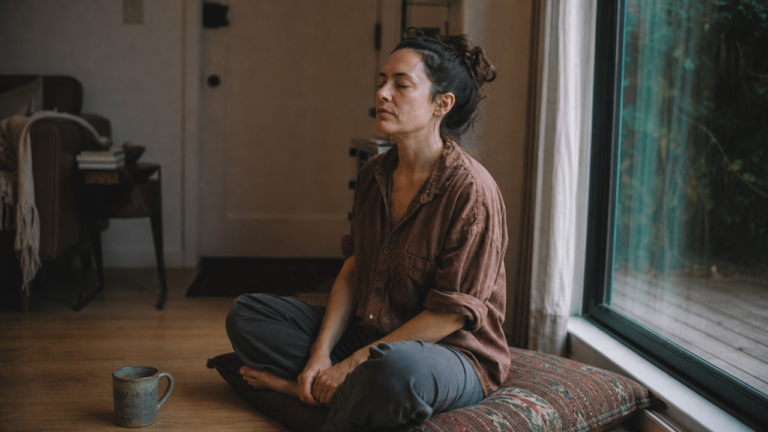
A mantra is a word or a short phrase you repeat, silently or out loud, and come back to every time the mind drifts. That's the whole method. Mindfulness asks you to notice whatever turns up. Mantra meditation gives the mind one thing to hold and asks you to keep going back to it.
It's also one of the oldest ways people have prayed. A rosary, a Sufi dhikr, a Tibetan mantra counted off on a string of beads: each gives the attention something to come back to, again and again, for as long as it takes. What changed in the West wasn't the method. It was the packaging around it.
Researchers sort it the same way. The largest review of meditation and stress, Goyal and colleagues in JAMA Internal Medicine in 2014, split meditation programmes into two families: mindfulness-based, and mantra-based. Transcendental Meditation and other mantra meditation went in the second.
Does a mantra meditation word have to mean something?
The traditions don't agree. TM says its mantra isn't meant to keep the mind active or focused, which sets it apart from affirmations or phrases chosen for their meaning. Christian contemplatives often pick a short phrase because of what it means. The phrase at the temazcal door means a lot: it's a statement about who you're tied to.
For practice at home I'd go with one rule. Pick a word you won't argue with. If the word irritates you every time it comes round, the repetition turns into a debate, and you'll lose the debate somewhere around minute four.
The personal mantra and the price tag
Here's the modern-life part. Mantra meditation is the only practice I know where the main ingredient is sold. You can't buy a breath. You can buy a course in which someone picks a word for you.

I don't think that's a scandal. A teacher's time costs money, the TM organisation describes itself as a non-profit, and people take a course more seriously once they've paid. I wrote about that same pull in the piece on the meditation subscription: paying is a commitment device as much as a purchase.
It still leaves a fair question for anyone weighing up mantra meditation. Is there evidence that a word chosen for you does something a word you chose yourself wouldn't?
I couldn't find any. I looked for a trial that gave one group an assigned mantra and another group a self-chosen word, with the same course, the same hours and the same follow-up. I didn't find one. That doesn't prove the source of the word is irrelevant. It means nobody has tested it in the open, so the claim rests on tradition, not on data.
Here's why it matters to you. If the assigned word were the active ingredient, every free version of mantra meditation, from a church pew to an app to a temazcal doorway, would be a weaker copy. If the repetition is the ingredient, then a course is paying for teaching, structure and someone checking in on you. Those are worth money. They're a different thing from a word.
What the research on mantra meditation found
Most of the evidence is about TM, which has been studied far more than any other mantra meditation programme. Two areas carry most of the weight: blood pressure, and post-traumatic stress.
Blood pressure: what the American Heart Association said
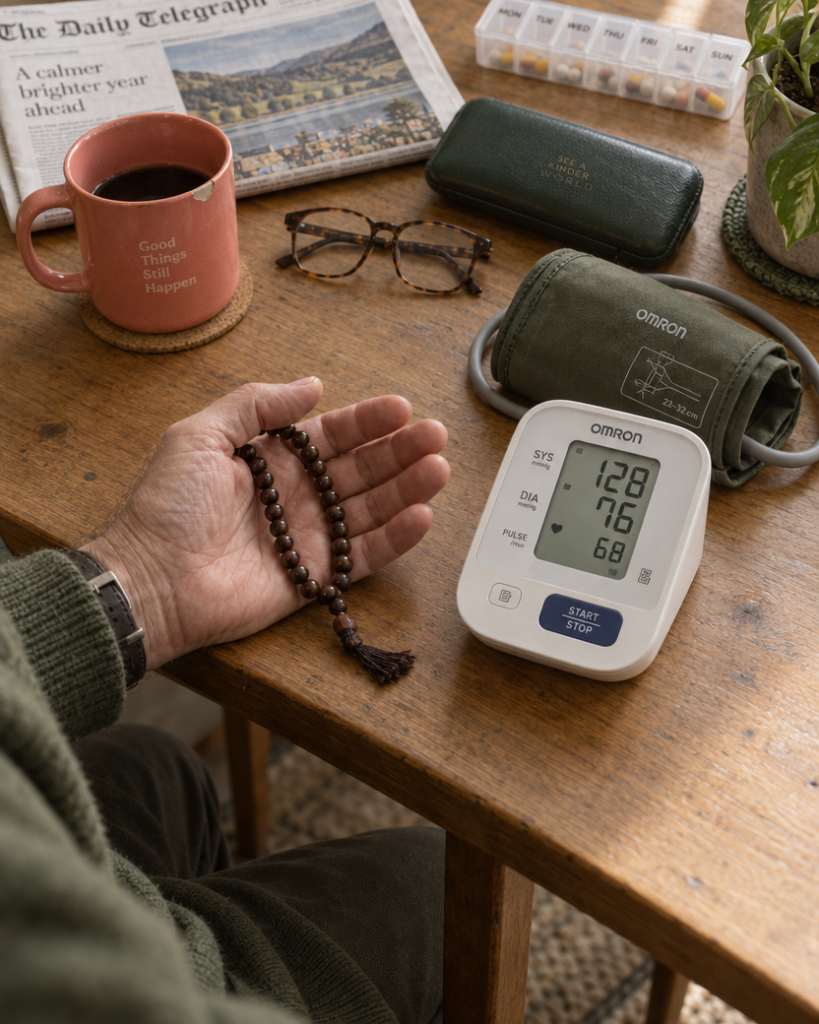
In 2013 the AHA published a scientific statement on non-drug ways to lower blood pressure. TM got Class IIB with Level B evidence, which in AHA terms means it may be considered, on modest or mixed support. Other meditation techniques got Class III, Level C. Aerobic exercise got Class I, Level A, the strongest grade in the whole statement.
So for blood pressure, mantra meditation in its TM form came out ahead of other meditation and a long way behind a brisk walk. The writing group's view was that people with readings above 120/80 can reasonably try approaches like these alongside proper treatment. Alongside, not instead.
PTSD in veterans: two mantra meditation trials
This is the strongest evidence, and it comes from two quite different programmes.
In 2018, Sanford Nidich and colleagues randomised 203 veterans with PTSD at the VA in San Diego to TM, to prolonged exposure therapy (the standard trauma-focused treatment), or to a health-education class. Each arm had 12 sessions over 12 weeks with daily home practice. TM did no worse than exposure therapy on the clinician-rated PTSD scale, and both beat the class. 61% of the TM group showed a clinically significant improvement, against 42% with exposure therapy and 32% with the class.
The same year, Jill Bormann and colleagues tested a mantram repetition programme with 173 veterans at two VA clinics. People learned to repeat a sacred word silently, slow their thoughts and hold attention on one point, in eight weekly one-hour sessions. Compared with present-centred therapy, the mantram group improved more on the clinician-rated scale. Of those who finished follow-up, 59% no longer met the criteria for PTSD, against 40%. Insomnia improved more too.
Put the two side by side. One is a trademarked course built around a personally assigned sound. The other is a plainer method developed inside a research setting at the VA. Both produced results in the same population, in the same year. Neither trial was designed to test where the word comes from, so this proves nothing about the word. It does tell you that a simpler, unbranded form of mantra meditation held its own against a real therapy.
Now the part that argues the other way
I'd be bending the record if I stopped there.
The largest review found no clear effect of mantra meditation
The Goyal review screened 18,753 citations and kept 47 trials with 3,515 participants. Every trial had an active control, so the effect of simply turning up to a class couldn't pass for the effect of meditating. Mindfulness programmes came out with moderate evidence of small improvements in anxiety, depression and pain. I went through those numbers in the post on meditation for anxiety. Mantra meditation programmes didn't improve any of the outcomes the reviewers examined, and the strength of that evidence ranged from low to insufficient.
The authors were careful about why. Very few mantra meditation trials met their criteria, and three of the TM trials enrolled heart patients rather than people with anxiety, so a flat result on anxiety isn't a surprise. Their honest position is that we don't know. They also found no evidence that any meditation programme did better than an active treatment such as drugs, exercise or another therapy.
Who ran the studies
In 2004, Peter Canter and Edzard Ernst reviewed the randomised trials of TM and blood pressure. Six met their criteria and five could be assessed. Three favoured TM, two found no difference, and only one had an adequate way of setting baseline blood pressure. None of the five was run by authors without an affiliation to the TM organisation. Their conclusion was blunt: there wasn't enough good-quality evidence to say whether TM lowers blood pressure at all.
That review is more than twenty years old, and the AHA statement came later with more trials to look at. But the problem it named hasn't gone away. When the people who teach a method also run most of the trials, you read the results more slowly.
The PTSD trials have limits too
In the TM trial, TM and the health class were mostly taught in groups while exposure therapy was one-to-one, so the arms differed in how much company people had. In the mantram trial allocation was open, the self-reported difference had gone by the two-month follow-up, and the share with a clinically meaningful change, 75% against 61%, wasn't a significant difference. These were veterans with a diagnosis, treated by clinicians over weeks. None of it tells you what ten minutes of mantra meditation on the sofa will do for an ordinary bad week.
How to try mantra meditation without buying a word
If you want to try it, this is what I'd do. None of it costs anything.
- Pick a short word or phrase you can say on one out-breath. It can be a sacred word from your own tradition or something plain. If you want the temazcal phrase, all my relations is three words and works silently.
- Say it silently, at whatever pace comes. Don't force it onto the breath. If it lines up with the breath by itself, let it.
- When you notice you've drifted, go back to the word. That return is the practice, not a sign you're failing at it. More on that in you can't clear your mind.
- Start with ten minutes. The TM trials in the Goyal review gave 16 to 39 hours of training over three to twelve months, and other mantra meditation programmes about half that. You won't match that in week one, and you don't need to.
- Say it with other people now and then. A word said by a room full of people is a different thing from a word said alone; I wrote about why in nobody meditates alone.
- Give it a month before you judge it. If mantra meditation still feels like nothing after four weeks, try another door, such as cyclic sighing.
When to stop mantra meditation and talk to someone
If repeating a word starts bringing back traumatic memories, panic, or a sense that you or the world aren't quite real, stop and talk to someone you trust or to a doctor. If you live with PTSD, the trials above ran inside clinical care, so take mantra meditation to your therapist as an addition, not a replacement. If you're on blood pressure medication, keep taking it. I wrote about what can go wrong more broadly in meditation side effects.
The word at the door
Back to the doorway, the copal and the forehead on the ground. The phrase there isn't kept from anyone. You hear it from everyone who goes in before you, and you say it with someone waiting behind you to say it next. Inside, the songs come round four at a time, and nobody owns those either.
I can't prove that an open word works as well as one handed to you by a teacher. Nobody has run that trial. What I can say is what the evidence shows: the best results for mantra meditation came from people repeating a word with structure, support and other people around them. The version I trust most is the one I learned at that door, where the word was never for sale.
References
Brook RD, Appel LJ, Rubenfire M, et al. (2013). Beyond medications and diet: alternative approaches to lowering blood pressure: a scientific statement from the American Heart Association. Hypertension, 61(6), 1360–1383. https://doi.org/10.1161/HYP.0b013e318293645f
Bormann JE, Thorp SR, Smith E, et al. (2018). Individual treatment of posttraumatic stress disorder using mantram repetition: a randomized clinical trial. American Journal of Psychiatry, 175(10), 979–988. https://doi.org/10.1176/appi.ajp.2018.17060611
Canter PH, Ernst E (2004). Insufficient evidence to conclude whether or not Transcendental Meditation decreases blood pressure: results of a systematic review of randomized clinical trials. Journal of Hypertension, 22(11), 2049–2054. https://doi.org/10.1097/00004872-200411000-00002
Goyal M, Singh S, Sibinga EMS, et al. (2014). Meditation programs for psychological stress and well-being: a systematic review and meta-analysis. JAMA Internal Medicine, 174(3), 357–368. https://doi.org/10.1001/jamainternmed.2013.13018
Nidich S, Mills PJ, Rainforth M, et al. (2018). Non-trauma-focused meditation versus exposure therapy in veterans with post-traumatic stress disorder: a randomised controlled trial. The Lancet Psychiatry, 5(12), 975–986. https://doi.org/10.1016/S2215-0366(18)30384-5