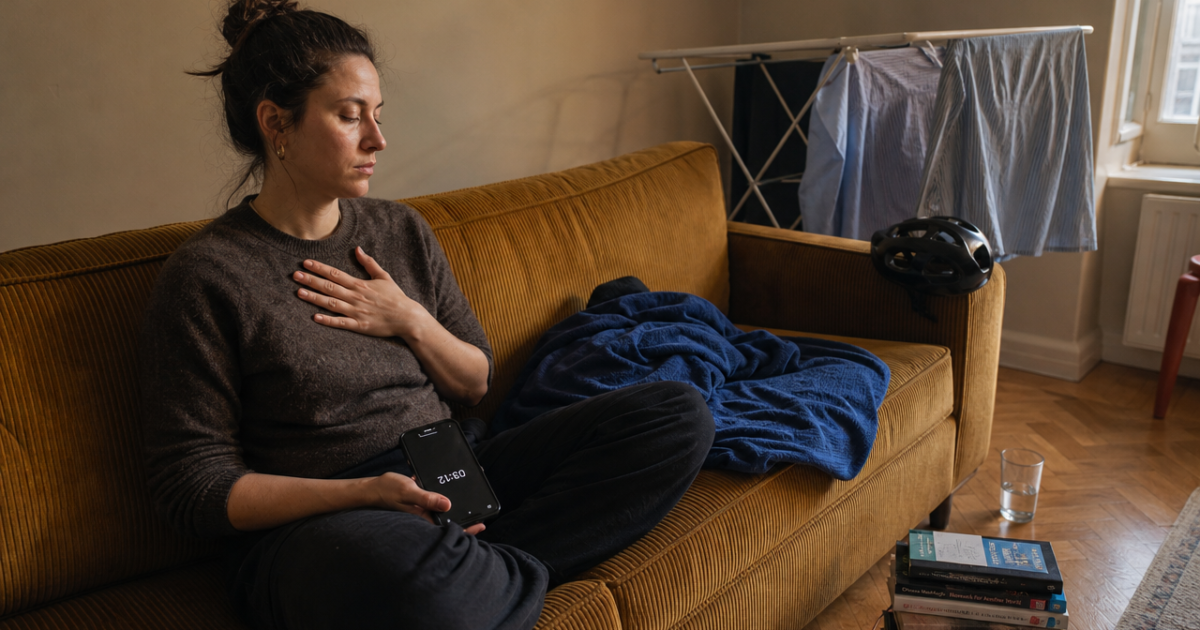
You sit down, set a timer for ten minutes and close your eyes, and the first thing you notice is your heart. Not a calm heart. A heart that seems to have noticed you noticing it, and has decided to speed up. By minute three you're checking whether it skipped. By minute five your eyes are open, the timer is still running, and you feel worse than when you sat down.
If that's how meditation for anxiety has gone for you, you're in good company, and it doesn't mean you did it wrong. It's one of the most common reasons anxious people give up in the first week. Almost nobody warns them.
Here's the strange part. The strongest trial we have on meditation for anxiety found it held its own against a standard prescription drug. Both things are true at once, and the gap between them is where most people quit.
What the biggest trial of meditation for anxiety actually tested
In November 2022, Elizabeth Hoge and her colleagues published a trial in JAMA Psychiatry with a blunt design. They took 276 adults with a diagnosed anxiety disorder, recruited at three academic medical centres in the US, and randomly assigned them to one of two things for eight weeks. Half went into a mindfulness-based stress reduction course, usually shortened to MBSR. The other half were prescribed escitalopram, an antidepressant that's one of the standard first-line medications for anxiety disorders, at 10 to 20 mg a day.
The people who rated everyone's anxiety at the end were interviewers who didn't know which group anyone had been in. That detail matters. It's what makes this more than a feel-good survey.
After eight weeks, anxiety severity had dropped by 1.35 points on a seven-point clinical scale in the meditation group and by 1.43 in the medication group. The difference was 0.07 of a point. The researchers had fixed in advance how big a gap would count as meaningfully worse, and the meditation group stayed inside it. In the trial's language, meditation for anxiety was noninferior to the drug. At 24 weeks the two groups were level to two decimal places.
That result deserves to be taken seriously. It's also a result about something much bigger than a ten-minute session on your phone, which brings us to the fine print.
The dose behind meditation for anxiety in that trial
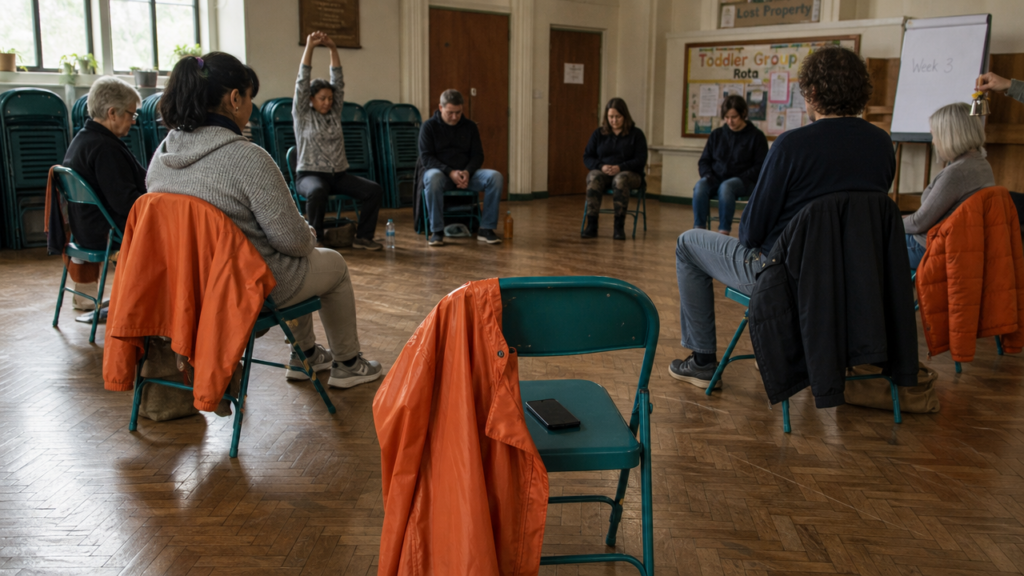
MBSR isn't something you slot into a lunch break. The version used in the trial was eight weekly classes of two and a half hours each, a full-day retreat around week five or six, and 45 minutes of practice at home every day. A trained teacher in the room. A group around you, the same faces week after week.
Add it up and that's about 20 hours of class, a whole extra day, and something like 40 hours of home practice if you did every session. When a headline tells you meditation for anxiety worked as well as a pill, that is the meditation it means. Not the free trial you downloaded at two in the morning.
I'm not saying that to put anyone off. I'm saying it because people try five minutes, feel their heart race, and decide meditation for anxiety doesn't work for them, when what they tried is something the study never tested.
Why meditation for anxiety can feel worse before it feels better
Look at the side-effect table in the same paper. In the medication group, 78.6% reported at least one side effect that was possibly or definitely linked to treatment: trouble sleeping, nausea, tiredness, headaches. In the meditation group the figure was 15.4%. And the only side effect that turned up in more than 5% of the meditators was this one. Increased anxiety. Thirteen people, 11% of the group.
So the one thing that went wrong with meditation for anxiety often enough to count was more anxiety. That's the first week I described above, with a number on it.
It makes sense once you think about what anxiety does. An anxious body is already scanning itself for danger. The heartbeat, the tight chest, the short breath are the evidence it keeps checking, over and over. Then the standard instruction arrives: close your eyes and pay close attention to your breath and your body. For a lot of people that's asking the alarm to listen to itself. The volume goes up.
I've written about the wider version of this in a piece on meditation side effects. For anxiety, the short version is this. The discomfort is common, it usually eases once you change how you practise, and it tells you something about the method rather than about you. The same goes for a body scan that feels like nothing is happening: what you feel in the first week is weak evidence either way.
Where to point your attention instead
The breath is the default anchor in almost every app. It's only one option, though, and for an anxious beginner it's often the worst one to start with, because the breath is exactly where anxiety lives. Some other places to rest your attention:
Keep your eyes open. Let them settle on a spot on the floor a metre or so in front of you. Closed eyes pull a lot of people inward faster than they're ready for.
Listen. The fridge, the traffic, a neighbour's radio through the wall. Sound is outside you, it changes on its own and you can't control it, which is exactly the relationship you're trying to learn with your thoughts.
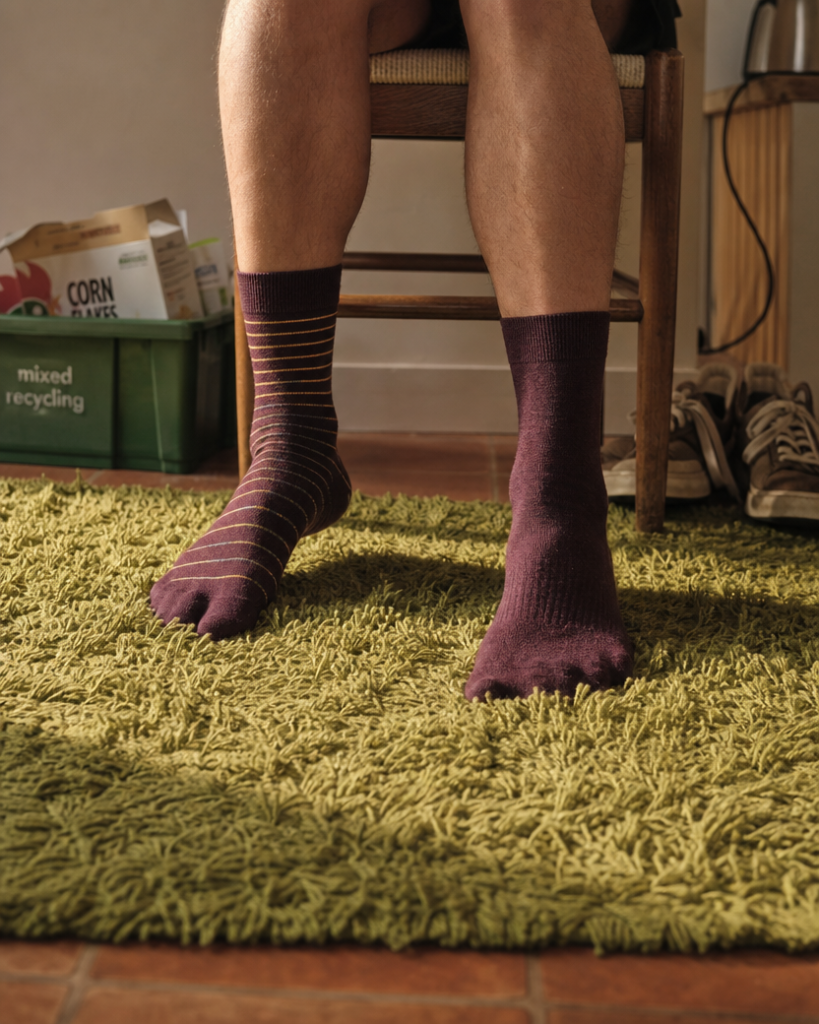
Try your feet. The soles on the floor are about as far from your chest as attention can go while staying in the body.
Or walk. Walking meditation works for plenty of people who can't sit still, because the body gets to use up some of the restlessness while the mind practises coming back.
And keep it short. Five minutes you can stay with does more than twenty you spend fighting. I made the case for that in a piece on short meditation, and it applies twice over when you're anxious.
Meditation for anxiety and the pill: not a contest
The worst way to read this trial is as a reason to stop taking medication. The authors don't claim that, and neither do I. If you're on an antidepressant and it's helping, meditation for anxiety can sit alongside it. Changing or stopping a prescription is a conversation with whoever prescribed it, not a decision to make after reading a blog.
What the trial offers is a second door. The authors note that roughly two-thirds of people who start an antidepressant stop taking it, and that cognitive behavioural therapy, the other first-line treatment, can be hard to get. For someone who tried medication and couldn't live with the side effects, or who's on a long waiting list for therapy, a structured course of meditation for anxiety is now a reasonable thing to bring up with a doctor. There's evidence behind it.
Now the part that argues the other way
I've given you the trial the way I read it. Here's why you shouldn't treat my reading, or anybody's, as settled.
The participants knew what they were getting. You can't hide a meditation class from the person sitting in it, so only the interviewers were blind. People who wanted meditation and got it may have felt better for reasons that have little to do with meditation for anxiety as such.
The two arms weren't matched for time. The authors say so themselves: the meditation group spent far more hours in treatment. Two and a half hours a week in a room with kind people, all paying attention to how you're doing, might ease anxiety whatever you happen to be doing in that room.
The sample was narrow. Three quarters of the participants were women, education levels were high, and everyone came from three urban medical centres in one country. The authors list that as a limit on how far the result travels.
The habit didn't last. At 24 weeks, only 28% of the meditation group were still meditating regularly, and their scores still matched the medication group. You can read that as good news, since eight weeks left something that stuck. You can also read it as a hint that the class itself, not ongoing meditation for anxiety, was doing the work. The trial can't separate the two.
And the wider evidence is moderate, not strong. In 2014, Madhav Goyal and colleagues pooled 47 randomised trials with 3,515 participants for JAMA Internal Medicine. Mindfulness programmes showed moderate evidence of reducing anxiety, with an effect size of 0.38 at eight weeks and 0.22 at three to six months. That's small to moderate. They found no evidence that meditation programmes did better than any active treatment, whether drugs, exercise or other behavioural therapies. Meditation for anxiety sits among the things that help. Not above them.
A realistic way to start meditation for anxiety
With all of that on the table, this is how I'd start if I were starting now, with a racing heart and not much patience for it.
Be honest about the dose. If you want what the trial measured, look for an eight-week MBSR course with a qualified teacher, in person or live online. If that isn't possible yet, a daily practice at home is still worth doing. Just know the evidence was built on the bigger version.
Pick a teacher over an app if you can. The meditators in the trial who felt more anxious had a class to bring it to every week. A meditation teacher can see when a practice is winding you up and change it. A timer can't.
Start with open eyes and an outward anchor: sound, feet, or walking. Come to the breath later, once sitting still no longer sets anything off.
Stop when it tips. If your heart races and doesn't settle within a minute or two of opening your eyes and feeling your feet on the floor, end the session there. That isn't failure. It's the adjustment.
Treat week one as the hard week. That's when the extra anxiety tends to show up, and it's when most people quit. Get through two weeks with the changes above and you'll know far more about whether meditation for anxiety suits you than you did on day three.
When meditation for anxiety isn't the next step
Here's the stop-line, and it matters more than anything above. The NHS advises seeing a GP if you think you might have generalised anxiety disorder, where the main sign is worry that affects your daily life and is hard to control, or if you've been diagnosed and treatment isn't helping. In England you can also refer yourself directly to an NHS talking therapies service. Outside the UK, your family doctor is the first stop.
If the racing heart is new, or comes with chest pain or fainting, get it checked by a doctor before you call it anxiety. And if anxiety has brought thoughts of harming yourself, that isn't a meditation question. Call your local emergency number or a crisis line today.
The heart you notice
Back to the ten minutes and the heartbeat. Strip the headline off the research on meditation for anxiety and what's left is fairly plain. It can help about as much as a first-line pill, at a dose most people never try. And the most common thing that goes wrong is the very feeling you sat down to get away from.
So open your eyes. Put your feet on the floor. Listen to the fridge for five minutes. It's a smaller start than the trial used, and a more honest one than trying to slow your heart down on command.
References
Hoge EA, Bui E, Mete M, Dutton MA, Baker AW, Simon NM (2023). Mindfulness-Based Stress Reduction vs Escitalopram for the Treatment of Adults With Anxiety Disorders: A Randomized Clinical Trial. JAMA Psychiatry, 80(1), 13–21. https://doi.org/10.1001/jamapsychiatry.2022.3679
Goyal M, Singh S, Sibinga EMS, et al. (2014). Meditation programs for psychological stress and well-being: a systematic review and meta-analysis. JAMA Internal Medicine, 174(3), 357–368. https://doi.org/10.1001/jamainternmed.2013.13018
NHS. Generalised anxiety disorder (GAD). https://www.nhs.uk/mental-health/conditions/generalised-anxiety-disorder/overview/