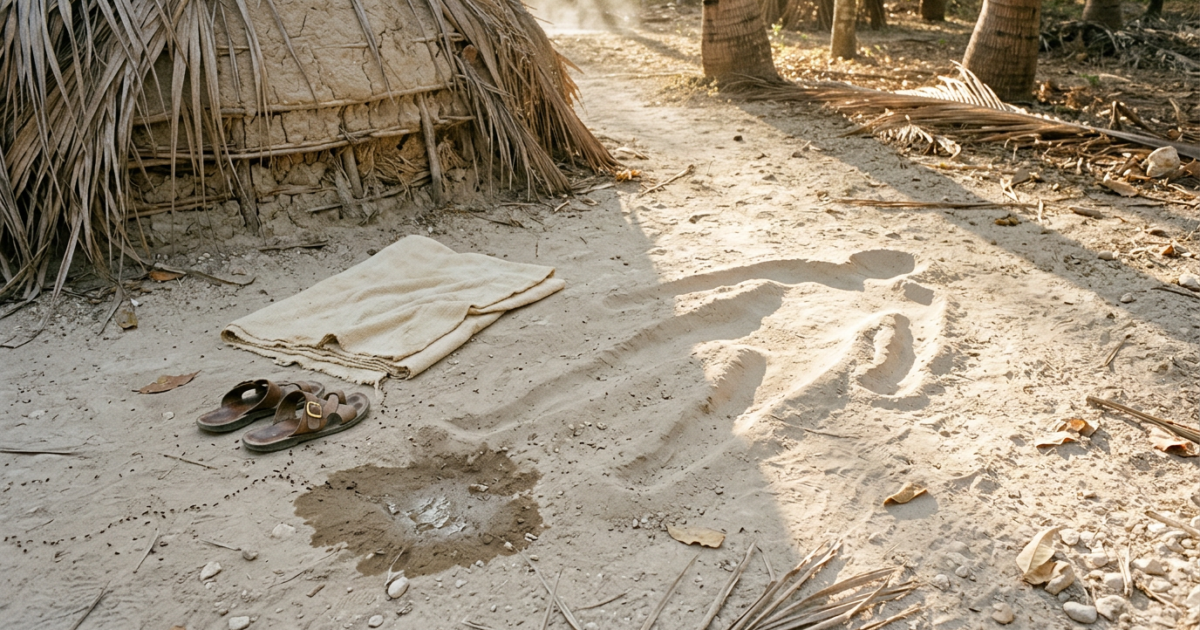
You come out of a temazcal low to the ground, and the first thing your body lies to you about is the weather. It can be thirty-six degrees outside with eighty percent humidity, and the air still lands on your skin like cold water. Two hours in the dark will do that to a sense of temperature. What you do next, in the tradition I was taught in, is nothing at all. You lie down flat on your back on the earth beside the lodge and look at whatever happens to be up there — stars, cloud, the moon — and for a while there's no time and no space in it. You're just there. And this is the part I want to talk about, because it has a name almost nobody uses: retreat integration. It's the third act. It's also the one act the modern version of all this quietly cut.
The insight doesn't arrive in the heat. That's the thing I didn't expect and still find slightly funny. Inside the lodge you're mostly surviving. Outside, on your back on the dirt, things start landing — I call it a download, for lack of a better word, and I've never once had it happen in the middle of the fourth round. Then a cold rinse, because the floor of a temazcal is bare earth and it's all over you. Then fruit. Melon, pineapple, papaya, orange, cut up and passed around, a small feast to mark being born and being alive. Ground, water, fruit. Three steps, an hour or two, no hurry in any of it. That sequence is retreat integration, done properly, by people who have never once called it that.
What the West kept, and what it left out
This is the last of four pieces about that gap. The first was about the company: every practice I was taught outside the West happened in a room with other people in it, and the version sold back to us is a person alone with a phone. The second was about the hour — the traditions do their deepest work after dark, and we moved the whole thing to seven in the morning because that's when the calendar had a gap. The third was about the guide, the person who decides when the door opens and comes after you when you walk out. This one is about what happens on the way home — retreat integration — and I think it's the biggest of the four.
Anthropology named the shape of this in 1909. Arnold van Gennep looked at initiation rites across a lot of cultures and found the same three-part skeleton every time: separation, then transition, then incorporation. You leave your ordinary life. You spend time in the strange middle — Victor Turner's word for it was liminal, betwixt and between, no status, outside the structure. And then you come back in, and the group formally receives you as someone who has been through it. Three phases. The wellness business sells two. Separation is a flight to Tulum, transition is the retreat you paid for, and incorporation is a shuttle to the airport at eleven. There's no third act, and there's no retreat integration, because nobody has worked out how to charge for the part where you go home.
Retreat integration, the way the traditions actually run it
Look at the temazcal sequence again and count the steps. The lodge is maybe two hours. The return has four — lie on the ground, rest, rinse, eat — and can eat the rest of the afternoon. Nobody rushes it. Nobody treats it as the bit after the real bit. The lying down isn't recovery time, it's a stage of the ceremony that happens to take place outside, and if you skip it and drive home you've done something structurally different from what everyone else did. That's retreat integration in its oldest form, and it costs nothing and involves no facilitator.

Compare it to how a retreat begins, including mine. People arrive at six. There's dinner, introductions, a formal round of who's here and who's working with you. Then an opening fire, and copal smoke, and a small piece of wood passed to every person in the circle. You put the wood in the fire, and it stands for whatever you carried in and don't intend to carry out. It takes ten minutes and it works. Now ask yourself the honest question: what's the equivalent on the last morning? For most retreats on earth, including plenty of good ones, the answer is a group photo and a van. We design the arrival with real care and let the departure happen by itself. That asymmetry is the whole argument here, and retreat integration is the name for what belongs in the gap.
Why retreat integration is where the insight lands
There's a small, strange study I keep coming back to whenever I think about retreat integration. In 2012, Michaela Dewar and colleagues at Edinburgh had people listen to a short story and then, in one condition, sit quietly with their eyes closed in a darkened room for ten minutes. In the other condition they played a spot-the-difference game for ten minutes. Same story, same people, different ten minutes afterwards. Seven days later, the material that had been followed by the quiet was remembered significantly better. Not for a few minutes — a week. The authors' explanation is consolidation: the brain does something with new material in the quiet immediately after, and filling that window with a task interferes with it. If that holds anywhere outside a memory lab, the first hour of retreat integration isn't a gap in the schedule. It's the mechanism.
Now the caveats, because they're large and I'd rather say them than have you find them. These were fourteen healthy older adults in the first experiment, average age seventy-three, and nineteen more in the second. Thirty-three people in total. They were learning stories, not coming out of a sweat lodge, and nothing in that paper is about ceremony, meditation or insight. What it does show is that ten quiet minutes after new input isn't dead time, and that the activity you choose for it changes what survives. Read it as a hint about the mechanism, not a proof of anything. But I'd point out that the airport shuttle is the spot-the-difference game, and so is the phone you pick up in the departures hall, and so is the inbox on Monday. Retreat integration is what you're skipping when you fill that window.
The research says retreats work. On retreat integration, it stops at the door.
Retreats do something, and the evidence for it is decent. A 2017 meta-analysis by Bassam Khoury and colleagues pulled together twenty papers, twenty-one studies, 2,912 people. Traditional meditation retreats came out moderately effective before-and-after (Hedge's g = 0.45) and against control groups (g = 0.49), with large effects on anxiety, depression and stress. So the middle act does its job. I'm not here to argue with that, and I'd be a hypocrite if I were, because I run retreats. What a meta-analysis of the middle act cannot tell you is anything at all about retreat integration.
Here's the part that stopped me. Of the twenty-one studies, only eight measured anything at all after people went home, and the average follow-up was 19.25 weeks. Thirteen studies end at the exit door. The authors write that results were maintained at follow-up, and they were — moderately, in eight studies, at roughly four and a half months. That sentence is doing an enormous amount of work in an industry that sells lasting change. The research has exactly the same blind spot as the brochure: everyone measures the peak, almost nobody measures the landing, and retreat integration is the phase where the measuring should be happening.
One more number from that paper, and it's the one I'd want a first-timer to see. Novice meditators got more out of a retreat (g = 0.51) than experienced ones (g = 0.34), and in the three studies of experienced meditators the effect on psychological symptoms wasn't statistically significant at all. Your first retreat is likely to be your biggest. Which means the habit of chasing the next one, the stronger one, the longer one, is chasing a curve that flattens — and the thing that would actually compound is retreat integration — the unglamorous work you do in the six weeks after the one you already went on.
Retreat integration is also where the damage shows up
This is the part of the piece I'd want to keep if I could only keep one section. In 2017, Jared Lindahl, Willoughby Britton and colleagues published a study of meditation-related difficulties in Western Buddhists — sixty practitioners, thirty-two teachers and clinicians, across Theravāda, Zen and Tibetan lineages. These were not dabblers. Sixty percent of the practitioners were meditation teachers themselves. It is also the strongest reason to treat retreat integration as a safety question rather than a nice-to-have.
Three findings, in the authors' own numbers. Challenges occurred during or immediately following a retreat for forty-three of the sixty practitioners — seventy-two percent. The median duration of symptoms was one to three years, ranging from a few days to more than ten. And seventy-three percent reported moderate to severe impairment in at least one domain of their lives, with seventeen percent reporting suicidality and seventeen percent requiring inpatient hospitalisation. Read that middle number again. Median. One to three years.
So the retreat integration window isn't only where the good material lands. It's where a hard experience either gets metabolised or turns into a long one. And that window is precisely the part with nobody in it, no structure around it, and a price of zero. Bathje and colleagues, writing about integration in a different context in 2022, put the mechanism plainly: without active effort, valuable lessons tend to fade, and difficult experiences can reinforce traumas or existing patterns and defenses. Fading is the outcome people worry about. Reinforcing is the one that should worry them more.
Now the part that argues the other way
I'll take my own argument apart, because it has two soft joints. The Lindahl study deliberately went looking for people who'd had difficulty. It's a sampling of hard cases, not a survey of everyone who ever sat a retreat, and it cannot tell you how common any of this is. Anyone who quotes those percentages as a rate — including anyone quoting me — is misusing them. What it establishes is that this happens, that it lasts, and that it clusters around the return — precisely where retreat integration is supposed to live. Not how often.
And I went looking for a real prevalence figure. The number in circulation is that fifty-seven percent of travellers get post-holiday blues, and I'm not putting it in this article, because when I followed it back it came from a marketing survey run by a passport-photo company. That's the whole provenance. There is no good published figure for how many people struggle after a retreat, and none whatsoever on whether retreat integration changes the odds, which is itself worth noticing: an industry this large has not funded the study that would tell it whether its customers are alright three weeks later. A percentage would have made this section sound stronger. That's usually the reason to leave it out.
A retreat integration plan for the first seventy-two hours
Write this before you go, not after, because the version of you that gets off the plane will not be in a state to plan anything. Seven things — a retreat integration plan you can write in ten minutes — and the first one is the one people skip.

Book the flight a day later than you need to. Every tradition I've practised in puts a horizontal, unhurried stage between the ceremony and ordinary life, and a taxi at eleven deletes it. If the retreat ends Sunday, fly Monday. Second: twenty minutes of nothing on the day you get home. Eyes closed, no input, not a meditation with a technique in it — nothing. That's the Dewar window, and it's the cheapest piece of retreat integration there is. Third: eat something with your hands, with another person, within a day. The fruit at the end of a temazcal isn't decoration, it's a step, and eating together is how most cultures on earth mark a return.
Fourth: say it out loud to one person inside three days. Not a post — a person, in a room or on a call, who says something back. Fifth: one sentence a week for six weeks, written down, about what you did rather than how it went. Six weeks, because that's roughly where new practices quietly die and a note to yourself is cheap insurance. Sixth: change exactly one thing. Not your life. One thing, small enough that you'd bet money on doing it in November. People come home meaning to change everything and change nothing, and then decide the retreat didn't take. It took. The retreat integration didn't.
Seventh, and this one isn't optional. If anything from the retreat is still disturbing your sleep, your work or your relationships two weeks later, that's not retreat integration going slowly. That's a reason to talk to a clinician who understands contemplative practice, and there are more of them than there used to be. Sitting with it longer is not a treatment plan. I've watched people wait a year because they were told the discomfort was part of the process, and given what the Lindahl numbers say about how long these things run, a year is a very expensive way to find out otherwise.
Four retreat integration questions before you book
What happens on the last morning — is there a closing, or does it end when the van comes? Is there anything after I leave, and is it included or is it an upsell? Who do I contact in week three if something's still moving, and is that a person with a name or a group chat? And: what do you do when somebody goes home in a bad state? A real answer to that last one has steps in it and usually a referral. A retreat that has thought hard about retreat integration will answer all four without hesitating, because they've been asked before. One that hasn't will tell you about the food.
I don't think the people running two-act retreats are cynical, for what it's worth. Retreat integration is genuinely hard to sell — it happens somewhere else, to someone you can't see, and it looks like nothing. It's a person lying on their back on the ground doing precisely no work at all. But that's where the temazcal actually finished for me, every time, and it's where it finishes for everyone I've ever seen come out of one. The heat is the part you'll describe to people. The fruit is the part that was doing the work.
Check my fertility retreat: 6 Day Fertility Retreat: Mayan Healing + Science Retreat, Mexico
References
Khoury B, Knäuper B, Schlosser M, Carrière K, Chiesa A (2017). "Effectiveness of traditional meditation retreats: A systematic review and meta-analysis."
• Lindahl JR, Fisher NE, Cooper DJ, Rosen RK, Britton WB (2017). "The varieties of contemplative experience: A mixed-methods study of meditation-related challenges in Western Buddhists."
• Bathje GJ, Majeski E, Kudowor M (2022). "Psychedelic integration: An analysis of the concept and its practice."
• Dewar M, Alber J, Butler C, Cowan N, Della Sala S (2012). "Brief Wakeful Resting Boosts New Memories Over the Long Term."