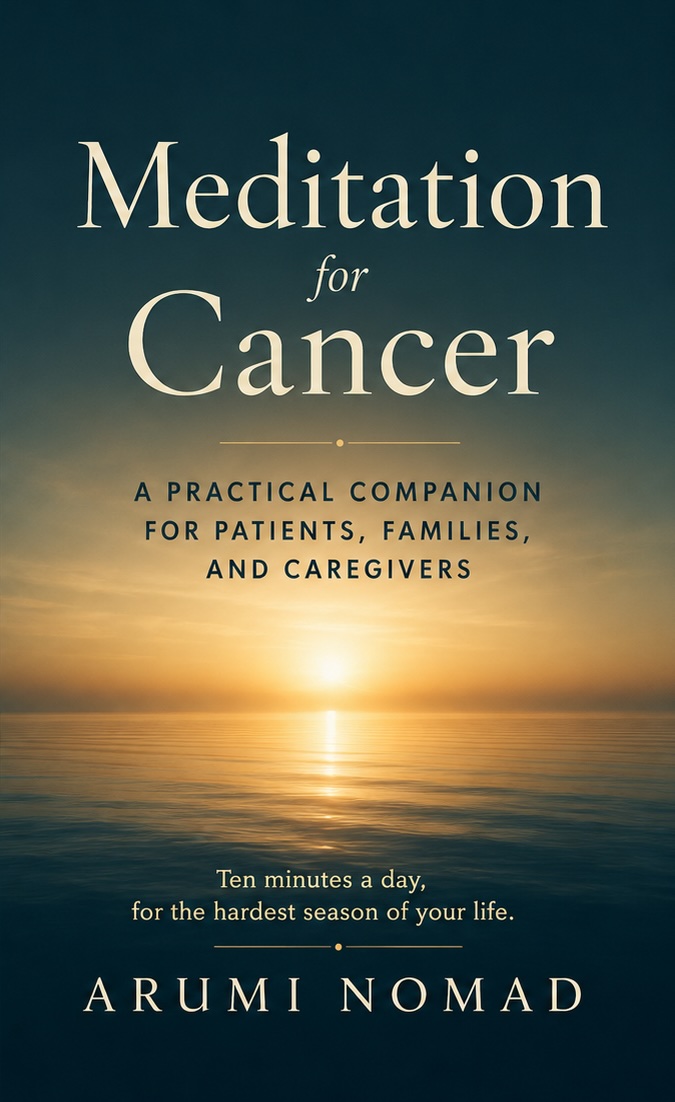
Meditation for Cancer: A Practical Companion for Patients, Families, and Caregivers
Ten minutes a day, for the hardest season of your life.
The storm is real. The anchor holds.
Meditation does not cure cancer. This book says so on the first page and never walks it back. What it offers instead is the thing most people go looking for at three in the morning, somewhere between the diagnosis and the next appointment: something to do with a mind that won't stop.
The major oncology bodies now formally recommend mindfulness-based practice for people in cancer care — the Society for Integrative Oncology and ASCO put it at the top of their guideline for anxiety and depression in 2023. That recommendation sits in clinical documents that almost nobody outside oncology reads. This book turns it into something you can do tonight, in ten minutes, with no experience and no equipment.
It is also honest about the limits. The evidence for mindfulness is strong on anxiety, depression and perceived stress, and considerably weaker on fatigue, sleep quality, pain and overall quality of life. Where a 2024 meta-analysis found no significant effect, the book prints that. Every study cited in it was checked against the source, not quoted from a list.
And it was written for three people at once, which is the part that makes it unusual. Not a book for the patient with a chapter tacked on for everyone else — a book where every practice has a version for the person in treatment, the family member sitting in the corridor, and the nurse who does this for a living.
Written for three readers
Each practical chapter carries guidance for all three. Read it straight through, or open it at the page you need.
The patient
The one who got the news. Short practices for the scan, the treatment chair, the panic that arrives without warning, and the nights that get long. Nothing here asks you to sit still for forty minutes or to have a quiet mind. If you can breathe, you can begin.
The family member
The husband, the daughter, the friend who drives to appointments. Chapter 10 is yours. It includes how to settle your own nervous system first, and how to help settle someone else's without saying a word — because most of the time there's nothing useful to say.
The professional caregiver
Nurses, oncology staff, hospice workers. Addressed directly rather than as an afterthought: how to stay human across a career of hard days, and what to do in the ninety seconds between one room and the next.
Four practices, taught properly
Four chapters, one practice each, written as instruction rather than description. Each comes with a version for a hard day and a version you can read aloud to someone else.
The one that works when nothing else does, because it needs no preparation and can be done with your eyes open in a waiting room. Includes what to do when the breath itself has become frightening — which happens more often than anyone warns you about.
Scripts you can use yourself or read to someone you love. Deliberately offered without battle imagery: for readers who don't want to picture a war inside their own body, there's a gentler version built around repair rather than attack.
Coming back into a body that may feel like a stranger, or like the thing that betrayed you. Taken slowly, with permission to skip the regions you're not ready for, and with a note on why a scan that feels like nothing is still doing something.
For the self-blame that arrives with a diagnosis and rarely gets said out loud — the quiet conviction that you caused this somehow. This chapter is the answer to that, and it's the one caregivers tend to need most.
Table of contents
Fourteen chapters, 138 pages, plus a medical disclaimer page and a full reference list. Chapter 3 is the one to open first if you want to start tonight.
- 1The Role of Meditation in Cancer Care
- 2Facing Cancer — The Emotional Landscape
- 3Getting Started — Your Quick Start Toolkit
- 4But What If I Can't Meditate?
- 5The Science Behind Meditation and Cancer
- 6Mindful Breathing
- 7Guided Visualization
- 8Body Scanning — Coming Back Into the Body
- 9Loving-Kindness Meditation
- 10The Ones Who Walk Alongside
- 11Seven Ways Through
- 12From the Fringe to the Clinic
- 13Technology as a Partner
- 14How to Continue
Five things this book won't do
It won't promise a cure. There is a disclaimer page, and it means it: meditation does not diagnose, treat or cure cancer. Any book in this category that implies otherwise is selling you something.
It won't call it a battle. No warriors, no fighting, no losing a fight. Two chapters explain why that language costs the patient more than it gives, and the visualisation chapter offers an alternative for readers who never wanted a war inside their own chest.
It won't overstate the science. Where the evidence is mixed, the book says it's mixed and names the study. The guideline recommendations are quoted; the null results are printed next to them.
It won't treat the family as an audience. Family members and professional carers get their own guidance in every practical chapter, plus a chapter of their own. Most books in this field give them a page.
It won't pretend to be written from the outside. The author has sat on both sides of this — a father lost to lung cancer, a mother-in-law given six months who is still here nine years later, a mother declared cured, a cousin healed by medicine alone. Four people, four different outcomes, and the reason this book refuses to tell you which road is the right one.
About Arumi Nomad
Arumi Nomad is a non-fiction author and retreat curator. He has been organising travel and group programmes for twenty-five years, worked with Cuba since 2000, and has lived in Mexico since 2017, where he runs retreats on the Riviera Maya.
He has no medical training and the book makes no medical claims on his authority. What he brings to it is a long practice in mindfulness and nervous system work — Himalayan monasteries, Amazonian ceremony in Putumayo, Wixárika tradition, Afro-Cuban ritual — and four cancers in his own family, watched from the chair beside the bed. The clinical material in the book is sourced and checked. The rest of it he learned the hard way.
Where to get it
The Kindle edition has been available since July 2026. The paperback is scheduled for 31 October 2026. An audiobook is coming, without a date on it yet.
| Edition | Price | Details | ISBN | Where |
|---|---|---|---|---|
| Kindle | $6.99 | 138 pages, published 20 July 2026 | 979-8-9989689-4-5 | Amazon |
| Paperback | — | 138 pages, 6″ × 9″ — 31 October 2026 | 979-8-9989689-5-2 | Tell me when it's out |
| Audiobook | — | Coming soon | — | Tell me when it's out |
Three free companions to the book
The First Seven Days is a guided week. The Meditation Journal is printable, one line a day, with dedicated pages for carers. The 90-Day Companion runs a full season of practice on the book's own arc, with a parallel caregiver track and a hard-day toolkit you can find in ten seconds.
Also from Arumi Nomad: Fertile Again! — a five-pillar approach to conception for women, men and couples.