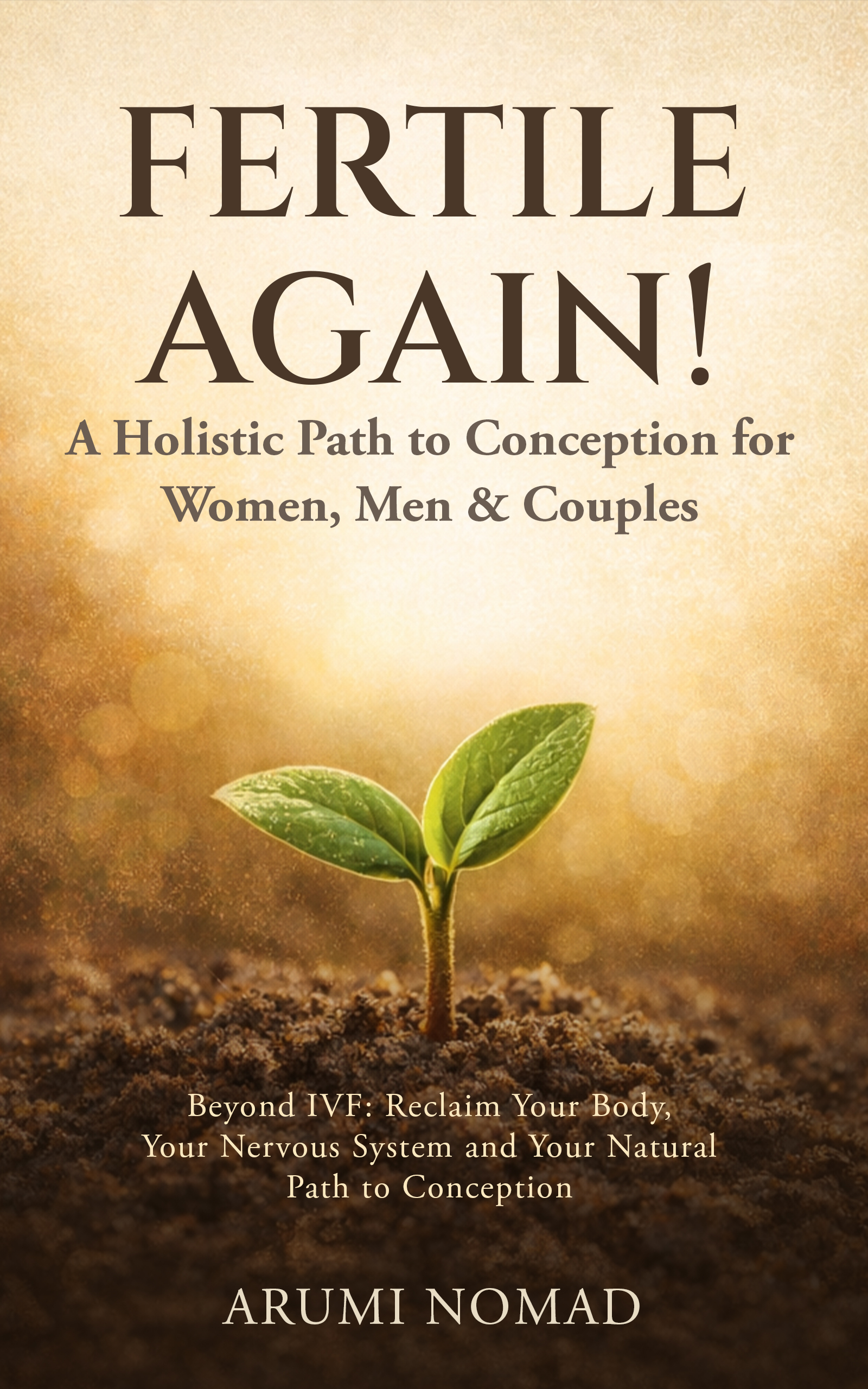
Fertile Again! A Holistic Path to Conception for Women, Men & Couples
Beyond IVF: Reclaim Your Body, Your Nervous System, and Your Natural Path to Conception.
Your body isn't broken. It's bracing.
Most fertility advice opens with what's wrong. A number on a lab sheet, a follicle count, a semen analysis with an arrow pointing the wrong way. Fertile Again! opens somewhere else — with the question of whether your body currently feels safe enough to do the thing it has been trying to do all along.
That isn't a metaphor. A body under sustained threat makes a series of practical decisions, and reproduction is the first one it postpones. Cortisol stays high. Sleep thins out. Digestion slows, circulation narrows, the cycle wobbles. None of it shows up as a diagnosis, which is part of why so many couples are told their case is unexplained and sent home with nothing to do between appointments.
This book is the something to do. It sits alongside medical treatment and never in place of it — you'll find no argument here against IVF, IUI, or the doctor you trust. What you will find is the part nobody hands you at the clinic: how to bring a nervous system out of survival, how to feed a body that is rebuilding, how two people stay a couple once trying stops being fun, and how to keep going when the month ends the way the last one did.
Across fifteen chapters it works from a single idea, and the whole framework hangs off it: you are not the seed, you are the soil. Egg quality responds over roughly ninety days. Sperm turns over in about seventy-four. That window is the book's working unit — long enough to change something real, short enough to start this week.
Who this book is for
Written for women between roughly 28 and 45, and for the couples around them who are further into this than they expected to be. It covers natural conception, IVF and IUI cycles, donor options, surrogacy and adoption — and it treats all of those as legitimate roads rather than ranking them.
It is not only a women's book. Chapter 12 belongs to the man, and it is a full chapter rather than a courtesy paragraph: what happens to a partner who is told he is fine, who has no appointments of his own, and who has quietly stopped saying how he feels about any of it. Couples who read it together tend to read that one twice.
If you have been told your infertility is unexplained, this book was written with you in the front of the author's mind.
The five pillars
Chapter 4 sets out the structure the rest of the book runs on. Each pillar arrives with a self-assessment and one question to sit with.
1 · Nervous System Softening
A body reading its environment as unsafe keeps reproduction switched off, whatever the lab numbers say. The practical work of getting out of survival: breath, sleep architecture, the daily inputs that keep the alarm on.
2 · Biological Nourishment
What you add and what you take away, treated as one subject. Food that supports egg and sperm development over ninety days, and the depleting side of the ledger — alcohol, endocrine disruptors in ordinary household products.
3 · Flow & Circulation
Blood, lymph and breath moving through the reproductive organs. Movement that helps and movement that overtrains, warmth, bodywork, and why a pelvis held tight for years rarely lets go on its own.
4 · Emotional Integration
The grief nobody registers as grief — a cycle that failed, a loss with no funeral, a friend's announcement that lands like a blow. Left unprocessed it becomes another form of bracing.
5 · Inner-Outer Coherence
Whether your life as it is actually lived matches the life you say you want. Work, home, relationship, the calendar. A body notices the gap long before the mind admits it's there.
Table of contents
An introduction, fifteen chapters in four parts, and a bonus section of tools. Every chapter closes with a journaling prompt.
- 1Understanding Your Fertile Self
- 2The Stress-Fertility Loop
- 3Healing the Emotional Body
- 4Creating Fertile Ground: The Five Pillars
- 5Nourishment
- 6Protection
- 7Activation
- 8Nature as Medicine
- 9The Power of Retreat Space
- 10The Fertile Couple Code
- 11Preparing Mind, Body & Soul
- 12The Male Journey: Seen, Heard, and Held
- 13Alternative Paths: Love Takes Many Forms
- 14The Complete Framework
- 15Closing Blessing: You Are Becoming
Five things you won't find in most fertility books
It is written for two people, not one. Most fertility books address a woman who will then relay the useful parts. This one assumes both partners are reading, and Chapter 10 gives them a shared vocabulary for the conversations that keep going wrong.
The man gets his own chapter. Chapter 12 is about being the partner nobody examines: what to do with the fear, the uselessness, the sense that your job is to stay steady while someone else carries everything.
Grief is named as grief. Chapter 3 deals with the losses that get no acknowledgement — the cycle that failed, the early loss, the year that disappeared. Unprocessed, it keeps the body braced. That chapter is the one readers write in about.
Nature and retreat space are treated as medicine. Part III comes out of years of running group programmes in the Riviera Maya and watching what changes in people when the phone goes away and the day gets slower. It's observation, not theory.
There's a family story behind it. The author watched his sister's family arrive by several different roads, none of them the road anybody had planned on. That's where the book's refusal to rank the paths comes from.
About Arumi Nomad
Arumi Nomad is a non-fiction author and retreat curator. He has been organising travel and group programmes for twenty-five years, worked with Cuba since 2000, and has lived in Mexico since 2017, where he now runs retreats on the Riviera Maya.
He is not a doctor and the book never pretends otherwise. What he brings is a long practice in mindfulness and nervous system work — Himalayan monasteries, Amazonian ceremony in Putumayo, Wixárika tradition, Afro-Cuban ritual — and several hundred retreat participants' worth of watching what actually shifts in a body when the pressure comes off. The clinical claims in the book are sourced; the framework around them comes from that practice.
Where to get it
Three formats, all of them the complete book. The audiobook is narrated by a digital voice, which is stated on every storefront that carries it.
| Edition | Price | Details | ISBN | Where |
|---|---|---|---|---|
| Kindle | $6.99 | Published 21 March 2026 | 979-8-9989689-1-4 | Amazon |
| Paperback | $14.99 | 448 pages, 6″ × 9″, published 23 March 2026 | 979-8-9989689-2-1 | Amazon |
| Audiobook | $4.99 | Digital voice narration, published 14 May 2026 | 9780466756253 | Gumroad · all retailers |
Read Chapter 2 before you buy anything
Chapter 2, The Stress-Fertility Loop, is the chapter most readers say made them keep going. It's free, it's the real chapter rather than an extract, and it comes with the reader tools.
Also from Arumi Nomad: Meditation for Cancer — a practical companion for patients, families, and caregivers.