You've already done it today without deciding to. Somewhere between the second email and the third, your chest filled a little more than usual, paused, and let go with a sound you didn't plan. A sigh. Nobody taught you that one.
Cyclic sighing takes that reflex and turns it into a practice: two breaths in through the nose, one long breath out through the mouth, repeated for about five minutes. In 2023 a small Stanford study made it briefly famous, and since then cyclic sighing has been sold as the fastest way to calm down, a five-minute fix, a hack for your nervous system. Some of that holds up. Some of it doesn't, and the part that doesn't is worth knowing before cyclic sighing turns into one more thing you feel guilty about skipping.
So here's what cyclic sighing is, what the research actually measured, where it's thin, and how to try it without turning a breath into homework.
What cyclic sighing is
How do you do cyclic sighing?
Sit somewhere you won't be interrupted for five minutes. A kitchen chair is fine. Then:
- Breathe in through your nose until your lungs feel comfortably full.
- Without breathing out, take a second, shorter sip of air through the nose, on top of the first.
- Let it all go slowly through your mouth, noticeably longer than the way in, until there's almost nothing left.
- Rest for a beat, then start the next round.
That's cyclic sighing. No count to memorise, no posture to hold. The second inhale is the odd part. The first few times it feels clumsy, like trying to fit one more jumper into a suitcase you've already zipped. Then it stops feeling clumsy, and the long exhale starts to feel like the point, which it is.
Why your body already knows this breath
The sigh isn't an invention of the wellness industry. Your lungs depend on it. In a 2016 paper in Nature, Peng Li, Jack Feldman, Mark Krasnow and colleagues described sighs as long, deep breaths that happen on their own every few minutes to reopen the alveoli, the tiny air sacs in the lungs that slowly deflate during ordinary shallow breathing. Working in mice, they traced the switch that turns a normal breath into a sigh to a cluster of about 200 neurons in the brainstem. Their abstract also notes that sighing increases under stress.

So cyclic sighing doesn't teach your body anything foreign. It takes a breath your body already uses every few minutes and asks you to do it on purpose, slowly, several times in a row. Whether doing it on purpose does more than doing it by accident is the real question, and it's the one the research is still answering.
What the Stanford cyclic sighing study found
Who was in the study, and what did they do?
The study came out in January 2023 in Cell Reports Medicine, from a Stanford team that included Melis Yilmaz Balban, David Spiegel and Andrew Huberman. It ran entirely remotely. 108 adults were randomised into four groups. Each person practised for five minutes a day for 28 days, wore a wrist sensor, and filled in short daily questionnaires about how they felt.
Three groups did breathing exercises: cyclic sighing (30 people), box breathing (21) and a fast pattern called cyclic hyperventilation with retention (33). The fourth group, 24 people, did mindfulness meditation, watching the breath without changing it. That group was the comparison.
How big was the cyclic sighing effect?
On mood, cyclic sighing came out ahead. Daily positive feeling rose by an average of 1.89 points in the cyclic sighing group, against 1.22 in the mindfulness group, and the statistical model that compared the two found the difference significant. Breathing rate also came down more in the breathing groups than with mindfulness, and cyclic sighing differed from mindfulness on that measure too.
Read those numbers slowly. A shift of under two points on a daily mood questionnaire is real, and it's small. The mindfulness group's own improvement didn't quite clear statistical significance on its own (p = 0.06), which is not the same as nothing happening. And the analyses of the body measures ran on 19 to 32 people per group. That's a promising pilot. It isn't proof.
Why the long exhale gets the credit
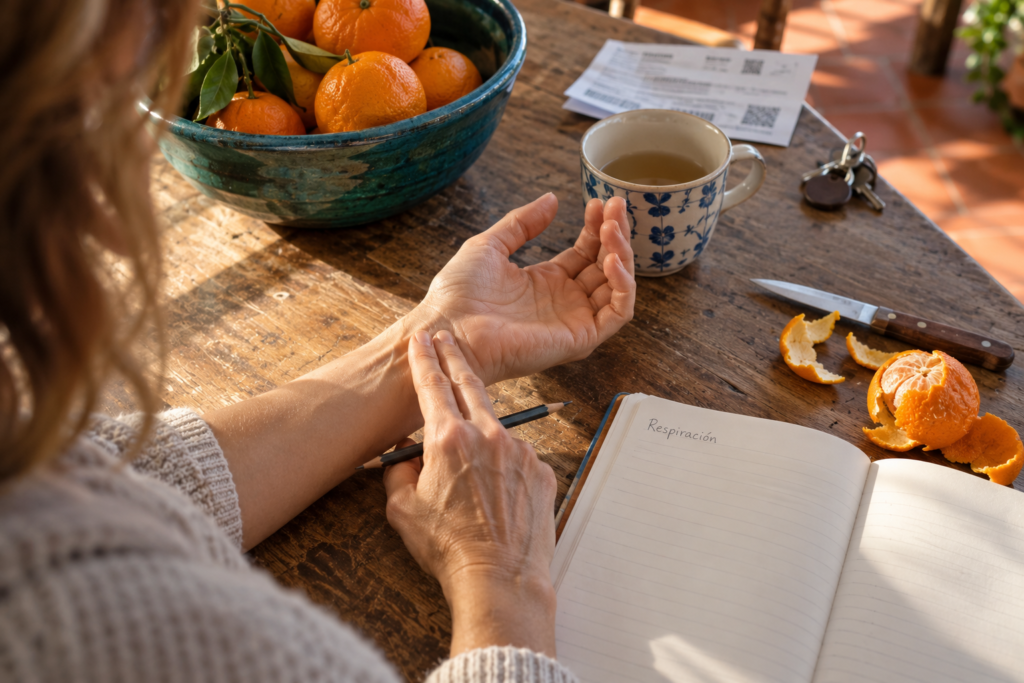
The theory behind cyclic sighing is all about the out-breath. When you breathe in, your heart speeds up a little. When you breathe out, it slows. You can feel it yourself: rest two fingers on the inside of your wrist and breathe slowly for a minute. A long exhale gives the slowing phase more time, and the gaps between heartbeats get more variable. Researchers read that variability as a sign that the parasympathetic side of the nervous system, the side that handles rest and digestion, is doing more of the work.
There's decent evidence that slow breathing in general does this. In 2022, Sylvain Laborde and colleagues pooled 223 studies of voluntary slow breathing and found that heart rate variability linked to the vagus nerve went up during slow-breathing sessions, straight after a single session, and after programmes that ran for weeks.
Here's the twist. In the Stanford study, heart rate variability didn't change significantly in any group, cyclic sighing included. Neither did resting heart rate or sleep. The mood moved. The heart numbers that people usually point to as the mechanism didn't, at least not in a way a wrist sensor could pick up over four weeks. If you watch your HRV in an app, something I wrote about in meditation tracking, don't expect cyclic sighing to put a new number on the screen.
Now the part that argues the other way
I like cyclic sighing. I'd still be misleading you if I stopped at the Stanford result.
Is cyclic sighing better than a placebo breath?
As far as I could find, nobody has yet tested cyclic sighing against a fake breathing exercise. But the question has been asked of a close cousin. In 2023, Guy Fincham, Clara Strauss and Kate Cavanagh randomised 400 adults to ten minutes a day of coherent breathing, about 5.5 breaths a minute, or to a placebo version at 12 breaths a minute that looked and felt like a real exercise. After four weeks, stress, anxiety, depression and wellbeing had improved in both groups, and by the same amount. The authors found no measurable effect "over and above a well-designed breathwork placebo."
Coherent breathing isn't cyclic sighing. But the lesson carries over. When you sit down every day to do something kind for your breath, expectation, routine and the plain fact of stopping may be doing a lot of the lifting. The Stanford study compared cyclic sighing with mindfulness, not with a placebo, so it can't pull those things apart.
What does the wider breathwork evidence say?
Fincham's group had earlier pooled 12 randomised trials of breathwork, 785 adults in all, in Scientific Reports. Breathwork lowered self-reported stress by a small-to-moderate margin, with similar small effects on anxiety and depression. Not one of the stress trials was judged to be at low risk of bias, and the authors warned in plain terms that the hype around breathwork was running ahead of the evidence.
What the Stanford study couldn't tell us
The limits are mostly in the paper itself. Mood was self-reported, and people knew which practice they'd been given. Nobody watched how they breathed or checked how long they kept going; it all ran on trust and daily surveys. The study lasted four weeks, with no follow-up. The groups were small, and the study was only powered to compare breathwork as a whole with mindfulness, so it can't rank cyclic sighing against box breathing. It was set up as an exploratory study and registered after the fact.
Put it together and cyclic sighing looks like this: a cheap, five-minute practice with one small encouraging trial behind it, a plausible mechanism, and a placebo result next door that should keep everyone modest. That's enough to try it. It isn't enough to sell it as a cure for anything.
Three ways people get cyclic sighing wrong
Forcing the second inhale
The top-up breath should be easy, not a gasp. If your shoulders climb toward your ears to make room for it, you're pulling air with your neck. Let the ribs widen and keep the jaw soft.
Rushing the exhale
Most people cut the out-breath short without noticing, usually because they want to get to the next round. In cyclic sighing the exhale is the practice. Let it run long, and let the last of the air leave on its own.
Saving it for emergencies
Cyclic sighing can help in a tight moment, and a few rounds at a red light won't hurt anyone. But the study tested it as a daily practice, done on ordinary days. If you only reach for it when you're already panicking, you teach yourself to associate the breath with panic.
How to try cyclic sighing this week
Pick the same five minutes every day, and use a timer so you aren't counting the clock in your head. My post on the meditation timer explains why the number you pick before you start matters more than you'd think. For the first two days, do three rounds and stop. After that, let it fill the five minutes.

Before you begin, write one word for how you feel: tight, scattered, flat, fine. Write one word after. Keep it on a single notebook page for a week. You're not looking for a result. You're looking for whether cyclic sighing gives you a different word, and whether that word changes how the next hour goes.
If sitting still is the problem, don't sit. Do your rounds on a slow walk, timing the long exhale to your steps. Walking meditation works on the same principle: the practice you actually do beats the one you planned.
When cyclic sighing isn't the right tool
Stop and rest if the breathing makes you dizzy, light-headed or panicky. Breathing too deeply too often can do that to anyone, and it's a signal to slow down, not to push through.
Talk to your doctor before starting a daily breathing routine if you have asthma, COPD or a heart condition, or if you're pregnant and unsure. If you have chest pain or breathlessness that isn't coming from the practice, get help now rather than waiting for the next session.
And some people find that paying attention to their breath makes anxiety worse at first. If that's you, nothing is wrong with you. I wrote about why in meditation for anxiety, and what to do when the first week feels harder than the stress did.
The breath you were already taking
Here in Playa del Carmen, I go into the temazcal with a group of friends at the new moon and the full moon. When the stones come in and the heat climbs, nobody has to be told to breathe out long. The body does it on its own. That's the oldest version of cyclic sighing I know, and it doesn't come with a study.
So use cyclic sighing for what it is. A small, portable, five-minute tool you can carry into a car park, a desk or the edge of a bed. One trial says it lifts mood a little more than mindfulness over a month. A placebo trial next door says expectation may be doing much of the work. Neither is a reason to skip it. Both are reasons not to expect more from it than five minutes can give.
References
Fincham GW, Strauss C, Cavanagh K (2023). Effect of coherent breathing on mental health and wellbeing: a randomised placebo-controlled trial. Scientific Reports, 13, 22141. https://doi.org/10.1038/s41598-023-49279-8
Fincham GW, Strauss C, Montero-Marin J, Cavanagh K (2023). Effect of breathwork on stress and mental health: a meta-analysis of randomised-controlled trials. Scientific Reports, 13, 432. https://doi.org/10.1038/s41598-022-27247-y
Laborde S, Allen MS, Borges U, Dosseville F, Hosang TJ, Iskra M, Mosley E, Salvotti C, Spolverato L, Zammit N, Javelle F (2022). Effects of voluntary slow breathing on heart rate and heart rate variability: a systematic review and a meta-analysis. Neuroscience & Biobehavioral Reviews, 138, 104711. https://doi.org/10.1016/j.neubiorev.2022.104711
Li P, Janczewski WA, Yackle K, Kam K, Pagliardini S, Krasnow MA, Feldman JL (2016). The peptidergic control circuit for sighing. Nature, 530, 293–297. https://doi.org/10.1038/nature16964
Yilmaz Balban M, Neri E, Kogon MM, Weed L, Nouriani B, Jo B, Holl G, Zeitzer JM, Spiegel D, Huberman AD (2023). Brief structured respiration practices enhance mood and reduce physiological arousal. Cell Reports Medicine, 4(1), 100895. https://doi.org/10.1016/j.xcrm.2022.100895