
Somebody says it at every thirty-fifth birthday dinner. Usually between the main course and the cake, usually as a joke that isn't quite one: a third of women over 35 won't get pregnant within a year of trying. Everyone at the table has heard it. Nobody can say where it comes from.
That one sentence is most of what people think they know about fertility after 35. It turns up in magazine headlines, in group chats, in the mouths of well-meaning aunts. And it lands on the body as a deadline. A woman who was relaxed about trying at 34 years and eleven months is, a few weeks later, counting.
So let's do what the dinner table never does. Follow the number back to its source, then look at what happened when researchers measured couples who were actually trying, this century, with diaries and pregnancy tests. The answer is less frightening than the joke. It's also less comfortable than "you've got plenty of time." You need both halves. Most of what gets said about fertility after 35 skips the second step entirely.
Where the fertility after 35 statistic came from
The cliff figure has a strange birth certificate. For most of the twentieth century, demographers couldn't measure how fertility changes with age in modern populations, because modern couples use contraception. You can't count how quickly people conceive when most of them are working hard not to.
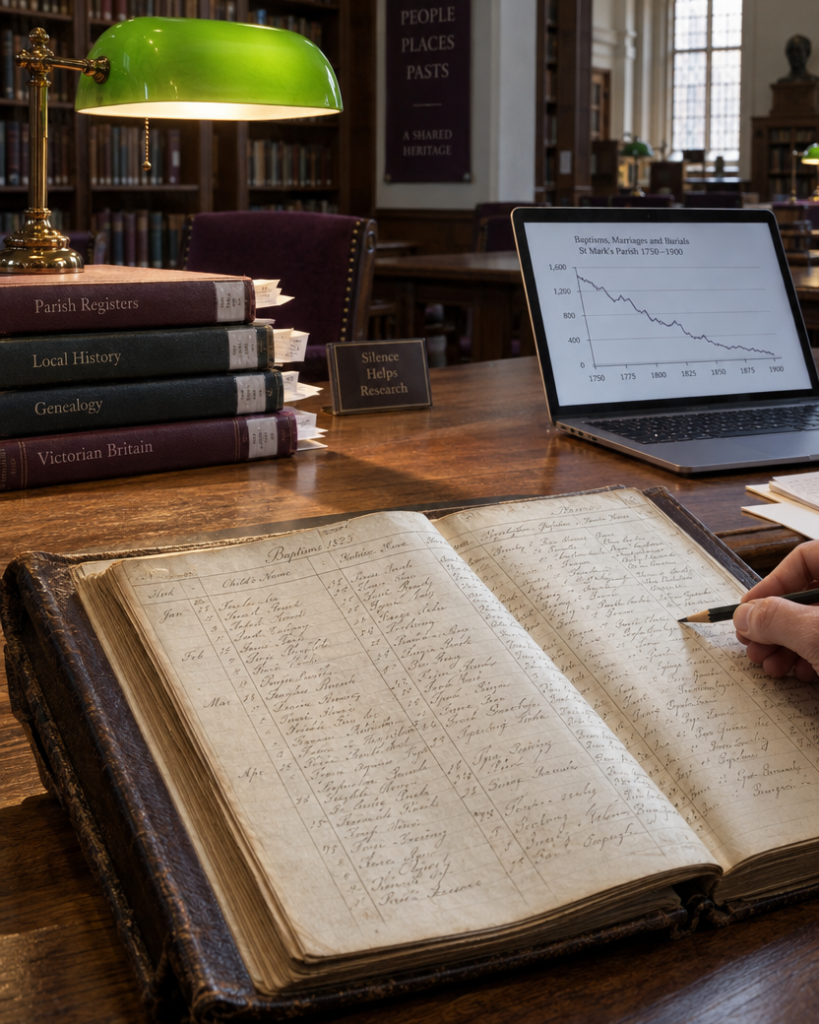
So they went to history. In 1986 Jane Menken, James Trussell and Ulla Larsen published a paper in Science with a plain title, "Age and infertility." They worked from historical populations that didn't use contraception, and the paper says outright that those records give upper bounds on how many couples were sterile at each age. Their own reading was calm. A woman in a monogamous union, they concluded, faces only moderate increases in the chance of becoming sterile until her late thirties.
Historical records come with historical lives attached. No antibiotics for the infections that scar fallopian tubes. Different food, different work, different marriage patterns, and very different habits about how often a long-married couple still slept together. Those numbers were the best anyone had at the time. They were never meant to be read aloud at your birthday as a forecast of fertility after 35 for you.
What fertility after 35 looks like in couples trying now
The better question is what happens to people trying today. In 2004 David Dunson, Donna Baird and Bernardo Colombo published data on 782 couples recruited through seven natural family planning centres in Europe. The couples kept daily records of their cycles and of when they had sex, which let the researchers pull age apart from timing.
The share who didn't conceive within a year came out at about 8% for women aged 19 to 26, 13 to 14% for women aged 27 to 34, and 18% for women aged 35 to 39. Turn that last figure over and it reads differently: roughly 82 of every 100 women in their late thirties conceived within twelve cycles. Absolute sterility sat at about 1% and didn't rise with age at all. And many couples who missed the one-year mark conceived in the year after it. Depending on age, the estimate ran from 43 to 63%.
That's the first honest picture of fertility after 35. The rate slows. It doesn't stop on a birthday.
The fertility after 35 slope is real
Now the other side of fertility after 35, because a slope is still a slope.
Some of the most careful modern data on fertility after 35 comes from North Carolina. Anne Steiner and Anne Marie Jukic followed women aged 30 to 44 who had been trying for three months or less and had no known infertility. Compared with women aged 30 to 31, the chance of conceiving in any given cycle was about 14% lower at 34 to 35, 19% lower at 36 to 37, 30% lower at 38 to 39, and 53% lower at 40 to 41. For the mid-thirties groups the margins of error were wide enough to include no difference at all. For the forties they weren't.
In Denmark, Kenneth Rothman's team followed 2,820 women from the general population. Age made little difference to the monthly chance of conceiving until the 35 to 40 group, where it fell to 0.77 of the rate at 20 to 24. Women who had never been pregnant felt the decline more strongly than women who had.
Henri Leridon, a French demographer, ran the numbers forward in a computer model that also counted miscarriage. Starting to try at 30, about 75% of women would have a conception ending in a live birth within a year. Starting at 35, 66%. Starting at 40, 44%. Give it four years and those figures climb to 91, 84 and 64%.
Put the three studies side by side and fertility after 35 has a shape. Gentle through the mid-thirties. Steeper from about 38. Clearly steeper past 40. No cliff, and no flat ground either.
Reading fertility after 35 for your own body
Averages hide the person. Two details in this research are worth knowing if you're trying to place yourself somewhere on the curve of fertility after 35.
First, history shifts it. In North Carolina, women who had never been pregnant had lower chances at every age over 30, and in Denmark the age decline hit women who had never given birth harder than mothers. Nobody should read that as a judgement. It does mean the friend who had her second at 39 without trying is a poor guide to your first at 37.
Second, the slope is counted in months. For most couples, fertility after 35 means it takes a few more cycles, and the per-cycle numbers are where that shows. A 30% lower chance in any one month at 38 adds up to more months of trying on average. That arithmetic is the whole reason the time limits for asking for help get shorter after 35, which we'll come to.
His age is in the fertility after 35 numbers too
Almost every article on this subject is written to her. The data doesn't let him off, and men are rarely told that fertility after 35 is their business too.

In Dunson's European couples, male age began to count in the late thirties. For women in their late thirties, the estimated share not conceiving within twelve cycles rose from 18% with a 35-year-old partner to 28% with a 40-year-old partner. Rothman's Danish data showed a smaller male decline, down to 0.95 for men aged 35 to 39, and his team's conclusion is worth taping to the fridge: couples experience a compounded effect of their two separate declines. By 40, a couple's monthly chance of conceiving is roughly half what it was at 30.
So when the talk about fertility after 35 is only about her eggs, it's missing half the arithmetic. If you're the man reading this over her shoulder, the ninety days it takes to make sperm belong to you (I went through the sperm production cycle in an earlier piece), and so does the appointment. There's more on why he rarely gets asked in what I wrote about male infertility.
Now the part that argues the other way
I'd be doing exactly what the birthday joke does if I only handed you the comforting half.
Start with who was in the reassuring study. Dunson's couples came from natural family planning centres: people who charted their cycles every day and knew their fertile window. That's a best-case group for timing. A couple guessing at ovulation from a phone app will usually take longer than they did.
Steiner and Jukic left out women with known infertility, PCOS or endometriosis. Their figures describe fertility after 35 in women with no diagnosis, which is useful, and also isn't everyone.
Leridon's model carries the hardest message. He asked whether IVF could make up for the births lost by starting later, and his answer was no. Under his assumptions, assisted reproduction recovered only about half of the births lost by postponing a first attempt from 30 to 35, and under 30% of those lost by postponing from 35 to 40. Treatment is a real option. It's a poor insurance policy. That's the half of fertility after 35 nobody wants to hear at the party.
And every number here is an average across thousands of strangers. None of these studies can tell you what your next twelve months hold. What they can tell you is that waiting has a price, the price rises each year, and medicine can't buy all of it back.
So the honest summary of fertility after 35 cuts both ways. Most couples in their late thirties who are trying will conceive within a year. Each extra year of waiting costs more than the one before.
What the fear does while you wait
Here's what fear about fertility after 35 does in real homes. It turns month three into month thirty. Sex gets scheduled around a test strip. A late period becomes a referendum. The month after a birthday feels heavier than the month before it, though nothing in the body changed overnight.
I've written about stress and fertility before, and about the timed intercourse trap, so I won't rerun the whole case. The short version: the research on stress and conception is messier than the internet makes it sound, and a plan built on fear tends to squeeze exactly the parts of trying that move the numbers.
Rothman's Danish data holds a detail I like. Three ordinary things each had a small effect on how fast women conceived: how often the couple had sex, how well they timed it, and whether the last contraception was non-hormonal. Women in the favourable group on all three had an estimated 88% probability of conceiving. The researchers called these volitional factors, choices that can offset part of the age-related decline in fertility after 35. None of them comes in a bottle. All of them get harder when every month feels like an exam. (Training plans are their own story; I went through exercise and fertility last week.)
Fertility after 35 and the six-month rule
This is the part to take with you. The patient guidance from the American Society for Reproductive Medicine says couples where the woman is younger than 35 should ask for a fertility evaluation after a year of trying, and couples where she's older than 35 after six months. The NHS says the same thing its own way: see a GP after a year, and sooner if you're 36 or over.

Go earlier than that, whatever the calendar says, if periods are irregular or have stopped, if either of you has a known condition, a history of pelvic infection, surgery, cancer treatment or testicular injury, or if something simply feels off. An early appointment is information, and asking early is part of taking fertility after 35 seriously. And if the tests come back clean and you still haven't conceived, that has a name too. I wrote about why unexplained is a statement about the tests, and says nothing final about you.
The six-month rule is the useful part of the fear about fertility after 35. It turns a vague dread into a date.
The birthday doesn't flip anything
Fertility after 35 is real biology. So is the averaging that turned it into a dinner-table threat. Your body didn't change between the last day of 34 and the first day of 35. The slope began earlier, it gets steeper later, and it belongs to both of you.
Write down the month you started trying. If she's over 35, add six months and put that date somewhere you'll both see it every morning. Then spend the months in between living like two people who want to be together, because that's also what the numbers reward.
Then go back and have the cake.
References
Menken J, Trussell J, Larsen U (1986). Age and infertility. Science, 233(4771), 1389–1394. https://doi.org/10.1126/science.3755843
Dunson DB, Baird DD, Colombo B (2004). Increased infertility with age in men and women. Obstetrics & Gynecology, 103(1), 51–56. https://doi.org/10.1097/01.AOG.0000100153.24061.45
Steiner AZ, Jukic AMZ (2016). Impact of female age and nulligravidity on fecundity in an older reproductive age cohort. Fertility and Sterility, 105(6), 1584–1588. https://doi.org/10.1016/j.fertnstert.2016.02.028
Rothman KJ, Wise LA, Sørensen HT, Riis AH, Mikkelsen EM, Hatch EE (2013). Volitional determinants and age-related decline in fecundability: a general population prospective cohort study in Denmark. Fertility and Sterility, 99(7), 1958–1964. https://doi.org/10.1016/j.fertnstert.2013.02.040
Leridon H (2004). Can assisted reproduction technology compensate for the natural decline in fertility with age? A model assessment. Human Reproduction, 19(7), 1548–1553. https://doi.org/10.1093/humrep/deh304
American Society for Reproductive Medicine (n.d.). Does my age affect my fertility? Patient fact sheet. ReproductiveFacts.org. https://www.reproductivefacts.org/news-and-publications/fact-sheets-and-infographics/does-my-age-affect-my-fertility/
NHS (n.d.). Infertility. nhs.uk. https://www.nhs.uk/conditions/infertility/