
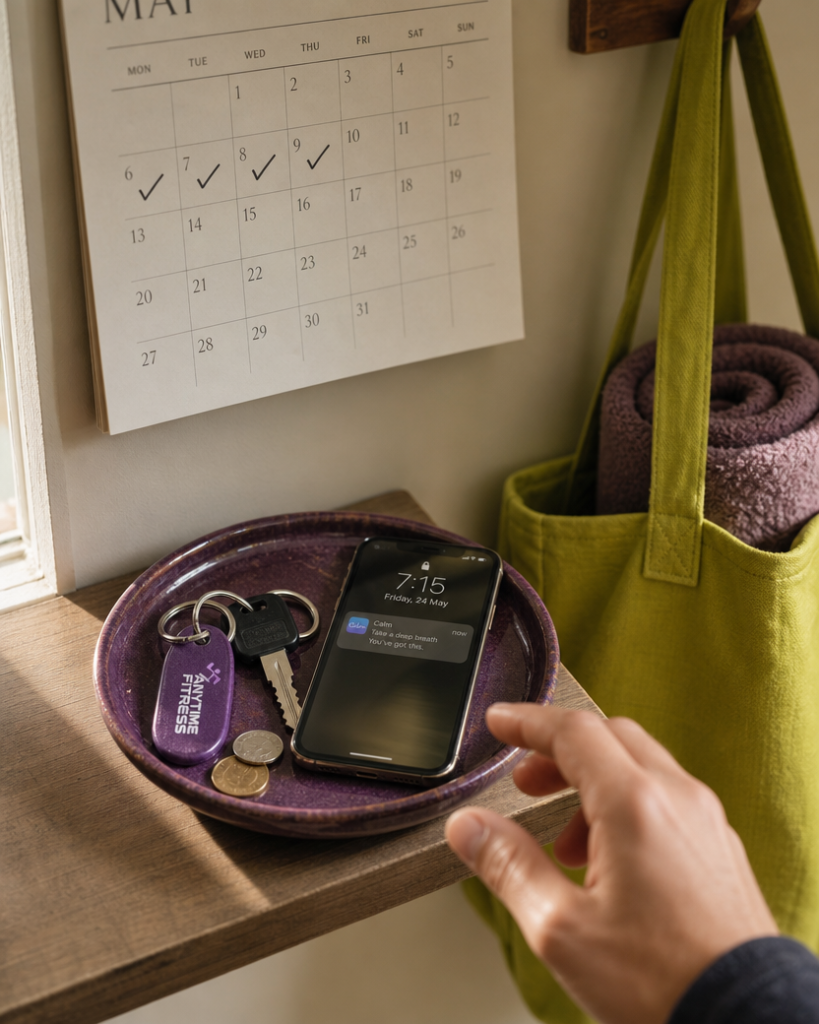
The renewal email usually lands at a bad moment. You're half-dressed, the coffee is going cold, and your phone tells you your plan renews in three days. You try to remember the last time you opened the app. It was a while ago.
You don't cancel. Cancelling would feel like admitting something.
That small flinch is what this piece is about. A meditation subscription, a monthly or yearly fee for access to guided sittings, is the third thing the West added to practice that the traditions never had. In September I wrote about the meditation timer, and last time about meditation tracking, the score that shows up after you sit. The meditation subscription is the next layer. It's a charge that arrives whether you sat or not.
Where I practise now, in Playa del Carmen, a group of friends goes into the temazcal at every new moon and every full moon. The calendar there is the moon's. It comes round every twenty-nine and a half days, and it has never once asked for my card details.
What a meditation subscription actually sells
Strip the branding off and a meditation subscription sells you three things. A library of recorded voices. A reminder that pings at the hour you chose. And a feeling that you've done something about your stress, which starts the moment the card goes through.
The first two are real, and I'm not going to sneer at them. On a bad night a calm recorded voice beats an empty room, and plenty of people learned to sit with one in their ear. I wrote about the streak counter back in August, and the reminder is its quieter cousin.
The third thing is the one worth looking at. It arrives on the payment date. The payment date has nothing to do with whether you sat, and a meditation subscription is built so that you never have to notice the gap between the two.
Then there's the yearly plan. On most app pricing pages I've looked at, it's the one with the badge and the bigger discount, and it's the one a meditation subscription business would most like you to take. A year is a long promise to make on a Sunday evening when you feel like changing your life. It's an even longer one to keep.
How many people still use a meditation subscription after a month?
Nobody publishes clean numbers for paying users, so here's the closest independent data I could find. In 2019, Amit Baumel and colleagues looked at 93 Android mental health apps with at least 10,000 installs each, using usage data collected by an outside panel rather than by the app makers. Across all of them, the median share of people still opening the app 30 days after installing it was 3.3%.
Meditation and mindfulness apps did better than most, at a median of 4.7% on day 30. Breathing-exercise apps sat at zero. And the people who did keep going used the meditation apps for longer each day than any other kind of app except peer support, a median of about 21 minutes.
Read that carefully, because it cuts both ways. The few who stay really do practise. But Baumel's data mixes free and paid apps, covers Android only, and doesn't separate people who paid from people who didn't. So I can't tell you how many people holding a meditation subscription are still sitting at day 30. I can tell you that across the whole category, most people who start have stopped within a month. The renewal date doesn't know.
Why a meditation subscription can feel like the practice itself
The clearest picture of this I know comes from gyms. In 2006, the economists Stefano DellaVigna and Ulrike Malmendier published a study of 7,752 members at three US health clubs, tracked over three years, in the American Economic Review. People who chose a flat monthly fee of over $70 went, on average, 4.3 times a month. That's more than $17 a visit, when a 10-visit pass would have cost them $10 a visit. Over the life of their membership, the average member left about $600 on the table.
The authors' explanation is plain and a bit uncomfortable: people were overconfident about their future self-control. The fee was priced for the person they expected to be next month. That person, in their heads, went a lot more often than the one who actually turned up.
Is a meditation subscription a gym membership with softer music?
The study is about gyms, and I'm stretching it over meditation, so take this as a comparison rather than a finding. But the structure of a meditation subscription is the same one. A flat fee. Automatic renewal. Attendance left entirely to you.
One more detail from that paper stays with me. Members on a monthly contract were 17% more likely than annual members to still be enrolled after a year, even though the monthly plan let them walk away any month. They paid extra for the freedom to cancel, and then didn't use it.
Here's how I read it. Paying is a decision you make once. Sitting is a decision you make every single day, usually tired. A meditation subscription quietly moves the effort onto the easy decision, and the easy decision feels like progress.
What the traditions ran on instead
I don't want to pretend the old ways ran on air. A temazcal needs wood, and the volcanic stones need hours in the fire before anyone crawls in. Somebody does that work before the circle arrives. Practice has always cost somebody something.
What changes is who pays, when, and for whom. The Vipassana courses taught in the tradition of S.N. Goenka are a clear example, because they write the rule down. On their own site they say the courses are "run solely on a donation basis." Donations are accepted only from people who have finished at least one 10-day course. A first-timer may give at the end. Neither the teachers nor the organisers are paid.
Look at the direction the money moves. You pay after, once you know what you got. And you pay for the next person's course, somebody you'll never meet, the way somebody before you paid for yours.
A meditation subscription runs the other way round. It charges you before, for your own access, and keeps charging while you're absent. One model asks what the practice gave you. The other asks what you intend to do next month. Both are ways to keep the lights on. Only one of them is still collecting when nobody is in the room.

The temazcal circle I sit with works on a third logic. There's no fee and no app, just a date set by the moon and people who show up because the others will be there. If I don't come, someone notices. That's the opposite of a renewal email, which is designed to go through precisely when nobody notices.
There's a quieter difference too, about time. A meditation subscription runs on a billing cycle, thirty days or three hundred and sixty-five, counted from whenever you happened to sign up. The temazcal runs on the moon, which everybody in the circle can see from their own garden. One calendar belongs to a company's finance team. The other one is shared by everyone who looks up.
Now the part that argues the other way
I've made the case against the meditation subscription. Here's the case for it, and some of it is strong.
First, the apps do something. In 2021, Éva Gál, Simona Ștefan and Ioana Cristea pooled 34 randomised trials covering 7,566 people in the Journal of Affective Disorders. App-based mindfulness reduced perceived stress (Hedges' g 0.46), anxiety (0.28) and depression (0.33) compared with control conditions. Those are modest effects, and the authors themselves warn about the small number of trials and an uncertain risk of bias. Still, modest and real is more than most things you pay for monthly.
Second, somebody has to pay the people who make it. A good recording at two in the morning costs money to produce, and a donation model works partly because the centres that use it run on volunteers. Most teachers I've met don't have that.
Third, paying can be the commitment. Some people sit because they paid, and that's a real gain. DellaVigna's members still went to the gym 4.3 times a month. Overpriced, yes. Zero, no.
And here's the part I can't settle. I looked for a trial that randomly gave some people paid access and others free access and then measured how much each group meditated. I couldn't find one. So I can't tell you a meditation subscription makes you practise less. What I have is gym data next door showing payment and attendance drifting apart, and app data showing most people stop within a month. Nobody seems to have checked our room.
How to make a meditation subscription earn its fee
If you keep your meditation subscription, and some people should, this is how I'd run it.
Put the renewal date in your own calendar today, two days early, with one question attached: how many times did I sit this month? Then divide the fee by that number. That's your price per visit, the same figure the gym study used. If a single sitting is costing you more than a class with a living teacher would, that's an answer.
Choose the plan you'll actually cancel. The monthly option looks flexible, but in the gym data the monthly members kept paying for longer. Flexibility you never use is just a higher price.
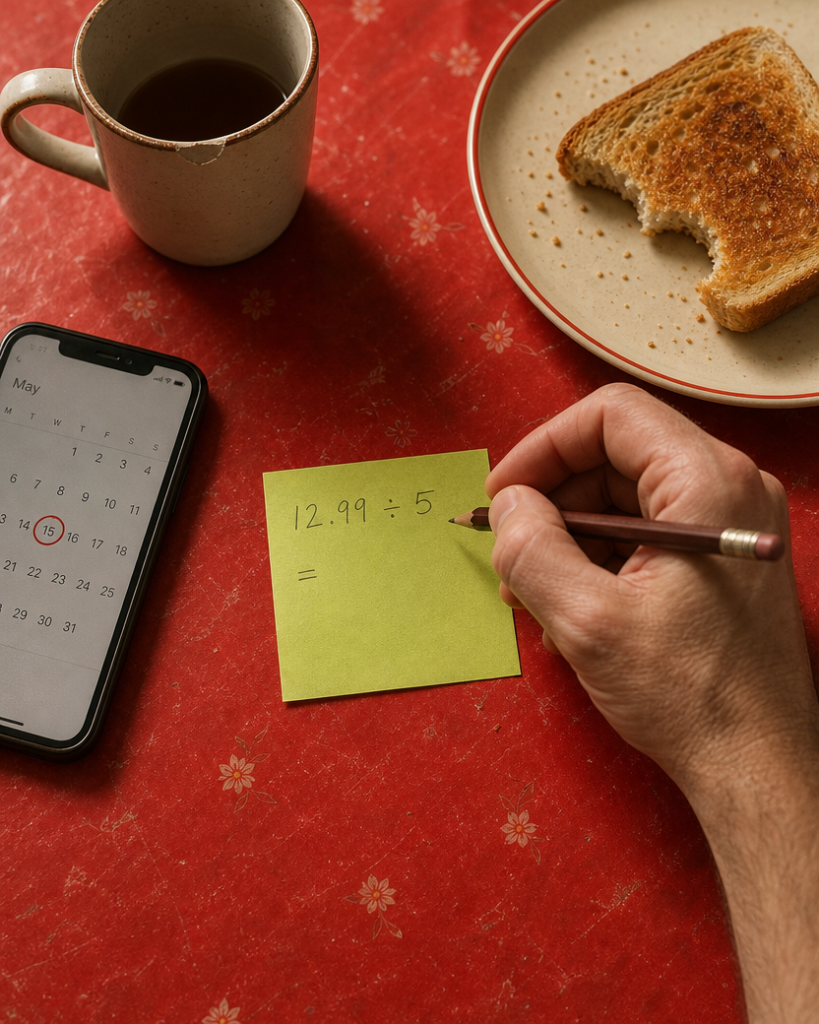
Try a month without it. Cancel, or pause if the app allows it, and notice whether you sit more or less. That's the experiment nobody has run for you, and you can run it on yourself starting this week.
Give some of the money to a person. Join a group that meets in a real room, or find a teacher who'll ask how it's going and wait for the answer. It's slower than a meditation subscription. It also knows when you're not there.
Read the cancellation page before you need it. Find out now how a meditation subscription ends on your phone, whether that's in the app, in the app store settings or by email. People in the gym study were slow to cancel even when it would have saved them money, and the less you know about the exit, the easier the delay gets.
And if you share a meditation subscription with a partner or a housemate, sit together once a week. It's the cheapest way I know to turn a recorded voice into something closer to a room.
When a meditation subscription isn't the right tool
An app isn't treatment. If anxiety or low mood is stopping you from working, sleeping or getting through ordinary days, talk to a doctor; I wrote more about where meditation fits and where it doesn't in meditation for anxiety. If you have thoughts of harming yourself, contact your local emergency number or a crisis line now. And if you find renewal charges on your statement you don't recognise, call your bank before you call the app.
The moon doesn't send a renewal email
Back to the email on your phone and the three days left. Renewing isn't a failure, and cancelling isn't a victory. The only question worth asking is the one the fee hides: did you sit?
The traditions I learned from asked for something too. Wood for the fire, hands to carry the stones, a donation after the course for someone who comes later. Mostly they asked you to show up, on a date the moon set, among people who'd notice if you didn't.
A meditation subscription asks for your card and lets you disappear. Keep the meditation subscription if it gets you onto the cushion. Just make sure it's measuring the sitting, and not only the payment.
References
Baumel A, Muench F, Edan S, Kane JM (2019). Objective user engagement with mental health apps: systematic search and panel-based usage analysis. Journal of Medical Internet Research, 21(9), e14567. https://doi.org/10.2196/14567
DellaVigna S, Malmendier U (2006). Paying not to go to the gym. American Economic Review, 96(3), 694–719. https://doi.org/10.1257/aer.96.3.694
Gál É, Ștefan S, Cristea IA (2021). The efficacy of mindfulness meditation apps in enhancing users' well-being and mental health related outcomes: a meta-analysis of randomized controlled trials. Journal of Affective Disorders, 279, 131–142. https://doi.org/10.1016/j.jad.2020.09.134 Vipassana Meditation as taught by S.N. Goenka. Code of Discipline. dhamma.org. https://www.dhamma.org/en/about/code