Bogotá is not where most people intend to stop.
It is a city you pass through on the way to somewhere else — a connecting flight, a layover extended to an overnight, a practical pause before the real destination. The traveler who arrives there in the early evening has their mind already further south, already in the landscape they came for. Bogotá is logistics. Bogotá is the night before.
This is a misreading that the city corrects quietly, on its own schedule, without making a fuss about it.
The altitude registers first. At 2,600 meters above sea level, the air is thinner than the body expects, and there is a moment — usually on the sidewalk outside the airport, luggage still in hand — when the lungs adjust without being consulted. A small recalibration. Nothing dramatic. But the body has already begun doing something different than it was doing an hour ago, and it did it without waiting for permission. Bogotá's first instruction arrives before you've decided you're paying attention.
The city itself is dense and loud and completely indifferent to first impressions. Several million people conducting several million transactions simultaneously, traffic that generates its own microclimate, the particular sensory texture of a capital that takes itself seriously. A traveler passing through tends to stay near the center, find food, sleep, and prepare for the morning flight. This is reasonable. This is also what most people do.
The ones who walk to Candelaria find something else.
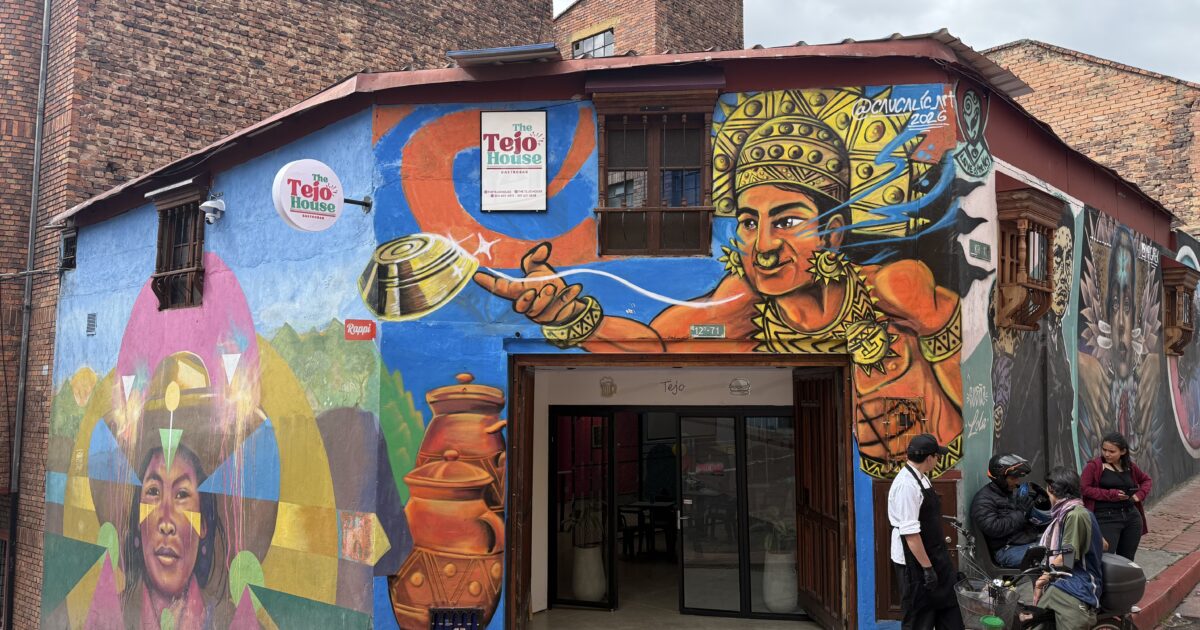
La Candelaria is Bogotá's oldest neighborhood, which means it is the part of the city where the Spanish colonial architecture survived long enough to become history, and history long enough to become something stranger. The streets narrow. The buildings are four and five stories of colonial-era construction in various states of painted deterioration — not ruins, but structures that have accumulated time visibly, each layer of paint and plaster and repair readable in the facade like sediment. It is a neighborhood that looks simultaneously very old and very much alive, and the combination produces a particular quality of attention in the person walking through it. You slow down, not because you decide to, but because the street itself makes speed feel inappropriate.
Then the murals begin.
They are not decorative. This distinction matters and is immediately apparent — there is a category of urban mural that exists to make a surface more pleasant, to fill in a blank wall with color, to signal that a neighborhood is the kind of place that values art. Candelaria's murals are not that. They are made with the seriousness of people who believe the wall is a surface that can hold meaning, and who have something specific to say.
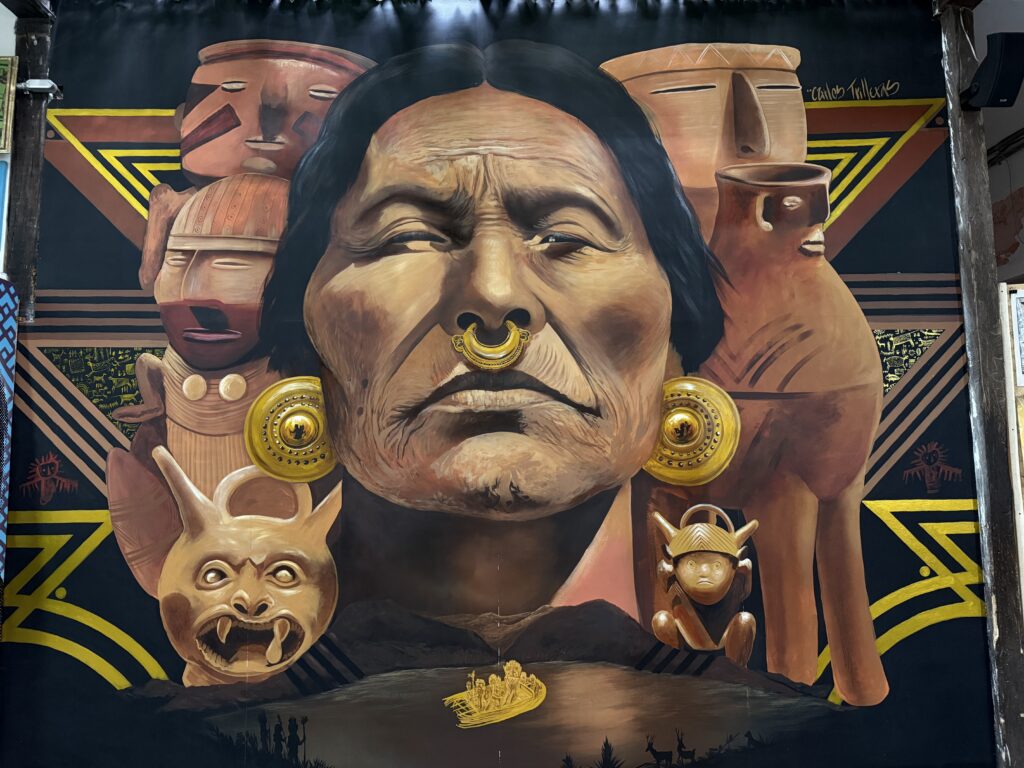
The subjects are indigenous. Not in the generalized, pan-indigenous, vaguely spiritual style of wellness-industry aesthetics — specifically indigenous, with the particularity of someone who knows the difference between a Kamsá face and a Shipibo textile and an Amazonian bird species and painted them accordingly. A face surrounded by birds: a toucan, a scarlet macaw, a condor, birds with coloring specific enough that a naturalist could name them, arranged around a child whose expression is composed and direct and entirely unconcerned with being observed. Another wall: a young woman in traditional beadwork, her mouth covered by a human hand rendered as a mask, flanked by white-fronted capuchin monkeys whose expressions range from wary to openly hostile. The artist's signature — Carlos Trilleras — appears in the lower corner of both, small and unassuming, as though the work doesn't need the signature to make its claim.
On another building, a woman laughs from the second floor — not a portrait, the entire facade of the building is the painting — her hair dissolving into water or sky, a jaguar taking shape in the lower half of the structure from geometric patterns that echo Amazonian textile design. The building next to it is a cigar shop. Across the street, a McDonald's. The mural doesn't acknowledge either of them. It doesn't need to.
The traveler walking through Candelaria for the first time has a specific experience that is difficult to describe without making it sound more significant than it feels in the moment, which is the wrong frame anyway — in the moment it feels exactly as significant as it is.
You are in a European colonial city. The walls are in the Amazon.
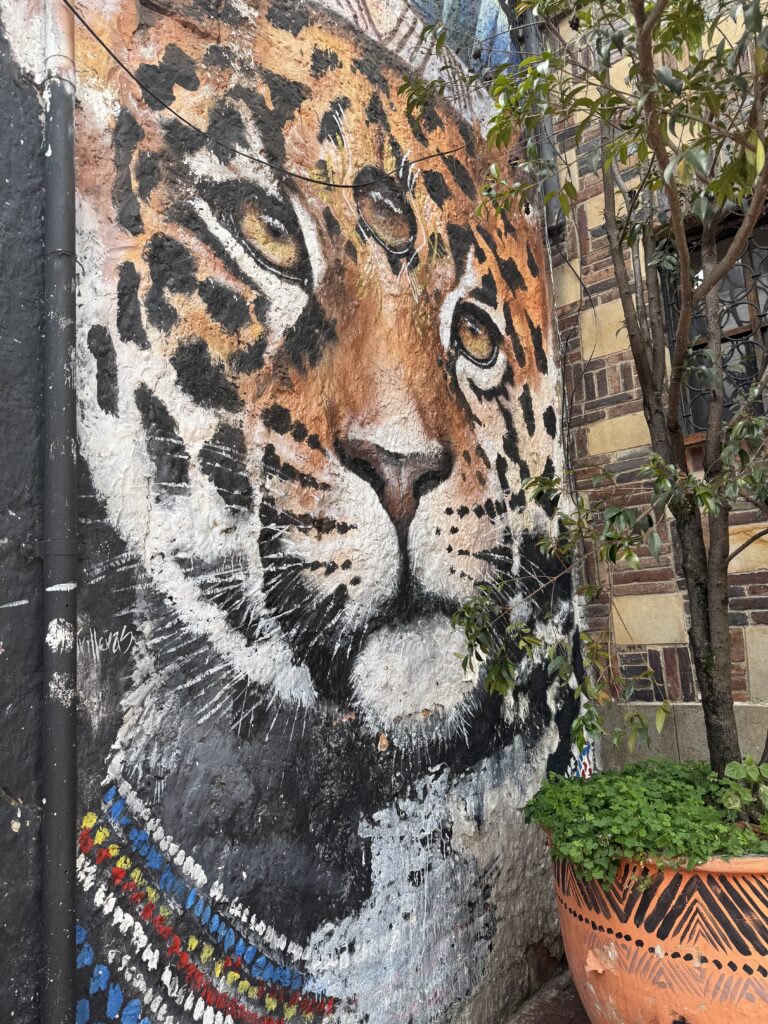
Not symbolically. Not as a metaphor for Colombia's cultural complexity, though that reading is available and not incorrect. Literally: the imagery on these walls belongs to a geography that is several hours' flight to the south, to traditions that predate the colonial architecture surrounding them by centuries, to a world that has almost nothing in common with the altitude and the traffic and the hot chocolate and empanadas you just had for dinner. And yet here it is, at eye level, on the street where you're standing with your overnight bag and your flight in the morning.
Something begins to move in the traveler who pays attention to this. Not a thought, exactly. More like a reorientation — the interior equivalent of the body adjusting to the altitude earlier that evening. Something shifts position without being told to.
The people who built this city came from one world and imposed it on another. The murals are evidence that the second world did not disappear under the imposition. It survived in the people, in the land, in the DNA of a culture that was never fully replaced, only covered — and now it resurfaces on the walls of the neighborhood where the covering is oldest and most visible. History isn't linear here. It's geological. It exists in layers, and in Candelaria the layers are thin enough that you can see through them.
There is a practical observation that experienced travelers on this route tend to make, and it is not usually framed in terms of preparation or meaning. It is framed in terms of adjustment. The ones who go directly from the international airport to the interior flight to Putumayo — skipping the overnight, optimizing the logistics — arrive at the ceremony site still carrying the speed of wherever they came from. They are physically present but not yet arrived. It takes them longer to settle. The body is there; the rest of the person is catching up.
The ones who spend a night in Bogotá, who walk Candelaria, who let the altitude work on them and let the walls ask their questions, arrive differently. Not better, necessarily — but different. Something has already begun to loosen. The city, despite itself, despite its noise and its traffic and its complete indifference to your interior state, has started a process.
This is not a mystical claim. It is an observation about what environments do to people who move through them slowly enough to be affected. Candelaria is not trying to prepare you for anything. It is not designed as a transition zone. It is a neighborhood with its own history and its own concerns and its own population who live there and work there and have no idea that you are about to fly south to sit in a maloca in the jungle. And yet it functions as preparation, for the traveler paying attention, because it places you — without asking — at the intersection of the world you came from and the world you are going toward.
The colonial architecture is your world. Glass and concrete and the airport you landed in and the city that looks recognizable enough to navigate. The murals are the other one. And for one night, in Candelaria, they occupy the same wall.
When the morning flight takes off and the city drops away and the Andes begin below the window, the traveler who walked through Candelaria the night before carries something that is hard to name but easy to feel. Not knowledge. Not preparation in any formal sense. More like: the journey has already started. Not here, not when the plane lifted. Back there, on the street, in front of a wall where a woman laughed from a building that should not still be standing, and a jaguar came out of patterns older than the building itself.
The jungle is still hours away. But something in you has already begun to listen.Arumi Nomad writes about ancient traditions, the body, and the spaces between