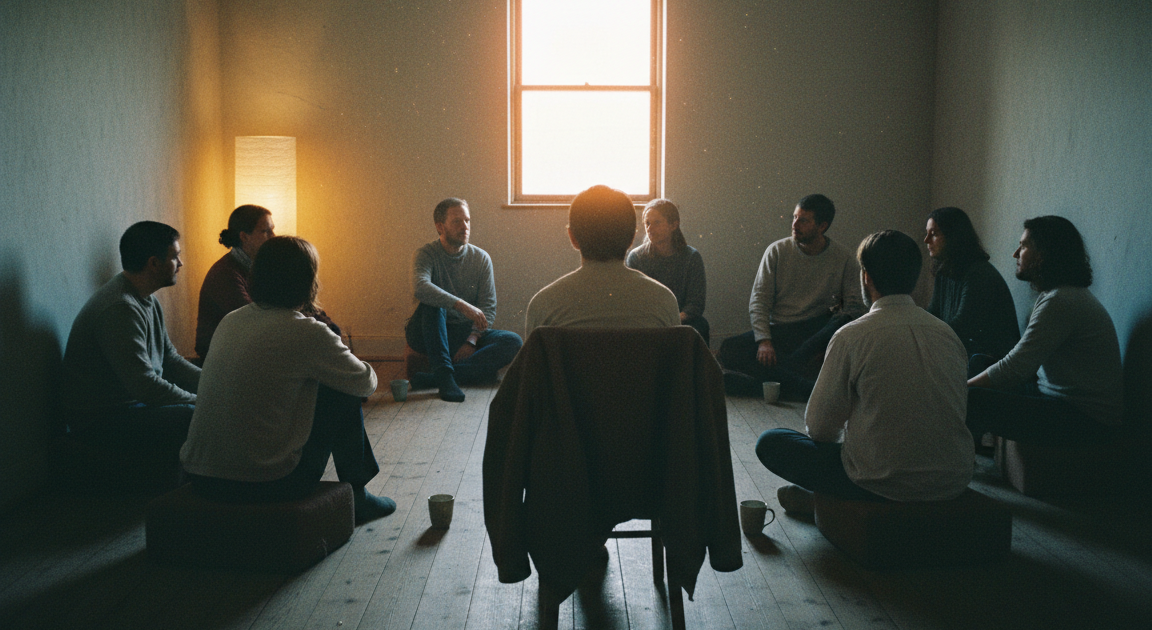
Every practice I was taught outside the West happened in a room with other people in it. Every one. The Putumayo, the hills above Pokhara, Havana, the high desert under Real de Catorce — four traditions with continents between them, and none of them ever handed me something to do by myself behind a shut door. A group meditation wasn’t the special occasion out there. It was Tuesday.
Then you come home and look at how meditation gets sold here. Headphones. An app. A timer. A door you close so nobody interrupts. The product assumes this is private work, and a group meditation becomes the optional social upgrade — a class you pay for, a retreat you book, the version that happens to have other people’s breathing in it.
We’ve got that backwards. Out there a group meditation is the default setting, and sitting alone is the odd variant that would have needed explaining.
The room was never empty
In the Putumayo the night runs on a voice. Someone is always singing, and everyone else is arranged around that voice in the dark — sitting, lying down, occasionally getting up and walking outside for air. You aren’t listening to a recording of a person singing. You’re in a room where somebody is working, and part of that work is aimed at you. If the singing stops, you notice it in your body before you notice it in your head, the way you’d notice a fire going out.
Nepal was the gentlest version of the same arrangement. An eco-village near Pokhara, rice terraces, the Annapurna sitting behind everything like a fact you kept re-noticing. The bowls came out daily, and they came out for everybody at once. Vibration doesn’t discriminate. It’s in your sternum and it’s in the sternum of the person to your left, and once you’ve felt that, you can’t unfeel it. Nobody handed anyone a set of headphones.
Cuba does the loudest version. Sixteen years there and I never once saw anyone go looking for silence. Drums, dancing, a room of people moving on the same pulse — the crowd is the practice. Take the crowd away and there is literally nothing left to do.
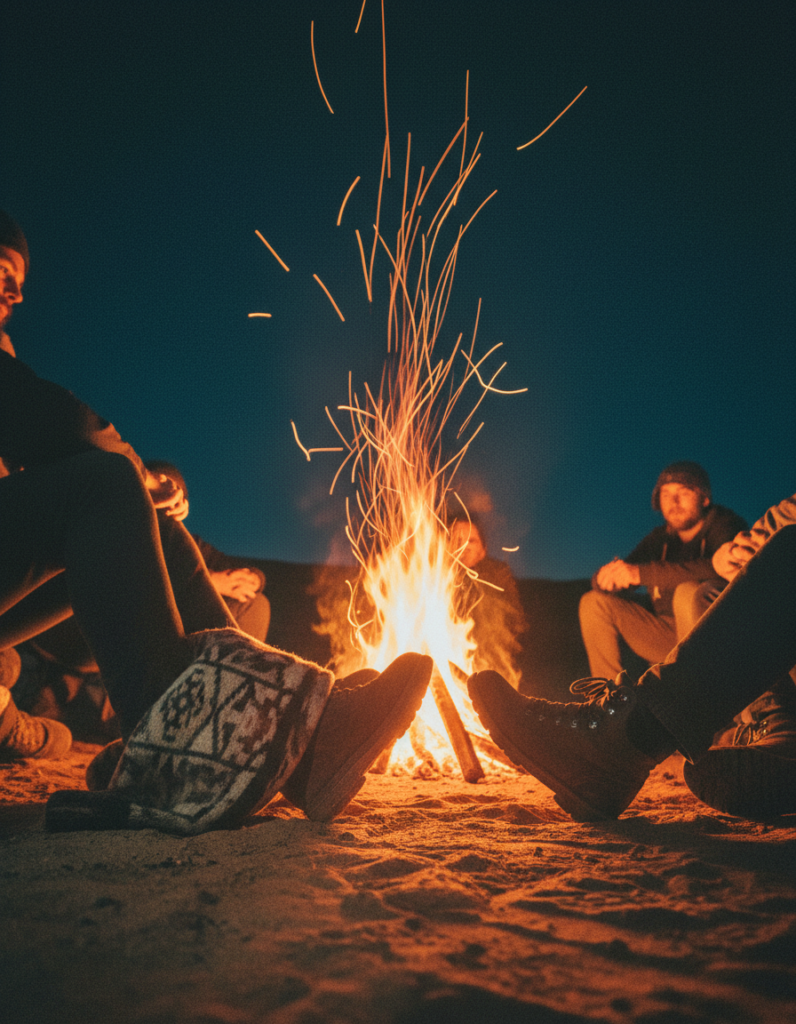
The Wixárika night runs on fire and a violin. Same shape again: a circle, one fire, one tune holding the hours together while the desert gets cold around it.
Different instruments, different cosmologies, different food. One structure underneath all four. I spent years filing that under atmosphere — the charming local packaging around the real technique. I think now the group meditation was the technique, and what I carried home was the wrapper.
What a group meditation does to a body that a solo one can’t
The measurements on what a group meditation does to a body are more interesting than the theory, so start with those.
Björn Vickhoff’s team in Gothenburg put heart monitors on choir singers and watched what happened. Their finding, in their own words: “Unison singing of regular song structures makes the hearts of the singers accelerate and decelerate simultaneously.” (Frontiers in Psychology, 2013, volume 4, article 334.) Nothing mystical in the mechanism. Song structure sets the breathing, breathing drives respiratory sinus arrhythmia, and hearts that breathe together vary together. In the mantra section, built on ten-second phrases, the singers’ heart rate variability lined up at 0.1 Hz. One song, one shared autonomic rhythm across a whole room of separate bodies.
Worth sitting with for a second: nobody in that study was meditating. They were singing. The synchrony came out of doing a structured thing at the same time as other people, which is also a fair description of a group meditation.
Why a group meditation works on a nervous system that won’t settle alone
There’s a second study I keep coming back to, because it puts a hard limit on the romantic version of the group meditation idea. In 2011 Ivana Konvalinka and colleagues fitted heart monitors to 38 people at a Spanish fire-walking ritual: twelve fire-walkers, nine spectators who were friends and family, seventeen visitors with no connection to anybody there. Across the thirty minutes of the ritual, the walkers’ arousal patterns matched their related spectators’. The visitors — same fire, same night, standing at the same distance — showed nothing. (PNAS 108(20):8514–8519.)
The authors read the mechanism as informational rather than physical, since the walkers and the watchers were doing completely different things with their bodies. That gives you the sharpest sentence available on this whole subject. Attendance isn’t the active ingredient. Relationship is.
Which should change what you go looking for in a group meditation. Twenty strangers in a rented studio with a bowl and a candle isn’t automatically the thing. Four people who know each other, sitting every Tuesday for a year, is. The traditions I sat in had that built in — you weren’t in the room because you’d booked, you were in the room because of who you knew and what you’d been through together.
The tradition the apps borrowed from already said this
Most Western mindfulness runs back through Burmese and Thai lineages to the Pali canon, so it’s worth reading what the source material actually says about company — and about whether a group meditation is optional. There’s a short exchange in the Upaddha Sutta (SN 45.2) where Ānanda offers what he clearly thinks is a generous assessment: “This is half of the holy life, lord: admirable friendship, admirable companionship, admirable camaraderie.”
He gets corrected on the spot. “Don’t say that, Ānanda. Don’t say that. Admirable friendship, admirable companionship, admirable camaraderie is actually the whole of the holy life.”
Not half. The whole. I’m quoting scripture rather than a trial and I’ll say so plainly — this tells you nothing about anyone’s cortisol. What it does tell you is that the source was unambiguous, and that somewhere between that sentence and a monthly subscription the company got dropped while the technique got kept.
What the numbers say about practising alone
Amit Baumel’s team ran the least flattering study anyone has run on the solo alternative to a group meditation. They pulled real usage data on 93 mental-health apps with ten thousand installs or more and looked at what people did rather than what they reported. Median daily open rate: 4.0%. Median 15-day retention: 3.9%. At thirty days: 3.3%. (JMIR 2019;21(9):e14567.)
Read that twice. Of a hundred people who install one of these apps, roughly four are still opening it a fortnight later.
Their caveats belong in here too. It’s Android panel data across mental-health apps generally, meditation is one slice of that, and installs are cheap so abandonment is cheap. One detail runs the other way and I like it: mindfulness apps had the longest sessions of any category in the sample, a median of about 21 minutes a day among the people still using them. The ones who stay, stay properly. Hardly anybody stays.
I don’t read that as a discipline problem. Nothing else we do for our bodies is organised this way. Almost nobody gets fit alone in a bedroom either — most people need a class, a club, or one friend who is outside at 6:40 whether anyone feels like it or not. We accept that about exercise without any moral commentary attached. With meditation we kept the solitary format, sold it by the month, and then explained the failure rate as your lack of willpower. A group meditation has a mechanism that a solo one cannot copy: somebody notices when you don’t turn up.
The part a group gives you that a technique can’t
Dario Páez and colleagues ran four studies on collective gatherings — folkloric marches and protest demonstrations, one set positive in tone, one negative — and published them in the Journal of Personality and Social Psychology (2015, 108(5):711–729). Taking part strengthened collective identity, identity fusion and social integration, along with self-esteem and positive affect. What carried the effect was perceived emotional synchrony: the felt sense that everyone present was feeling it at the same moment.
Two correlational studies, one semi-longitudinal, one experimental. Marches and demonstrations, not meditation halls, and I won’t stretch it past where it goes. What it does say is that the feeling of being in time with other people does measurable work on a person, and that a solo practice has no access to it whatsoever. Put that beside the choir and the fire-walkers and you have three separate research groups circling the same unglamorous conclusion: other bodies in the room are doing something a group meditation gets for free and a solo sit never gets at all.
How to build a group meditation with no temple nearby
Most people reading this have no sangha within driving distance, and the class in town costs money and runs at a time that doesn’t work. Fine. The traditions I sat in weren’t running institutions. They were running rooms. Five things make a room work, and none of them cost anything.
Two is a group. Konvalinka’s related spectators were nine people who knew each other, and the effect needed no stadium. A group meditation of two is a real one.
Fix the time before you fix anything else. Every tradition I’ve named runs on a calendar rather than on how anybody feels that evening. That’s the entire trick, and it’s the one an app can’t perform for you.
Somebody holds the shape. Not a guru — a person who starts it, says how long, and ends it. In the Putumayo that’s whoever is singing. In a living room it can be whoever’s turn it is this week.
Do the same thing every time. The synchrony in that choir came out of a regular structure, not out of anyone’s mood. Same posture, same length, same close, week after week, until nobody has to ask what happens next.
Let there be sound. Four traditions and not one of them used silence as the medium. A recording is allowed. So is one person humming badly. Silence is a Western default, and it’s the hardest possible surface to hold a group meditation on.
A group meditation for two people at a kitchen table
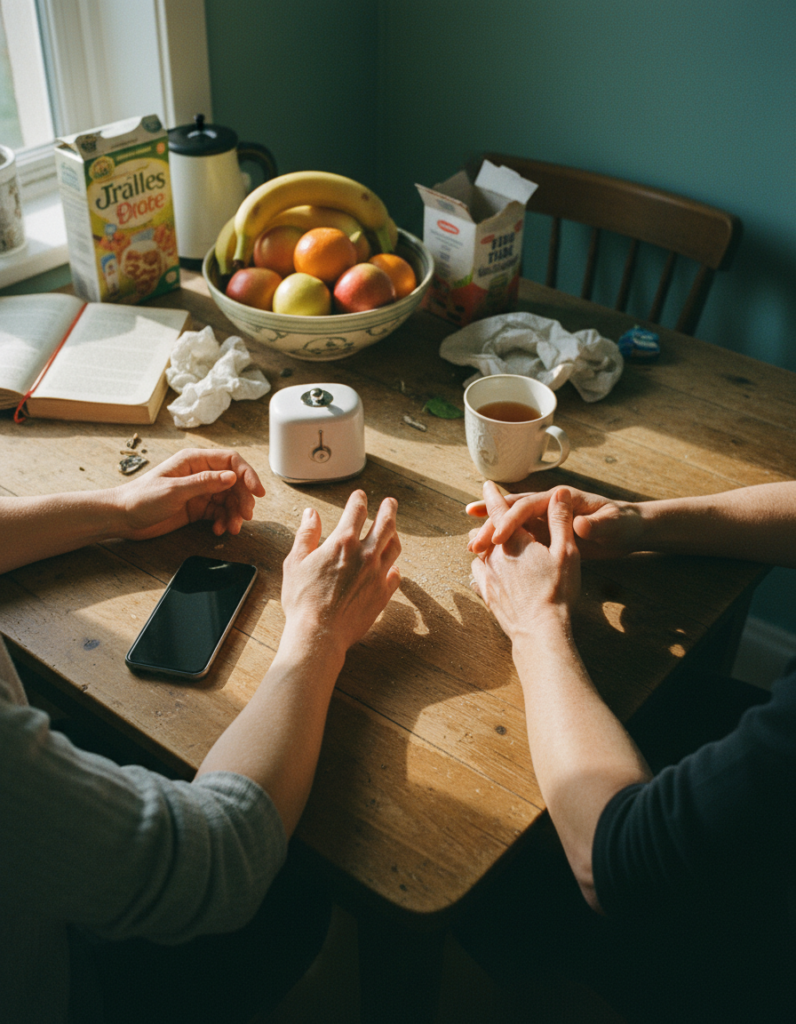
Twelve minutes, no equipment. Sit across from each other, feet on the floor, eyes closed or lowered. One of you says “start” and sets a timer.
First four minutes: breathe normally and count ten exhales, then begin again at one. When you notice you’ve lost count, begin again at one. Losing count is the practice, not the failure — that small return is the whole repetition, and you’ll get dozens of them.
Second four minutes, and this is the part that makes it a group meditation rather than a solo one: drop the counting and put your attention on sound. The fridge. Traffic outside. The other person breathing, which you will hear, and which is the entire reason you’re doing this across a table instead of in separate rooms.
Last four: nothing to do. Sit. Let the timer run out on its own.
Then say one sentence each about how that went. Not a debrief — one sentence. The saying-out-loud is what converts two people sitting near each other into a group meditation. Skip it and you’ve just had two solo sits in the same kitchen.
Do it three times a week for a month before you decide anything about it. Two weeks is precisely where the app users vanish, and a group meditation is the one format that gets you past a fortnight, because somebody else is sitting down at the same time.
What a group meditation can’t do for you
Groups go wrong, and it would be dishonest to write a piece like this without saying how. A room can generate real pressure to feel whatever everybody else appears to be feeling, and being the one person who felt nothing is a lonelier place than your own bedroom ever was. Any group organised around a single charismatic figure eventually has a problem; the spiritual world has produced enough case studies to make that a rule rather than a worry. Three questions before you join anything: can you leave, does anybody owe money, is disagreement allowed.
The fire-walking result cuts both ways too. If unrelated spectators standing at the same fire on the same night showed no synchrony at all, then one ticket to sit among strangers may buy you very little. What you’re after is the nine people who know each other, and that takes a year rather than a booking. The group meditation that works is slow to build and then hard to kill.
Here’s my opinion, and I’ll own it. The West didn’t lose the group by accident. A group can’t be sold to one person at a time. An app has to work for somebody alone in a flat at eleven at night, so the product got engineered around the hardest version of the practice, and then the failure rate got explained back to the customer as a character flaw. A group meditation has nothing to sell you, which is most of why nobody is selling it.
You’re not bad at this. You were handed the one format a monastery would have called unreasonable, and asked to keep it up alone.
So find two people. Pick a night. Sit for twelve minutes and say one sentence each afterwards. That’s a group meditation, and that’s the whole of it.
External resources:
• Vickhoff B, Malmgren H, Åström R, Nyberg G, Ekström S-R, Engwall M, Snygg J, Nilsson M, Jörnsten R (2013). “Music structure determines heart rate variability of singers.” Frontiers in Psychology 4:334 — doi.org/10.3389/fpsyg.2013.00334 · pmc.ncbi.nlm.nih.gov/articles/PMC3705176/ (quoted verbatim in the body: “Unison singing of regular song structures makes the hearts of the singers accelerate and decelerate simultaneously”; song structure guides respiration → respiratory sinus arrhythmia → synchronised heart acceleration; the mantra condition, on ten-second phrases, produced HRV coherence at 0.1 Hz).
• Konvalinka I, Xygalatas D, Bulbulia J, Schjødt U, Jegindø E-M, Wallot S, Van Orden G, Roepstorff A (2011). “Synchronized arousal between performers and related spectators in a fire-walking ritual.” PNAS 108(20):8514–8519 — doi.org/10.1073/pnas.1016955108 · PMID 21536887 · pmc.ncbi.nlm.nih.gov/articles/PMC3100954/ (38 participants: 12 fire-walkers, 9 related spectators, 17 unrelated visitors; heart-rate dynamics analysed by recurrence and cross-recurrence quantification across the 30-minute ritual; abstract quoted: synchronised arousal appeared “between active participants and related spectators, but not participants and other members of the audience”, and the authors read the mediating mechanism as “informational” since the two groups’ bodily behaviour differed completely).
• Baumel A, Muench F, Edan S, Kane JM (2019). “Objective User Engagement With Mental Health Apps: Systematic Search and Panel-Based Usage Analysis.” Journal of Medical Internet Research 21(9):e14567 — doi.org/10.2196/14567 · PMID 31573916 (93 Android apps with ≥10,000 installs; median daily active users / open rate 4.0% [IQR 4.7%]; median 15-day retention 3.9% [IQR 10.3%] and 30-day 3.3% [IQR 6.2%]; among users still active, mindfulness/meditation apps had the longest daily use of any category, median 21.47 minutes).
• Páez D, Rimé B, Basabe N, Wlodarczyk A, Zumeta L (2015). “Psychosocial effects of perceived emotional synchrony in collective gatherings.” Journal of Personality and Social Psychology 108(5):711–729 — doi.org/10.1037/pspi0000014 · PMID 25822033 (four studies — two correlational, one semi-longitudinal, one experimental — on positively valenced folkloric marches and negatively valenced protest demonstrations; participation strengthened collective identity, identity fusion and social integration alongside self-esteem, efficacy and positive affect, with perceived emotional synchrony mediating the effects).
• Upaddha Sutta: Half (of the Holy Life), SN 45.2, translated from the Pali by Thanissaro Bhikkhu — accesstoinsight.org/tipitaka/sn/sn45/sn45.002.than.html (both quoted lines confirmed verbatim against the translation: Ānanda’s “This is half of the holy life, lord: admirable friendship, admirable companionship, admirable camaraderie” and the reply “Don’t say that, Ānanda. Don’t say that. Admirable friendship, admirable companionship, admirable camaraderie is actually the whole of the holy life”)
Meditation for Cancer: A Practical Companion for Patients, Families, and Caregivers takes this same idea into the specific weeks of treatment.