
When was the last time you relaxed and gave yourself a 20 minutes rest listening to a meditation and just letting everything go?
When you crawl out of a temazcal, the first thing you do is go down. I wrote about that two weeks ago, in grounding meditation. This piece is about what comes next, when you stay down.
You lie on your back on the bare earth beside the lodge. Eyes closed, or open. Above you is whatever the night has that evening: stars, cloud, sometimes the moon. It's 36 °C outside with 80% humidity, and after the heat inside, that air feels cold on your skin. And then, for a while, there's no time in it and no space in it. You just are.
That's where the thoughts come. I call them teachings, or downloads: small aha moments that make sense of something I've been chewing on for months. They never come in the fourth round, in the dark, when the heat is at its worst. They come outside, lying there. Some people would call it samadhi. I don't need a word for it.
Back in a city, the nearest thing I know to that state has a name and a huge library of recordings: yoga nidra. You lie down, a voice walks your attention through your body, and the promise is a rest deeper than a nap while you stay awake. I wanted to know how much of that promise holds. And how much of what happens beside the lodge is the yoga nidra part, and how much is simply lying on the ground after you've survived something.
This is the second of four short pieces about the way home from the heat: ground, rest, rinse, eat. In September I wrote about retreat integration and used that order as its spine. Each of these goes one step further into a single part of it.
What yoga nidra is, and what it used to be
The name translates as “yogic sleep”. In a 2022 review of where yoga nidra comes from, Pandi-Perumal and colleagues describe it as a simplified form of an old tantric relaxation technique, done lying flat in shavasana, the pose yoga classes still call corpse pose. The systematised version most of us know was brought to the public in the 1960s through the writings of Swami Satyananda Saraswati. The aim, they write, is deep relaxation with some awareness of your surroundings still in place.
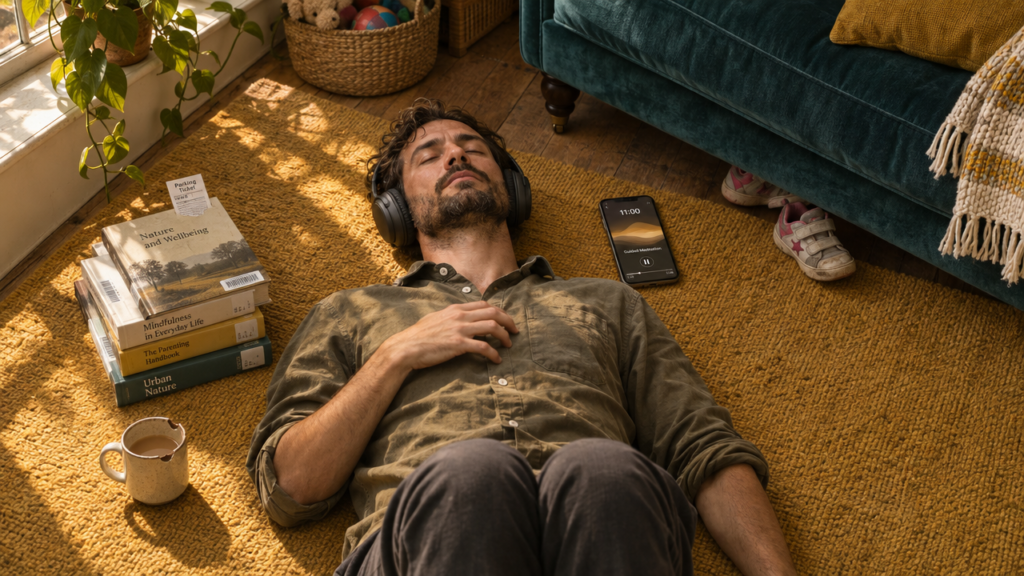
So the yoga nidra you download today is about sixty years old in its current shape. That doesn't make it fake. Most of what we practise has been rebuilt by somebody.
The same review lists what practitioners claim for it: a calm inner stillness that helps with stress, and a mind more open to personal resolutions, the short intention you repeat at the start and the end of many recordings. Notice the verb. Those are claims made by people who practise it, and the authors report them as claims. Whether a resolution planted in deep rest sticks better than one written on a sticky note is a question I couldn't find tested anywhere.
Beside the lodge nobody asks me for a resolution. The fire ceremony on the first night already did that work: each person puts a small piece of wood into the fire for what they brought and don't want to carry on. By the time I'm lying outside the temazcal, I'm not trying to plant anything. Which may be why things arrive.
There's a catch, though, and it matters for every study below. In 2013, Stephen Parker and two co-authors pointed out that many studies use the term yoga nidra for plain relaxation or guided imagery, and that those techniques don't match what the traditional accounts describe. When a paper says yoga nidra, it may mean a recorded relaxation script. Keep that in mind as you read on.
Is yoga nidra sleep, or something else?
Datta and colleagues set out to answer exactly that. They taught yoga nidra to 30 novices, let them practise on their own for two weeks, and then recorded them with 19 EEG channels before, during and after a session. By the standard scoring rules, the 26 whose sessions were scored stayed awake the whole time. Yet slow delta waves, the kind that belong to deep sleep, increased over the centre of the head, and fell over the prefrontal area. The authors call it local sleep: parts of the brain idling while the person is awake. Their sleep diaries improved over the two weeks, too.
I read that and thought of the ground beside the lodge. No time and no space, but not asleep either.
I can't tell you my brain did the same thing out there. Nobody wired me up. It's a small study of beginners in a lab, two weeks in. But it's the first description I've read that sounds like the thing.
What the yoga nidra studies found
For sleep, the most interesting trial comes from the same group. Between 2012 and 2016 they randomised 41 people with chronic insomnia either to cognitive behavioural therapy for insomnia, the standard first treatment, or to yoga nidra. Both groups slept longer and spent less time awake, by diary and in the sleep lab. The yoga nidra group showed a bigger rise in N2 and N3 sleep, N3 being the deepest stage, and their salivary cortisol fell (p = 0.041). The weak spots: it's small, and the repeat sleep-lab recording was done only on the patients who volunteered for it.
The largest trial I found ran online. In a 2025 randomised trial, Moszeik, Rohleder and Renner assigned 362 people to an 11-minute yoga nidra recording, a 30-minute one, ten minutes of music, or a waiting list, to be practised ideally every day for two months. The short yoga nidra beat the waiting list, but the effect sizes ran from 0.08 to 0.16. By any standard, that's small. People who practised regularly had lower total cortisol across the day. The authors don't oversell it. They argue that small effects from a cheap tool still count for health.
The longer recording did a little more. Against the short one, the 30-minute version raised what psychologists call acting with awareness, and it beat the short form when both were compared with music and the waiting list. It also came with a flatter cortisol response on waking, which is harder to read than it sounds: that morning rise is supposed to happen, and flatter isn't automatically better. I'm reporting it, not selling it.
I agree with the authors on the main point. Eleven minutes a day costs nothing. But small is the honest word.
Why do some yoga nidra studies look so strong?
In 2026, Ghai and colleagues pooled 73 studies with 5,201 participants on yoga nidra for stress, anxiety and depression. The headline effects were moderate to large: for anxiety, against an active comparison, Hedges' g was −1.35. Then the authors wrote the line I wish every wellness headline carried. Given the low methodological quality and how differently yoga nidra was delivered from study to study, these effects likely reflect inflated estimates.
So the pattern runs the way it often does in this field. The small, loose studies find big effects. The bigger, tighter trial finds a small one.
Now the part that argues the other way
Here's the study I keep coming back to, because it tests the exact question I had beside the lodge. In 2023, Sharpe and colleagues brought 22 adults with insomnia into a sleep lab. On the first visit, everyone was asked to lie quietly for ninety minutes. On the second, half were randomised to do yoga nidra for the first thirty of those minutes. So the comparison wasn't yoga nidra against nothing. It was yoga nidra against lying down quietly.
On brain waves, heart rate variability and how fast people fell asleep, there was no difference between the groups. One thing did change: breathing. The yoga nidra group slowed by 1.4 breaths a minute during the practice and by 2.1 afterwards, while the others sped up by 0.2 and 0.4.
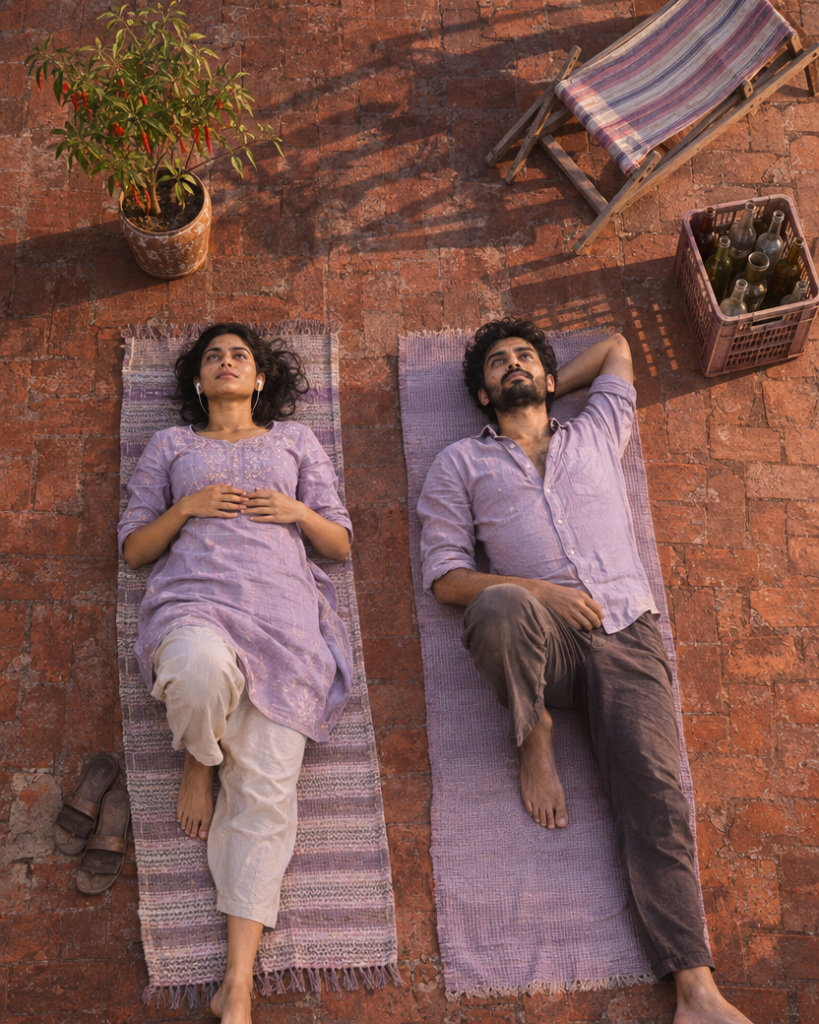
Twenty-two people, two visits, early work. It doesn't prove yoga nidra does nothing. It does say something I'd suspected for a while: a good part of what we credit to the recording may be the lying down. Permission to stop. A flat surface. Nobody needing you for half an hour. If you've read my piece on the lost art of doing nothing, you know I think that's already a lot.
It also fits what I see at retreats in the jungle. There are no windows there, only mosquito nets, and at night everything moves and everything makes noise. The frogs don't stop for anyone. Plenty of people can't bear it at first, and my advice is always the same: stay one night and see how it looks in the morning. Hungarians say sleep on it once more. Nothing in that advice is a technique. It's lying down in the dark and letting the place do its work. After reading Sharpe, I suspect that's a bigger part of rest than any recording.
What I can't settle
Beside the lodge, nothing is isolated. There's the heat before, the earth underneath, the open sky, the relief of having made it through, other people lying a few metres away. No voice, no recording. I looked for a study of yoga nidra, or of any guided rest, after a sauna or a sweat lodge, and didn't find one. So I won't tell you that lying on the earth after the heat does more than a mat on your living-room floor. I don't know that. Nobody does yet.
What the research supports is modest and useful. Yoga nidra is well tolerated, it may slow your breathing, and it may help sleep somewhat. The rest is lying down, which is free.
How to try yoga nidra at home
You don't need a lodge. You need a floor or a bed and about eleven minutes, the short dose from the online trial.
- Lie on your back. If your lower back complains, bend your knees or put a cushion under them. Shavasana doesn't have to be flat to work.
- Cover yourself. Lying still, you cool down faster than you expect, the way warm night air beside the lodge feels cold after the heat.
- Use a recorded voice at first. Most yoga nidra recordings move your attention around the body and then to the breath. If you already know a body scan, it will feel familiar.
- Keep your eyes open if closing them feels wrong. Beside the lodge, I do both.
- If you fall asleep at bedtime, you probably needed it. If you want the awake version, practise earlier in the day.
If sleep is the main problem, the version I'd copy is the one in Datta's insomnia trial: a few sessions guided by a teacher first, then your own practice. My notes on meditation for sleep cover the nights yoga nidra doesn't reach. And if you only have five minutes in the middle of the day, the cyclic sighing I wrote about in October is shorter still.
When yoga nidra isn't the answer
Lying still with your attention turned inward isn't neutral for everyone. If memories you don't want start coming up, or your body tightens instead of letting go, open your eyes, sit up and stop. That isn't failure. Trauma-informed teachers exist for exactly this, and it's worth finding one.
After heat, whether it's a sauna, a sweat lodge or a hot bath, if you feel faint, confused, or your heart won't settle, don't meditate through it. Lie down, drink water, get help. And if your insomnia has lasted months, see someone. In Datta's trial the comparison was cognitive behavioural therapy for insomnia, and it worked too.
Back on the earth beside the lodge
When I lie there, I'm not doing yoga nidra. Nobody's guiding me. I'm on my back on the earth, the air is cooling my skin, and for a stretch the clock stops mattering. Then something becomes clear that wasn't clear inside.
What the lab adds is a little humility on both sides. A yoga nidra recording may not do much more than lying down quietly. And lying down quietly does more than we give it credit for.
After a while you notice the earth stuck to your sweaty skin, and you get up to rinse it off with cold water. That's the next piece.
References
Datta, K., Tripathi, M., Verma, M., Masiwal, D., & Mallick, H. N. (2021). Yoga nidra practice shows improvement in sleep in patients with chronic insomnia: A randomized controlled trial. The National Medical Journal of India, 34(3), 143–150. https://doi.org/10.25259/nmji_63_19
Datta, K., Mallick, H. N., Tripathi, M., Ahuja, N., & Deepak, K. K. (2022). Electrophysiological evidence of local sleep during yoga nidra practice. Frontiers in Neurology, 13, 910794. https://doi.org/10.3389/fneur.2022.910794
Ghai, S., Odyniec, P., & Ghai, I. (2026). Effects of yoga nidra on stress, anxiety, and depression: A systematic review and meta-analysis. Annals of the New York Academy of Sciences, 1556(1), e70149. https://doi.org/10.1111/nyas.70149
Moszeik, E. N., Rohleder, N., & Renner, K. H. (2025). The effects of an online yoga nidra meditation on subjective well-being and diurnal salivary cortisol: A randomised controlled trial. Stress and Health, 41(3), e70049. https://doi.org/10.1002/smi.70049
Pandi-Perumal, S. R., Spence, D. W., Srivastava, N., Kanchibhotla, D., Kumar, K., Sharma, G. S., Gupta, R., & Batmanabane, G. (2022). The origin and clinical relevance of yoga nidra. Sleep and Vigilance, 6(1), 61–84. https://doi.org/10.1007/s41782-022-00202-7
Parker, S., Bharati, S. V., & Fernandez, M. (2013). Defining yoga-nidra: Traditional accounts, physiological research, and future directions. International Journal of Yoga Therapy, 23(1), 11–16. https://doi.org/10.17761/ijyt.23.1.t636651v22018148
Sharpe, E., Butler, M. P., Clark-Stone, J., Soltanzadeh, R., Jindal, R., Hanes, D., & Bradley, R. (2023). A closer look at yoga nidra: Early randomized sleep lab investigations. Journal of Psychosomatic Research, 166, 111169. https://doi.org/10.1016/j.jpsychores.2023.111169