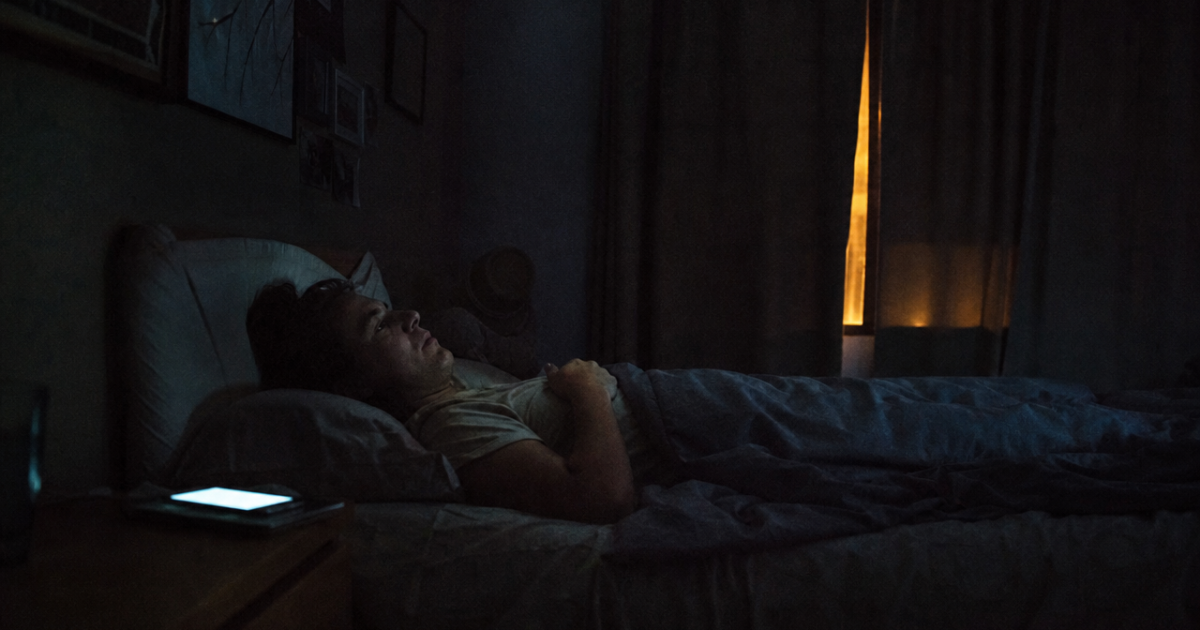
It’s 3:40 in the morning. Something woke you — a noise, a dream, nothing you can name — and now you’re lying very still with your eyes closed, doing everything right. Slow breathing. Not looking at the clock, mostly. Somewhere around the fourth calculation of how many hours you’d still get if you dropped off in the next ten minutes, you reach for your phone and start a meditation for sleep, because that’s what it’s there for. Forty minutes later the voice has finished, the ocean is still lapping through the speaker, and you are the most awake person in the house.
Then comes the part that stings, the quiet filing of this into the drawer marked works for everyone but me. The recording probably did exactly what it does. The trouble was the job you handed it. You weren’t running a practice at 3:40 in the morning — you were taking a sedative with a deadline attached and a stopwatch running behind your eyes the whole time. Nobody mentions that when they hand you a meditation for sleep and tell you it’ll knock you out by track three.

Sleep is automatic, and that’s the whole problem
Falling asleep belongs to a small family of things your body does well as long as you leave it alone. Swallowing on command. Blushing on purpose. Retrieving a name while somebody stands there watching you retrieve it. Sleep is the head of that family, the most automatic of all of them, and the most easily spooked by supervision. Every meditation for sleep that has ever failed you failed on this rock.
Colin Espie and his colleagues mapped exactly how this goes wrong in a 2006 review in Sleep Medicine Reviews. They called it the attention–intention–effort pathway, and their sentence is worth reading slowly: sleep normalcy is “a relatively automatic process” and is therefore “vulnerable, and may be inhibited, by focused attention and by direct attempts to control its expression.” Three steps, each of them completely reasonable on its own. First you start paying attention to your sleep. Then you form an intention to sleep. Then you put in effort. Reasonable, reasonable, reasonable — and between them they take a process that ran fine unsupervised for thirty years and install a manager on top of it.
Which is where a meditation for sleep quietly turns against you. You press play with a purpose, and now there’s a part of you standing at the back of the room with a clipboard. Am I drifting yet? Was that a drowsy feeling? Is this working? That monitoring is attention. The reason you pressed play is intention. The slow, careful, determined breathing is effort. You’ve assembled all three ingredients of Espie’s pathway and pointed them at the one process that can’t tolerate any of them. The recording never had a chance.
What a meditation for sleep is actually good for
Here’s the reframe that changes how the whole thing feels. A meditation for sleep is not a switch that turns you off. It’s a way of lowering the volume on a nervous system that came to bed still braced from the day — the meeting that went sideways, the message you never answered, the low-grade alertness you stopped noticing around the age of thirty. Bring the arousal down and sleep often arrives on its own, the way it used to. But it arrives as a side effect. It will not come when it’s summoned, and every instruction in a meditation for sleep has to respect that or the whole thing collapses back into effort.
So the strange, true instruction is this: a meditation for sleep works best on the nights you genuinely stop caring whether you sleep. Lie there and do the practice because you’re doing the practice. If sleep shows up, fine. If you’re still awake at the end of it, you spent that time resting instead of calculating, and resting is not nothing — the body repairs on far less than we’ve been told it needs. Your body isn’t broken. It’s on guard. The practice is how you tell it the night is safe, and there’s no version of that message you can deliver while standing over yourself with a stopwatch.
What the research actually shows
None of this is folk wisdom, and a meditation for sleep holds up better under measurement than most people expect. In 2015, David Black and colleagues at UCLA published a randomized trial in JAMA Internal Medicine: 49 older adults with moderate sleep trouble, split between a six-week mindfulness program and a six-week course in sleep hygiene education — the sensible advice about caffeine and screens and a cool dark room. On the Pittsburgh Sleep Quality Index, the meditation group went from 10.2 to 7.4. The sleep-education group went from 10.2 to 9.1. The gap between them came out at 1.8 points, effect size 0.89, p = 0.002, and the meditation group also improved on insomnia symptoms, depression and daytime fatigue. Learning to meditate outperformed being told how to sleep.
Keep the size of that study in view: 49 people, two thirds of them women, all of them older adults, and the authors say plainly that funding ruled out actigraphy, so the sleep was self-reported rather than measured by a device. A good signal for meditation for sleep. Not a verdict.
The bigger picture arrived in 2019, when Heather Rusch and colleagues pooled 18 randomized trials covering 1,654 people with real sleep disturbance for the Annals of the New York Academy of Sciences. Two numbers came out, and they point in different directions. Against attention-matched controls — an equally pleasant activity, equally sociable, equally full of somebody paying attention to you — mindfulness meditation improved sleep quality with an effect size of 0.33, and at follow-up between five and twelve months later the benefit hadn’t faded, it had grown to 0.54. So a meditation for sleep keeps paying out long after the course ends. That’s the encouraging half.
The other number is the one I’d rather you carried out of this article. Against established treatments, most importantly cognitive behavioural therapy for insomnia, the effect of meditation was 0.03, with a confidence interval sitting squarely across zero. Nothing. A meditation for sleep beats doing something equally nice with your evening. It does not beat the actual treatment for insomnia, and anyone selling you an app on the promise that it does is hoping you never read the second number.
If your sleep is genuinely broken, start somewhere else
I’d rather lose you to a specialist than keep you with a practice aimed at the wrong problem, so let me be blunt about the limits here. If you’ve been sleeping badly for months, if you dread the bedroom, if the sleeplessness has its own gravity now — the first-line treatment is cognitive behavioural therapy for insomnia. It is more effective than sleeping pills over the long run, and by the Rusch numbers a meditation for sleep is not going to match it. Ask your doctor, or find a CBT-I program. That’s the honest recommendation and it costs me nothing to make it.
The same goes for the physical causes. Loud snoring, gasping, a partner who’s noticed you stop breathing, waking with headaches, falling asleep sitting up in the afternoon — that pattern needs a sleep study, not a practice. No meditation for sleep can hold open an airway that keeps closing. Restless legs, thyroid trouble, pain, the side effects of a new prescription: all of these are doors that a body-scan will not open. Use this piece for the ordinary wired sleeplessness of a modern life. For anything with a medical shape to it, get the medical answer first, and bring the practice along afterwards.
A meditation for sleep you can do at 3 a.m.
Here’s the meditation for sleep itself, and the first instruction is the one that makes the rest of it work: you are not doing this in order to fall asleep. Say that to yourself before you begin. Lie however you’re comfortable, on your back or your side, and let the exhale get a little longer than the inhale — no counting system, no technique to get right, just the out-breath running slightly long. Then start at your feet. Bring your attention to your feet, notice whatever’s there, let them be heavy. Then the calves. The knees. The thighs, the hips, the belly, the ribs, up through the shoulders, down both arms, into the jaw and the small muscles around the eyes, which have almost certainly been working all night without your permission.
Move slowly enough that it’s mildly boring. When you reach the top of your head, go back to your feet and start again. And when you catch yourself checking — is this working, am I nearly under, how long has this taken — that noticing is the practice, not a failure of it. Return to whichever part of the body you’d reached, without any commentary about it, and carry on. Notice what’s missing from this meditation for sleep: there’s no end of the tape, nothing to finish, no voice telling you that you’re doing well. That’s the point. A meditation for sleep with a beginning and an end is a task, and tasks have outcomes, and the outcome is the thing that’s keeping you awake.
One more rule, borrowed openly from CBT-I because it’s better than anything meditation has to offer on this particular point: if you’ve been lying there roughly twenty minutes and you can feel yourself winding tighter rather than settling, get up. Leave the bedroom. Low light, a dull book, no phone. Go back to bed when your eyes start to close on their own. Lying in bed fighting is how a bed gets trained into a place where you fight. Take the meditation for sleep with you to the armchair if you like — the practice travels, the pressure doesn’t have to.
The practice that changes your nights happens during the day
Look again at what Black’s participants actually did, because this is the detail that gets dropped every time the study gets summarized, and it quietly rewrites what a meditation for sleep even is. They weren’t meditating at 3 a.m. They came to a two-hour class once a week for six weeks and practised at home during the day, starting at five minutes and working up to twenty. Their nights improved as a consequence of what they did while the sun was up.

That’s the shift I’d make if you only take one thing from this. Treat meditation for sleep as a daytime practice with a night-time dividend. Ten minutes somewhere in the middle of your day, at roughly the same time, sitting or walking, nothing elaborate. You’re lowering the baseline arousal that follows you into bed, and you’re also getting fluent in the practice while the stakes are zero, so that at 3:40 in the morning your attention already knows how to walk down through the body without needing a stranger’s voice to lead it. The bed is a terrible classroom. Everything you’ll need there is learned somewhere else.
The night you stop chasing it
There’s a particular kind of relief in being told you can stop trying. Most people who lie awake are not lazy sleepers — they’re the most effortful sleepers in the room, running protocols, tracking scores, doing everything the articles said. The effort is the symptom, and a meditation for sleep is only useful to the degree that it takes the effort away rather than giving it somewhere new to go. Espie’s pathway describes exactly that, and every honest teacher I’ve ever sat with has said some version of the same thing in plainer language: you cannot make yourself sleep, and the attempt is what’s keeping the lights on.
So tonight, do the practice and drop the target. Feet, calves, knees, hips, up through the body and back to the feet again. If you fall asleep somewhere in the middle, you’ll never know which part you reached, and that’s the best possible outcome of a meditation for sleep. If you don’t, you’ll have spent the small hours resting rather than doing arithmetic about tomorrow. Either way you’ve stopped supervising something that has always worked better unsupervised. You’re not bad at sleeping. You’ve just been trying very hard at something that only comes to people who stop.
References:
• Espie CA, Broomfield NM, MacMahon KMA, Macphee LM, Taylor LM (2006). “The attention-intention-effort pathway in the development of psychophysiologic insomnia: a theoretical review.” Sleep Medicine Reviews 10(4):215–245 — doi.org/10.1016/j.smrv.2006.03.002 (PMID 16809056). Quoted verbatim in the blog: sleep normalcy is “a relatively automatic process” and is therefore “vulnerable, and may be inhibited, by focused attention and by direct attempts to control its expression.”
• Black DS, O’Reilly GA, Olmstead R, Breen EC, Irwin MR (2015). “Mindfulness Meditation and Improvement in Sleep Quality and Daytime Impairment Among Older Adults With Sleep Disturbances: A Randomized Clinical Trial.” JAMA Internal Medicine 175(4):494–501 — doi.org/10.1001/jamainternmed.2014.8081 (PMC4407465). 49 older adults (mean age 66.3, 67% female) randomized to a 6-week Mindful Awareness Practices program (n=24) or 6-week Sleep Hygiene Education (n=25); PSQI 10.2→7.4 vs 10.2→9.1; between-group difference 1.8 points (95% CI 0.6–2.9), effect size 0.89, P=0.002; secondary gains on insomnia symptoms, depression and fatigue (all P<0.05).
• Rusch HL, Rosario M, Levison LM, Olivera A, Livingston WS, Wu T, Gill JM (2019). “The effect of mindfulness meditation on sleep quality: a systematic review and meta-analysis of randomized controlled trials.” Annals of the New York Academy of Sciences 1445(1):5–16 — doi.org/10.1111/nyas.13996 (PMC6557693). 18 RCTs, 1,654 participants with clinically significant sleep disturbance. Versus NONSPECIFIC (attention-matched) controls: effect size 0.33 (95% CI 0.17–0.48) post-intervention, rising to 0.54 (0.24–0.84) at 5–12 month follow-up. Versus SPECIFIC active controls (evidence-based treatments incl. CBT-I): 0.03 (95% CI −0.43–0.49) — no effect.
The book adapts this exact practice for chemo days, waiting rooms, and the caregivers doing this every day: Meditation for Cancer.