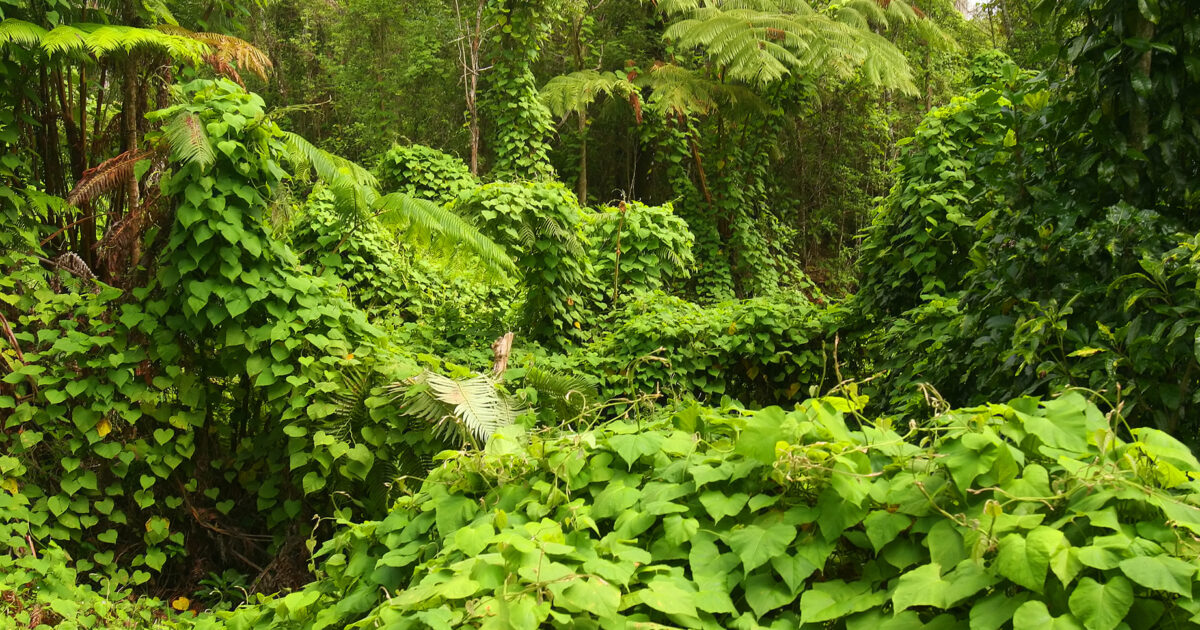
The road gives up before you do. Somewhere past the last town the pavement breaks into gravel, the gravel into mud, and the mud into a track a truck takes at walking speed. By the time it lets you out, the light is already going. You step down stiff and damp into the smell of wet earth and woodsmoke, and a wooden house stands at the edge of the trees with a lamp burning in one window. This is where the Colombian Amazon begins for most people who come overland — not at a gate, not at a sign, but at the moment the engine stops and you hear, for the first time, what the forest is actually doing.
What it is doing is making noise. A great deal of it. You expected green and got sound instead, a wall of it that seems to come from every direction at once, and your first honest thought is that there has been some mistake. You came two days down out of the mountains for silence, and this corner of the Colombian Amazon is roaring.
Inside the house the people who live here move slowly through the heat. Someone sets a pot on the fire. The woodsmoke and the river-damp work into your clothes within the hour and stay there for days. You sit on the step while the last light drains out of the sky and the trees go from green to blue to a black that has weight to it, and you wait to be told what happens now. What happens now is that you listen, because in the Colombian Amazon listening is most of what there is to do after dark.
The wall that comes up at dusk
The sound is not constant through the day. It builds. In the flat hours of the afternoon the forest is almost lazy, a few birds, the drone of something you can’t name. Then the light starts to fail, and the volume climbs with the dark, layer onto layer, until by full night it is a solid thing pressing on the windows of the little wooden house. Cicadas lay down a metallic floor that never stops. Frogs come in over the top, dozens of kinds, some clicking, some ringing like wet glass. Things move in the leaves. Somewhere a single bird throws out a call so loud and so sudden it sounds mechanical, like a gate swinging on a rusted hinge.
The first night in the Colombian Amazon, you do not sleep so much as wait. You lie under the net and listen to the wall and try to find an edge to it, a seam where it might let up, and there isn’t one. City ears, even tired ones, keep hunting for the off switch. The forest has none. It simply continues, indifferent to whether anyone is resting, and you begin to understand that the quiet you came looking for is not on offer here and never was.
By the second night you stop working the problem. City ears run along the wall feeling for a door — a gap, a lull, the place where it might thin out and let you rest — and there is no door. The Colombian Amazon does not pause for anyone’s sleep. So you give up looking for the lull and start, without quite deciding to, living alongside the sound, the way you stop hearing a refrigerator until the moment it switches off.
Nothing in the Colombian Amazon is silent
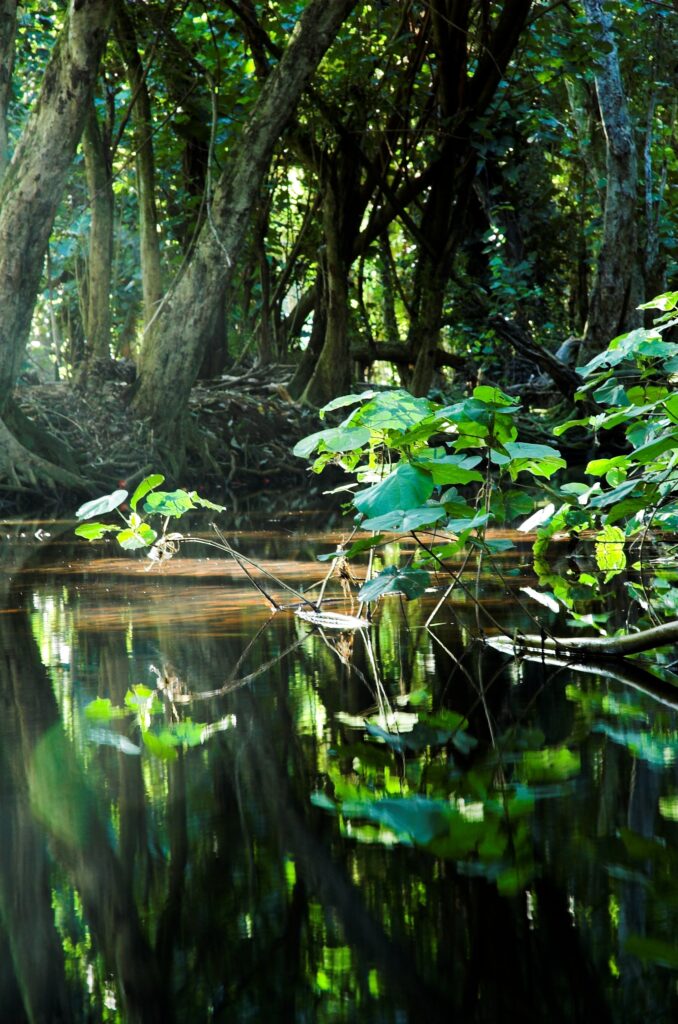
It helps, later, to learn that the noise is not chaos. Scientists who study the forest by ear have been recording places like this for years, leaving microphones running for days at a time, and what they find is that the rainforest never sleeps. Animals call around the clock. The sound rises and falls on a daily tide — loud near midday, dropping through the afternoon, climbing again as evening comes — but it does not stop, because at every hour something out there is awake and has a reason to be heard.
One stretch of recordings in the Amazon turned up around 230 species of bird in the audio alone, before anyone counted the frogs, the insects, the monkeys. The whole soundscape carries information, which is why researchers now use it the way a doctor uses a stethoscope: a healthy patch of the Colombian Amazon sounds dense and layered, and a damaged one thins out and goes quiet in a way that is its own kind of alarm. Silence, here, is the bad sign. Noise means the place is alive.
That inverts everything a city trains into you about quiet. Where you come from, silence is peace and noise is the problem to be fixed. In the Colombian Amazon it runs the other way. The roar is the sound of a place still fully itself, every niche occupied, every hour spoken for. The day this forest goes quiet is the day to be afraid for it.
The bird you hear before you see the Colombian Amazon
That mechanical call, the one like a hinge, has a name. It is the screaming piha, a plain grey bird you will almost never lay eyes on, and its three-note song — people in some places call it the cricrió, for the sound it makes — is one of the loudest in the world. It carries through something like four hundred meters of dense forest, which is to say it reaches you long before the bird is anywhere near. Measured close, it sits near the threshold where loudness turns into discomfort. There is a bird here louder still, the white bellbird, that reaches the volume of a chainsaw. You spend your first days assuming these sounds belong to something enormous. They belong to birds you could hold in one hand.
The piha is not alone. After dark the Colombian Amazon fills with a whole cast you come to know by ear and almost never by sight — the bone-dry rattle of insects, frogs that ring like struck metal, the sudden crash of something heavier shifting through the canopy, and far off, every so often, a low call you feel in your chest before you can name it. You stop asking what each one is. You start noticing where each one sits.
The difference between hearing and listening
Something changes around the third night. It is hard to date exactly, because it happens to you rather than around you. The forest is no louder and no softer than before. But your ear has stopped treating the whole thing as one mass of noise and started picking it apart. The cicada floor, which had been a single grinding tone, separates into near and far. The frogs sort themselves into kinds. You begin to notice when a sound stops — and the stopping, you realize, is as full of meaning as the sound was.
This is the quiet trick the Colombian Amazon plays on a visitor, and it is worth slowing down on, because it is the whole point of being here. You arrive thinking silence is the absence of sound. The forest teaches you that the silence you were chasing is really a quality of attention. There was never going to be a moment when the noise switched off. There was only ever the moment your listening got fine enough to move through it, the way your eyes adjust in a dark room until shapes come back. Nothing in the room changed. You did.
The shift is not effort. You cannot force it by concentrating harder; concentration only builds another wall. It arrives on its own, usually once you have stopped reaching for it, and after the Colombian Amazon has come apart into layers for you it never fully closes back into a single mass again. You have learned the place the way you learn a piece of music — not all at once, but until one day you can pick out the second violin under everything else. After that, the wall is not a wall. It is an orchestra you had been sitting inside of, badly, with your hands over your ears.
The first human sound
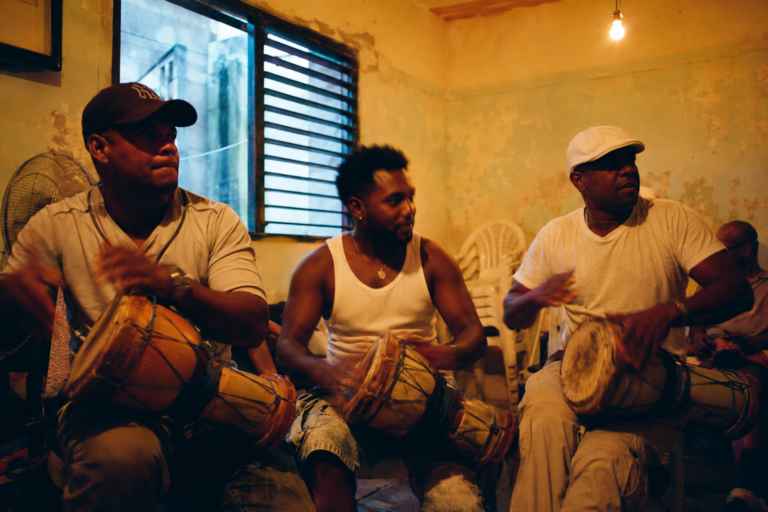
Late on one of those nights, somebody picks up an instrument. Not a performance — a man on the next bench, half in shadow, lifting a small wooden flute to his mouth, or a harmonica cupped in two hands. He plays a few notes, low, almost under the noise, the kind of thing a person does without deciding to, the way you’d hum on a long walk. And the strangest thing happens to the sound of the whole forest.
It reorganizes. The moment a human breath shapes a few deliberate notes, the wall behind it stops being a wall and becomes a background — something the flute is set against, a field the melody moves across. Your ear, which had been drowning, grabs the human line like a handrail, and suddenly the forest behind it has depth, foreground and distance, the cicadas way back and the frogs in the middle and this small warm sound right up close. One person breathing through a reed changed nothing in the Colombian Amazon and everything in the listening. The notes did not cover the noise. They gave the ear a place to stand inside it.
That is when you understand why people who live close to a place like the Colombian Amazon have always made music out of air — flutes, reed pipes, the breath pushed through a narrow channel until it sings. It is the oldest way of answering the forest in the forest’s own register. The instrument made of breath does not compete with the wall of sound. It threads through it, finds the gaps the human ear could not find on its own, and hands them to you. After that you cannot stop hearing them.
The melody was simple, four or five notes, nothing you could write down and call a song. But it did the work. For as long as he played, the Colombian Amazon arranged itself into foreground and distance around that thin warm line, and when he stopped, the arrangement held for a while before the wall slowly closed over it again. I have thought about those few notes more than almost anything else I carried home.
What you carry back out
You leave the way you came, up the same broken road, and the mountains close the forest off behind you like a door. But the Colombian Amazon does not stay where you left it. For weeks afterward you notice that your own city, the one you swore was too loud to think in, has gone strangely legible. The traffic separates into parts. The hum of a room resolves into the fridge, the street, a neighbor’s television, your own breathing. You are doing to the city what the Colombian Amazon taught you to do to the night — moving through the noise instead of fighting it, finding the one seam where your listening can stand.
That is the thing nobody tells you about going to the loudest place you have ever been. You go looking for silence and you come back with something better and harder to lose: the ability to find the quiet inside the noise, anywhere, by changing nothing but the way you pay attention. The Colombian Amazon never once went quiet for me. It taught me I had been listening for the wrong thing my whole life.
• Amazon natural region (Colombia) — en.wikipedia.org/wiki/Amazon_natural_region (Putumayo is one of six Colombian Amazon departments; the region covers ~483,000 km², 35% of Colombia, mostly tropical rainforest).
• “To save the Amazon, scientists are listening to its rich sounds,” Mongabay (2022) — news.mongabay.com/2022/10/to-save-the-amazon-scientists-are-listening-to-its-rich-sounds/ (the rainforest never sleeps; ~230 bird species identified by audio; screaming piha ~116 dB, white bellbird 125 dB; soundscape density signals ecosystem health).
• Screaming piha — en.wikipedia.org/wiki/Screaming_piha (iconic Amazon call, among the loudest birds, audible through ~400 m of forest; the three-note song
Listen to my audiobook: https://audiobook.aruminomad.com/
If this kind of practice speaks to you, Meditation for Cancer takes the same approach and builds it around a cancer diagnosis instead.