
Somewhere in the first hour of that night, a man sat down near the fire, tucked a violin under his chin that was too small to be a real violin, and started to play. That was my introduction to Huichol music, and it landed nothing like the drums in Cuba or the bronze bowls in Nepal. It didn’t fill the space. It drew a thin bright line straight through the middle of it, and for the next several hours I held onto that line like a handrail.
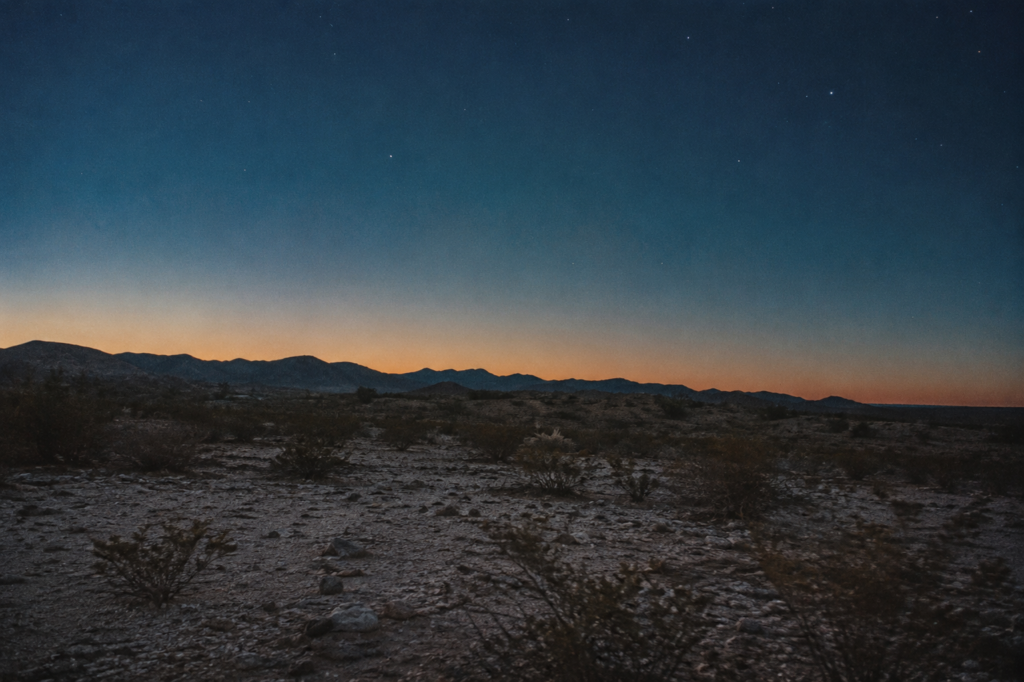
The high desert above Real de Catorce gets cold in a way the afternoon gives you no warning about. Creosote and dust, a sky with far too many stars in it, and a silence that isn’t restful at all, because there’s nothing in it for your attention to hold onto. This is the country the Wixárika walk to. Most of the world writes their name as Huichol, and that’s the word I’ll keep using here alongside the right one, for the same reason search engines do: one of those names is correct and the other is the one people know. Look up Huichol music and you’ll find something. Look up Wixárika music and you’ll find half as much, which tells you who’s been doing the naming.
I’d come to the desert after a long stretch of listening in other places. The Colombian Amazon taught me about breath pushed through reeds until the air itself sings. Nepal taught me that the oldest sound arrives in the chest a half-second before it reaches the ears. Cuba taught me that a drum can drown out a thinking mind, and that drowning it out works just as well as quieting it. I assumed the desert would be a variation on one of those three. It wasn’t. Huichol music turned out to be a different animal from all of them, because strings do a different job, and it took me most of a night to work out what the job is.
What Huichol music actually is
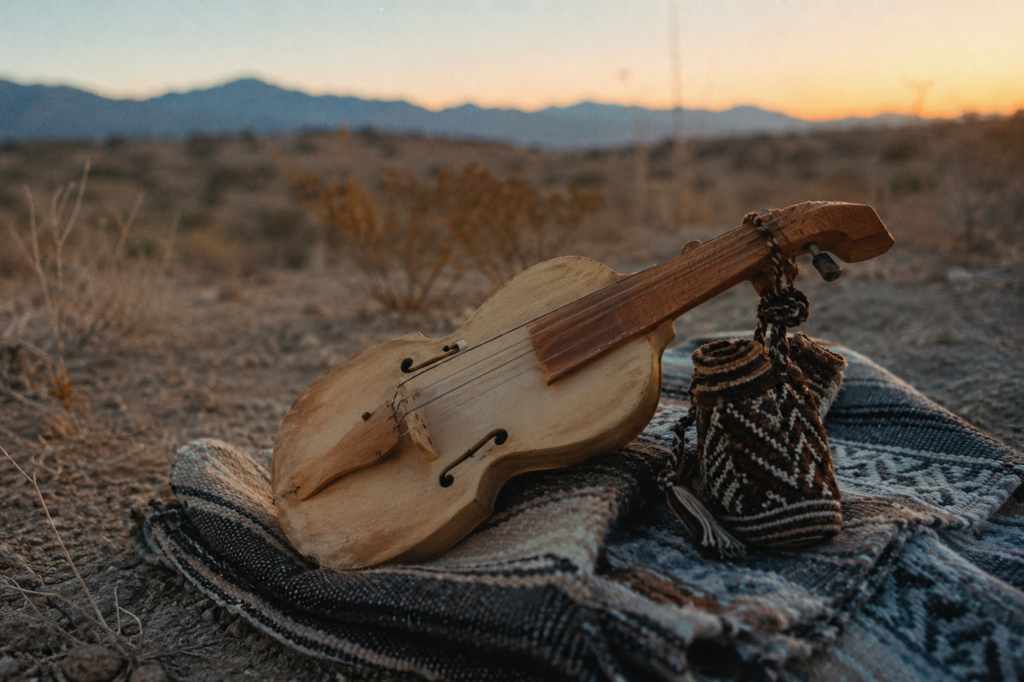
Two instruments carry Huichol music. The xaweri, a violin, and the kanari, a small guitar. Both are handmade and both are startlingly small. The Hartenberger World Musical Instrument Collection has a mid-twentieth-century Huichol fiddle on record: nineteen inches long, six wide, an inch and a quarter deep, cut from white cottonwood, strung with two metal strings and two horsehairs, a crocheted pouch in geometric patterns tied to the neck and a pompom hanging off the bow. Nineteen inches. That’s a violin you could lose in a backpack.
There’s a drum as well, the tepo, and a rattle made from a gourd, and flutes for certain occasions. But in Huichol music the violin and the guitar are what carry the tune — the “melodic base,” as one Wixárika artisan community puts it — and in ceremony the verses get made up on the spot, which means nobody in the circle has heard tonight’s version before, including the man playing it.
Then there’s the part I’d have got wrong if I hadn’t gone and checked. The violin at the centre of Huichol music isn’t ancient and it isn’t American. The Spanish brought over the rabel, a rough folk fiddle descended from the medieval rebec, in the sixteenth century. Authorities banned it in 1555. Out in the countryside, where bans carry less weight, people went on building their own versions and those versions went on diverging, and the xaweri and the kanari are what that divergence produced up in the sierra. The most traditional-sounding instrument in the whole ceremony arrived on a Spanish ship. There’s a legend attached to it that I like far too much to leave out: that the fiddle came to the Huichol straight from Santo Cristo, who won it in a fiddle contest.
The night the violin kept the thread
A hikuri ceremony runs long, and Huichol music runs the whole length of it. Not an evening — a night, the entire thing, fire in the middle and the cold pressing in from every direction, ending when the sun comes up rather than when anyone decides it should. Long enough that you stop checking. Long enough that the ordinary machinery of keeping track of yourself gets tired and quietly puts itself away.
What I remember most clearly is not the visions and not the fire. It’s that the Huichol music never went away for long. The playing would stop, and there’d be talking, or someone would put wood on the fire, or nothing at all would happen for a stretch I couldn’t have measured — and then those two thin strings would start again, and the sound would arrive like somebody turning a light on in the next room. I’d been drifting. Now I was here. The tune was going somewhere and I was going with it.
At some point in the small hours I understood that I was using the Huichol music to navigate. Not to relax — nothing about that night was relaxing. To navigate. When things got big and formless, the violin was a line I could put my hand on and follow forward, and when I lost the thread of myself entirely, which happened more than once, the melody was still running, and it hadn’t lost anything. It knew where it was. I could borrow that.
Why Huichol music works as a map when a drum doesn’t
Here’s the difference, and I think it’s the most useful thing in this whole field note. A drum pins you to the present. It’s a hammer landing on now, then now, then now, and there’s no story in it, which is precisely why the batá can flatten a racing mind so effectively — there’s nothing to follow, only something to be hit by. A singing bowl works lower still: pure vibration, no direction at all. Huichol music is built on melody, and a melody has a shape. It has a before and an after. It’s already leaning toward the next note before it gets there, and your body knows this, and leans with it.
Nobody has put Huichol music in a brain scanner, and I’m not going to pretend the research runs that close to the fire. But there’s decent neuroscience under the leaning itself. Salimpoor, Benovoy, Larcher, Dagher and Zatorre ran listeners through PET and fMRI and found dopamine released in the striatum at peak emotional arousal to music — then found something more interesting in the timing. The caudate was more involved during the anticipation, the nucleus accumbens during the peak itself. Two anatomically distinct pathways: one for arriving, one for being about to arrive. The paper ran in Nature Neuroscience in 2011, and the authors’ own summary is that anticipation of an abstract reward can release dopamine along a pathway distinct from the one behind the pleasure.
I want to be straight about what that study is and isn’t. It’s a laboratory experiment with brain imaging, using music as what the authors themselves call an abstract stimulus. Nobody in that scanner was in a desert, and none of it says a single word about ceremony, or about Huichol music specifically, or about anything healing. What it does establish is a mechanism I felt working on me all night, and that Huichol music happens to use better than anything else I’ve sat inside: a tune pays you for knowing where it’s going. That’s what makes it usable as a map. You are, at every moment, slightly ahead of yourself — and on a night when being present is more than you can carry, being slightly ahead of yourself is an enormous mercy.
A living tradition, not a preserved one
The Spanish-ship business bothered me for a while, and then it stopped bothering me and became the best part. Huichol music carries its own contradiction right there in the wood. People arrive at something like this wanting the untouched and the ancient. What’s actually there is a culture that took the colonizer’s fiddle — an instrument that showed up with the invasion and got banned within thirty-five years — shrank it, rebuilt it out of cottonwood and horsehair, tuned it to its own purposes, and set it at the centre of the most sacred night it has. That’s not a tradition kept behind glass. That’s a tradition eating what came at it.
I’d argue the borrowed instrument is stronger evidence of a living culture than any amount of purity would be. Dead traditions are the immaculate ones. And the Wixárika keep making this point without any help from me — the elders pass the knowledge along on the walk itself, through stories and dances and the songs that Huichol music is made of, which is why Mexico’s national anthropology institute describes the route as a kind of itinerant Mesoamerican university. Not an archive. A school that moves.
Wirikuta is not a destination
The desert where the hikuri grows, and where Huichol music does its longest work, is called Wirikuta. It sits at the end of a pilgrimage route running more than five hundred kilometres across five Mexican states — Nayarit, Jalisco, Zacatecas, Durango, San Luis Potosí. On 12 July 2025, UNESCO put that route on the World Heritage List: twenty sites, and the first inscription in Latin America for a living Indigenous tradition rather than a set of ruins.
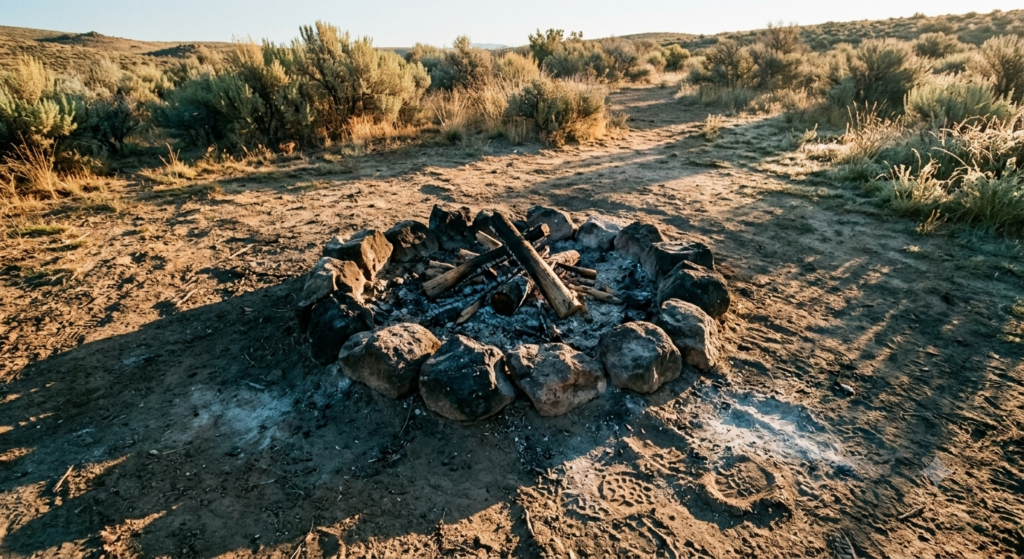
The inscription arrived because the route is under real pressure. Close to eighty mining concessions cover more than two-thirds of the Wirikuta protected area. Greenhouse agriculture is pulling hard on an aquifer in a desert that had no water to spare to begin with. There’s peyote poaching by people with no business taking it, illegal fencing thrown across paths pilgrims have walked for centuries, and a steady trickle of psychedelic tourism. The Wixárika Regional Council named all of it plainly and said they hoped the listing would become another instrument for protecting the territory. None of that is background scenery to Huichol music. It’s the ground the music is standing on.
So here’s my opinion, and you’re welcome to dislike it. This is not a thing to go and get. You can listen to Huichol music. You can’t buy the night. There’s no version of what I’ve described that you can book, and the sound I’m telling you about belongs to a people who walked five hundred kilometres to make it, inside a religion that isn’t a wellness product and was never offered to us. Go to Real de Catorce if you like — it’s a beautiful, half-ruined mining town and nobody’s forbidding you the desert. Just don’t go shopping for somebody’s sacrament. The poaching the Council is fighting has customers, and the customers are people who read articles like this one and decided they wanted a turn.
What the strings left me with
What travels out of Huichol music, and what I can hand you honestly, is the mechanism. Not the plant and not the ceremony — the shape of the sound and what it does to a nervous system that has stopped coping. Most of what gets sold as calming music is built to have no direction at all: ambient washes, held chords, deliberately going nowhere so you can’t get attached to anything. That works for some states. It’s useless in the ones that actually hurt. At three in the morning, being suspended in a lovely static nowhere is nearer to the problem than the cure.
A melody with somewhere to go does the opposite. It says there’s a next bar, and then another one, and you don’t have to invent either of them — just follow. That’s a much smaller thing to ask of a person than calm down. And that, in the end, is what Huichol music did for me across a very long night in a very cold place. It didn’t soothe me and it never once tried to. It went first. All I had to do was keep up.
I don’t own a xaweri and I wouldn’t play one if I did; it isn’t mine to play, and Huichol music isn’t a style you pick up because you liked the sound of it. But I’ve changed what I reach for. When a night goes bad now, I don’t put on something ambient and formless. I put on something with a tune in it, something that’s going somewhere and expects me to come along. Nineteen inches of cottonwood taught me that, in a desert I had no business being calm in.
External resources
INAH — Ruta Wixárika por los sitios sagrados hasta Wiricuta (official, Mexico’s national anthropology and history institute): https://lugares.inah.gob.mx/en/node/6372
Wixárika Research Center — Wixárika Pilgrimage Route Earns UNESCO World Heritage Status: https://www.wixarika.org/wixarika-pilgrimage-route-earns-unesco-world-heritage-status
The Esperanza Project — After UNESCO, what’s next for the Wixárika route to Wirikuta? (2025): https://esperanzaproject.com/2025/native-american-culture/after-unesco-whats-next-for-the-wixarika-route-to-wirikuta/
Hartenberger World Musical Instrument Collection — Mexico, Huichol ‘Raweali’ (Violin): https://wmic.net/mexico-huichol-raweali-violin/
Salimpoor VN, Benovoy M, Larcher K, Dagher A, Zatorre RJ (2011) — Anatomically distinct dopamine release during anticipation and experience of peak emotion to music: Nature Neuroscience 14(2):257–262 · doi 10.1038/nn.2726 · PMID 21217764 — https://doi.org/10.1038/nn.2726
Nierika (Wixárika artisan community site) — Traditional Huichol music: https://nierika.com.mx/en/traditional-huichol-wixarika-music/
Meditation for Cancer: A Practical Companion for Patients, Families, and Caregivers takes this same idea into the specific weeks of treatment.