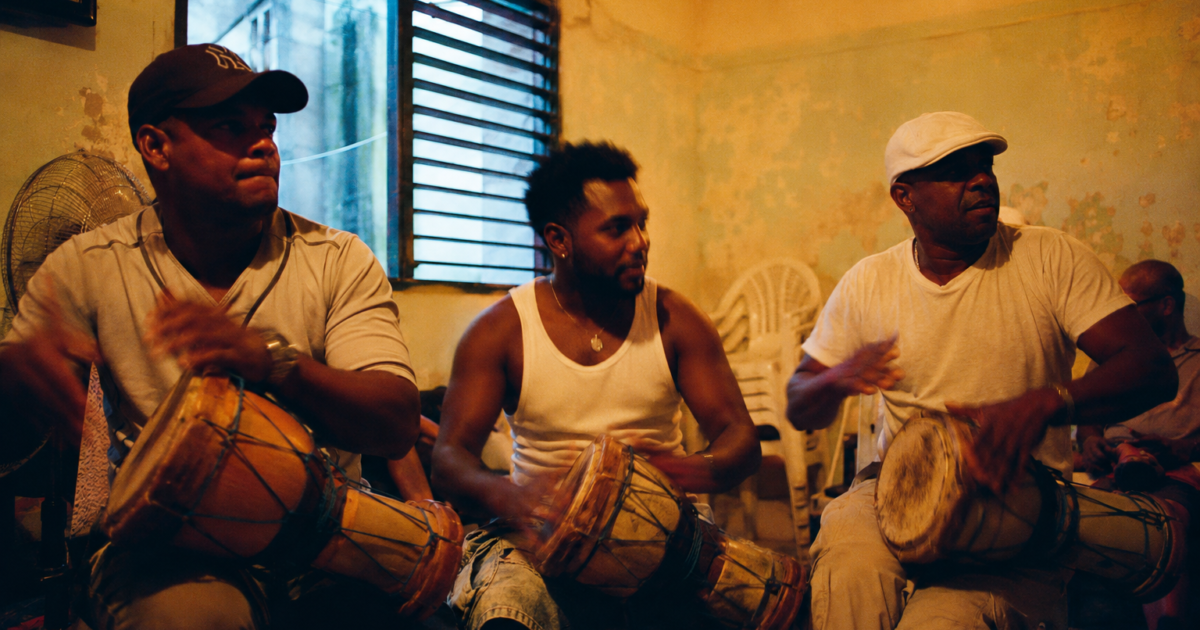
The first thing Cuba takes from you is your idea of what healing is supposed to sound like. You arrive carrying the whole Western picture — a dim room, a low voice, something soft playing at the edge of hearing, everyone speaking in that hushed register we reserve for the sacred, as though it were easily startled. Then three men sit down with a set of batá drums in the front room of a house on an ordinary street, and what comes out of that room has no interest whatsoever in your comfort. It's loud. It's fast. Nobody is whispering. And your chest, without asking your permission first, starts keeping time.
I lived sixteen years in Cuba. Long enough to stop being a visitor. Not long enough to stop being surprised. The thing that took me longest to understand was that the island does its deepest work at full volume. Other traditions I've sat inside lower the sound to bring you in — the jungle at night, a bowl on the sternum in the Himalayan foothills. Cuba goes the other way. The batá drums don't coax you inward by going quiet. They get so loud that the voice in your head narrating your life can no longer hear itself, and for a few hours, mercifully, it gives up.
What the batá drums actually are
Three tapered, hourglass-shaped drums, each played on both heads with bare hands. The largest is the iyá, the mother. The middle one is the itótele. The smallest is the okónkolo, the baby. They came from Yoruba country in what is now western Nigeria, carried across the Atlantic inside people who were not permitted to bring anything else, and they've been played in the Cuban Lucumí tradition — what most outsiders call Santería — since the 1800s. Three drums, three players, sitting close enough that their knees nearly touch. There is no conductor and no sheet music. What holds a set of batá drums together is the pattern each man already knows in his hands.
Calling them instruments undersells it. A consecrated set of batá drums has a spirit of its own, Añá, living inside it, and only a man who has been initiated — who has received Añá — may lay a hand on the sacred drums at all. Unconsecrated batá drums exist for concerts and teaching. The sacred ones aren't for that. There are well over a hundred distinct rhythms in the repertoire, different ones for different orishas, and a drummer is expected to know which one to play, when, and for whom. A ceremony can run four to six hours. Nobody in that room considers this a performance, and it's worth being clear that a toque de santo isn't a cultural attraction with a ticket price. It's someone's religion, in someone's house, on a Tuesday.
The night the batá drums stopped my thinking
The house was small and the room was full and there was nowhere to stand that wasn't against somebody. Plastic chairs pushed back to the walls. A fan pushing hot air around without conviction. Somebody's grandmother in the corner with her eyes half closed, singing the responses without appearing to think about them, the way you'd hum a song you learned before you could read. The batá drums started, and the first thing I noticed was that I couldn't listen to them the way I listen to music. There was too much happening. Three separate patterns, locked into one another, each one leaving a hole exactly the shape of the others. I kept trying to find the one — the downbeat, the place a Western ear expects to plant its foot — and the batá drums kept moving it.
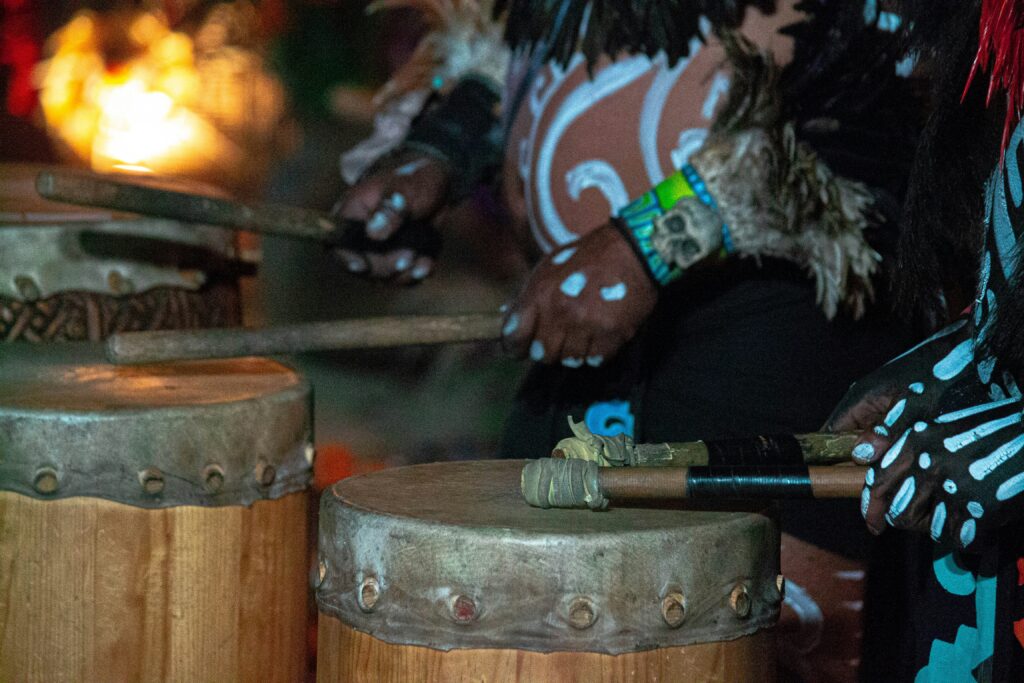
So I stopped trying to follow it. That was the whole thing — the entire lesson, and it arrived by accident, because analysis simply became impossible. My mind reached for its usual grip, found nothing to hold, and let go. Somewhere in the second hour I noticed that I had no idea how long I'd been standing there, that my jaw had come unclenched at some point without my involvement, and that I'd been moving — not dancing, exactly, just moving, the way everyone in the room was moving. The batá drums had done in ninety minutes what I'd spent years trying to arrange on a cushion. I hadn't quieted my mind. It had been drowned out, which turns out to work just as well.
Why the batá drums make an easier anchor than the breath
Every meditation instruction I'd ever been given pointed toward something faint. Watch the breath. Notice the sensation at the nostrils. Beautiful, subtle, and for a wired, over-caffeinated, twenty-first-century nervous system, almost impossible to hold on to for more than nine seconds. The batá drums are the opposite kind of anchor. They're enormous. They fill the room and then keep going into your ribs. You couldn't lose the thread if you tried, because the thread is hitting you in the sternum several times a second. Attention has nowhere else to be. That's not a lesser practice than watching the breath — for a body like mine, on a night like that one, the batá drums were the only anchor big enough to hold. The same principle turns up in the singing bowl work I did in Nepal — the sound you feel rather than hear — and in the noisy-city meditation I keep coming back to. The louder anchor is the kinder one.
This is also why the batá drums don't ask for stillness. In the Western import of meditation we made stillness the whole point, and lost a lot of people that way. In that living room, nobody sits down. The rhythm arrives and the body answers, and the answering is the practice. There's no separate audience. If you're in the room, you're in it — and being in it means moving, whether or not you know the steps, whether or not you can hold a beat, whether or not you're any good.
What actually happens in a body that drums for weeks
I want to be careful here, because there's a whole industry that takes a real ceremony, strips out everything difficult about it, and sells the leftovers with a wellness label. So let me give you the research at exactly the size it is. In 2016, Daisy Fancourt and colleagues published a study in PLOS ONE on group drumming with mental-health service users in London — ten weeks of weekly sessions, forty-five people finishing, thirty drumming and fifteen in a comparison group. Depression scores dropped significantly in the drumming group and stayed down three months later. Anxiety fell. Social resilience rose by a wide margin. Their saliva showed a shift away from a pro-inflammatory immune profile toward an anti-inflammatory one.
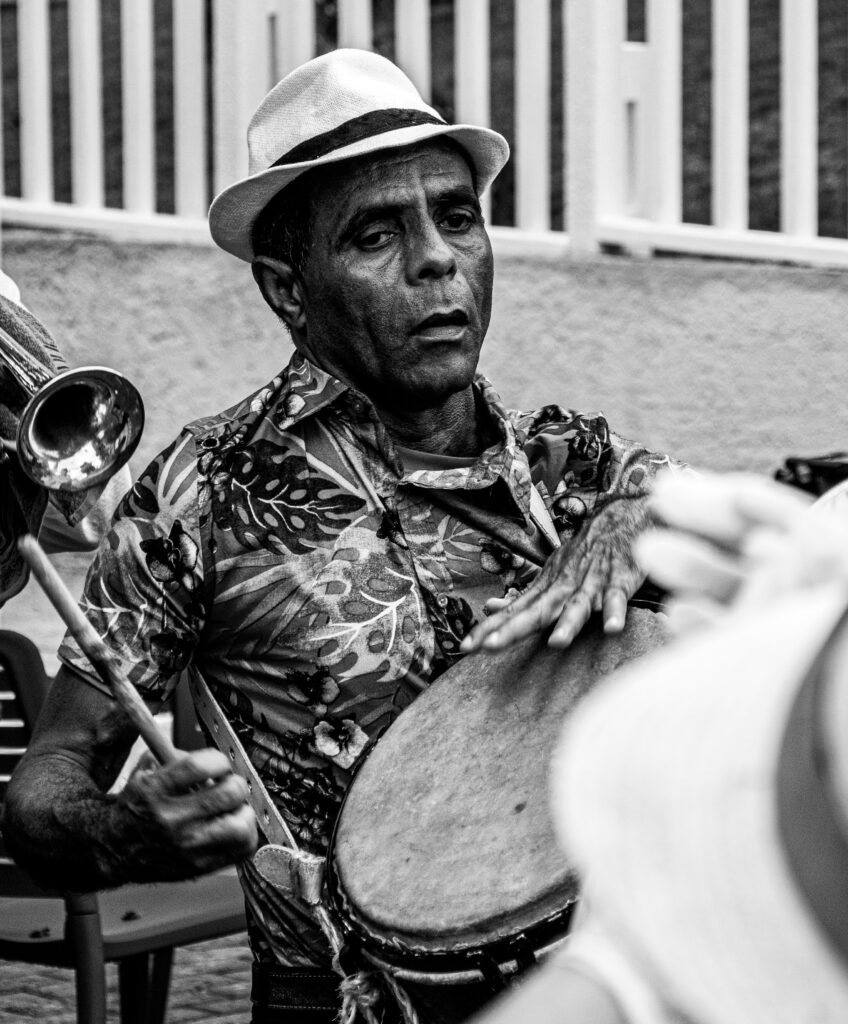
The honest caveat, which the authors state themselves: this wasn't randomised. People were sorted by which part of London they lived in, and the two groups didn't start from identical baselines. The authors called it quasi-experimental and asked for a proper randomised trial. So it's a strong signal rather than a verdict. But notice what the signal is pointing at. Not listening to drums. Playing them, together, in a room, every week for ten weeks. Which is a fair description of what has been happening around the batá drums in Cuban houses for two hundred years, minus the saliva samples. Nobody in that London community centre was playing batá drums, to be clear — it was a group class with hand drums. But the ingredient being tested is the one Cuba never needed to be told about.
Then everybody stands up
The batá drums are only half of the Cuban argument. The other half is what people do with their bodies once the drums start, and Cuba has never separated the two. Rumba was added to UNESCO's list of intangible cultural heritage in 2016, and the description is unusually blunt for that kind of document: it grew up in marginal neighbourhoods and shanty towns where communities of enslaved Africans lived, and it works as an expression of self-esteem and resistance. It's transmitted by imitation, within families and neighbourhoods. Nobody teaches it in a studio. You learn it by being small in a room where it's happening.
And what's happening in that room, physiologically, isn't nothing. Tarr, Launay, Cohen and Dunbar ran an experiment with 264 teenagers on Marajó Island in Brazil, published in Biology Letters in 2015, and separated two variables that usually travel together: how hard you're moving, and whether you're moving in time with other people. Both raised pain threshold, which is the standard indirect proxy for endorphin release. Both increased how bonded people felt to their group. Synchrony did it independently of exertion — dancing together, in time, did something that dancing hard alone did not. Ten minutes of it, in a lab, with strangers, at 130 beats per minute.
Now stretch that from ten minutes to five hours, from strangers to a neighbourhood, from a lab to a house where the batá drums have been calling the same rhythms for a hundred years. I'm not going to pretend the study proves anything about a toque de santo — it doesn't, and the researchers would say so first. But it does suggest that the thing Cuba does casually, several nights a week, in kitchens and courtyards and on the corner, is not merely cultural decoration. Moving in time with other people appears to do something measurable to human beings. The island simply never stopped.
If you'll never stand in that room
Most people reading this will never be in a house in Havana with the batá drums going. That's fine, and it's honest to say so — you can't download this, and there's no ten-minute version of a five-hour night with the batá drums. But you can take the underlying instruction, which is much simpler than the tradition that carries it: your nervous system responds to rhythm, and it responds more when you move with the rhythm instead of watching it. Put something on with a real pulse to it. Not ambient. Something with a drum in it. Then move — badly is fine, alone in a kitchen is fine, for the length of one song.
Do it with somebody else if you can. That's the part the research keeps pointing at and the part modern life quietly deleted: the together. Dance with your partner in a room with the lights on. Take a class where you'll be terrible in public for an hour. Go where people are already moving and stand close enough that their timing becomes yours. You're not recreating a ceremony and you shouldn't try. You're borrowing one small mechanism from a tradition that never mislaid it — that a body which moves in time with other bodies stops bracing, and that this happens whether or not you understand why.
The argument Cuba has been making all along
We inherited a strange idea somewhere along the way: that going inward has to be quiet, private, and still. One person, one cushion, one silent room, door closed. Sixteen years on an island where the sacred is loud and crowded and sweaty and shared has left me suspicious of that inheritance. The batá drums make a different case. They say the way in is not always down and inward — sometimes it's out, and sideways, and through everybody else in the room at the same time.
Your body knows this already. It knew it before you had words. Put on a rhythm you like and watch what your foot does before you've decided anything, watch how your breathing changes when the room fills up and everyone lands on the same beat. The batá drums didn't teach me anything my body hadn't already known. That isn't something you have to learn. It's something you'd have to work hard to lose. Your body isn't broken and it isn't slow. It's waiting to be played.
References
Fancourt D, Perkins R, Ascenso S, Carvalho LA, Steptoe A, Williamon A (2016). “Effects of Group Drumming Interventions on Anxiety, Depression, Social Resilience and Inflammatory Immune Response among Mental Health Service Users.” PLOS ONE 11(3): e0151136
Tarr B, Launay J, Cohen E, Dunbar R (2015). “Synchrony and exertion during dance independently raise pain threshold and encourage social bonding.” Biology Letters 11(10): 20150767.
UNESCO Intangible Cultural Heritage (2016). “Rumba in Cuba, a festive combination of music and dances and all the practices associated.” Inscribed on the Representative List, 11.COM
Wikipedia — “Batá drum.” Background reference for the instrument itself