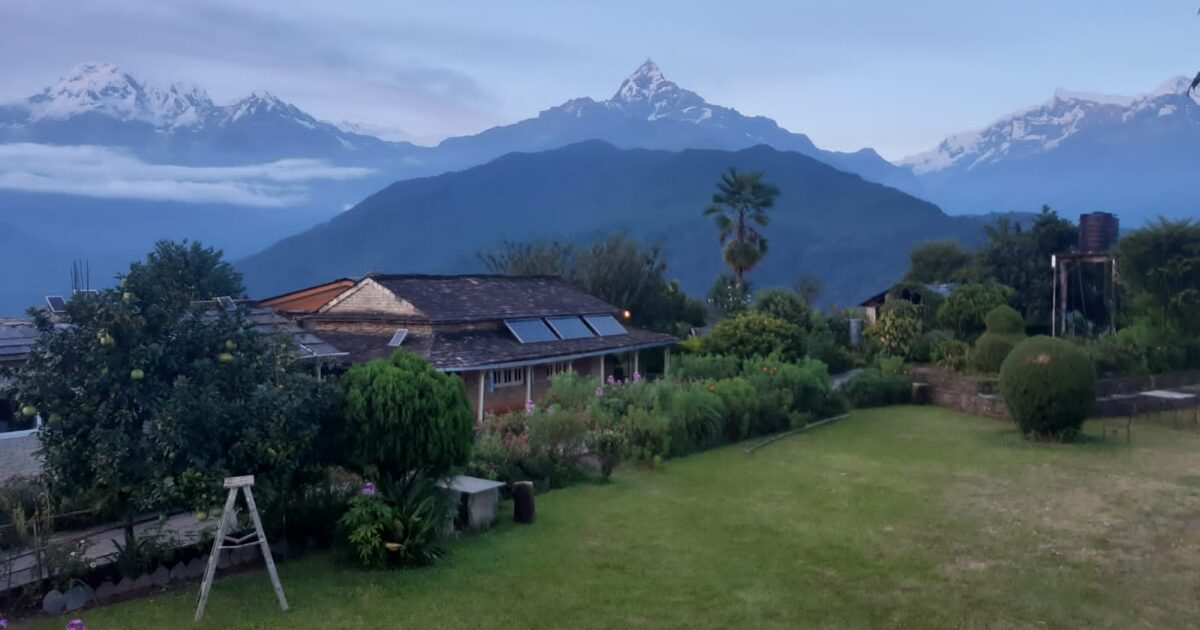
The eco-village sat on a shelf of terraced land below Annapurna, an hour or so out of Pokhara, where the road gives up on being a road and the rice fields take over. I’d come for a month of yoga teacher training — early mornings, long afternoons, plain organic food grown a few terraces down from where we ate it. Nobody had warned me the mountain would be that close. You’d step outside before dawn and there it was, a wall of white rock hanging in the dark where the sky should have been. And every morning, before the sun cleared the ridge, one of the teachers would set a singing bowl down on the wooden floor of the practice hall and strike it once. That single note is where this field note starts.
I’d spent the months before Nepal learning to hear. In the Colombian Amazon I’d sat inside a wall of night sound until it stopped being noise and turned into weather I could read. In a maloka in the Putumayo I’d watched an old man steer a whole room through the dark with a harmonica — breath pushed through reeds until the air itself sang. Sound, always sound, arriving the way sound arrives: through the ears. Nepal was about to move the whole thing lower in the body. The singing bowl doesn’t really work on the ears. It works on the chest and the bones, and it took me a while to feel the difference between those two things.

I’ll be honest about where I started, because it makes the rest of it mean more. I arrived a little skeptical of the whole singing bowl business. I’d seen it sold in wellness catalogs next to crystals and essential oils, photographed under soft purple light with a serene woman and a candle, and my instinct was to file the entire thing under decoration. A pretty noise you pay for. I did the morning practice because it opened and closed the yoga sessions. I expected nothing from the metal itself. Which is exactly the frame of mind you want to be in when a thing turns out to be real. Nobody sold me on it. It just happened to my body while I wasn’t paying attention.
The morning the singing bowl found my chest
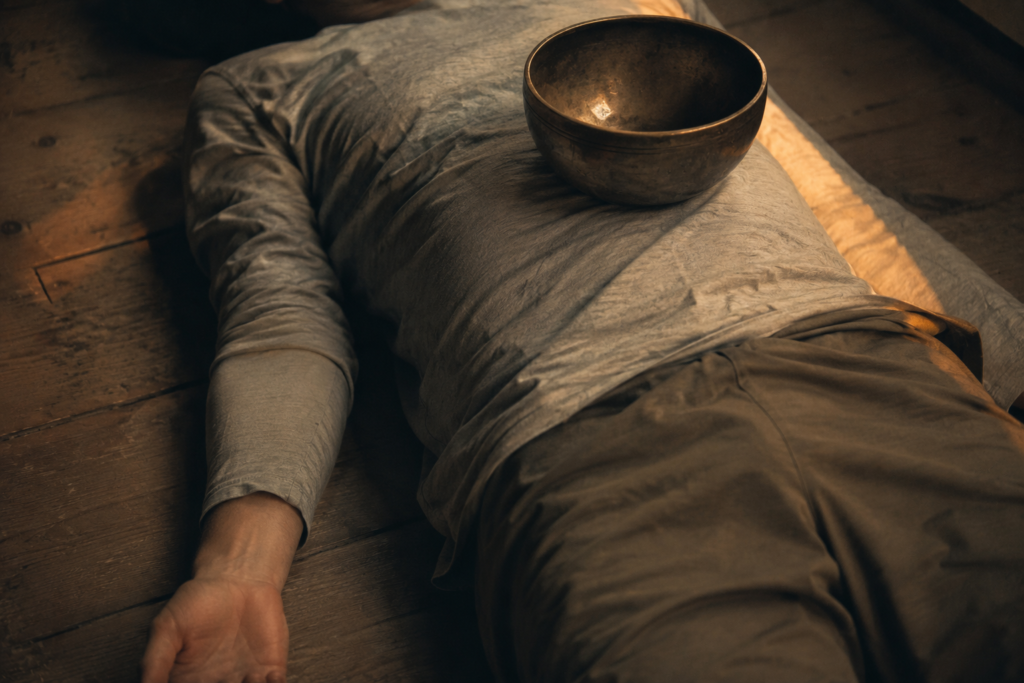
Second week, one of the teachers had us lie flat on our backs on the wooden floor and rested a heavy bronze singing bowl on the center of each person’s chest. Mine was cold through my shirt and heavier than it looked, the whole weight of it pressing down over my sternum. Then she began to circle the rim with a felt mallet, slow and even, the way you’d stir something you didn’t want to spill.
The first thing that happened wasn’t a sound. It was a pressure. A low hum started somewhere in the metal and walked straight into my ribs, spread sideways into my back where it met the floor, and buzzed faintly in my teeth. I could hear the note too — the round bronze tone of it filling the hall — but the hearing felt almost secondary, like the echo of the real event, which was happening inside my chest wall. When she lifted the singing bowl away, the note went on ringing in the air, and my body kept humming for a few seconds after it, the way a struck bell holds a memory of the strike. I lay there and thought: I have been listening to music my whole life through the wrong organ.
The odd part came later. That whole day I felt slightly rearranged, the way you do after a long swim in cold water — loose, quiet, a little further back behind my own eyes than usual. I hadn’t done anything. I’d lain on a floor for twenty minutes with a lump of bronze on my chest. But something had been shaken loose that talking never seems to reach. I remember eating lunch on the terrace that afternoon, looking at the rice and the mountain, aware that I was calmer than the day warranted and not especially interested in explaining why.
Sound you hear, vibration you feel
That gap — between the note I heard and the pressure I felt — turned out to be the whole thing, and there’s real physics under it. A singing bowl is a bell you play by friction. Drag a mallet around the rim and the metal wall flexes, hundreds of times a second, far too fast to see. Two physicists, Denis Terwagne at Liège and John Bush at MIT, filled a Tibetan singing bowl with water and filmed what those flexing walls actually do. As they rubbed the rim, the water came alive: standing waves first, then a chop, and finally droplets that tore loose and leapt off the surface and bounced there like little glass beads. Nonlinearity published it in 2011. You can watch the vibration with your eyes. It moves matter.
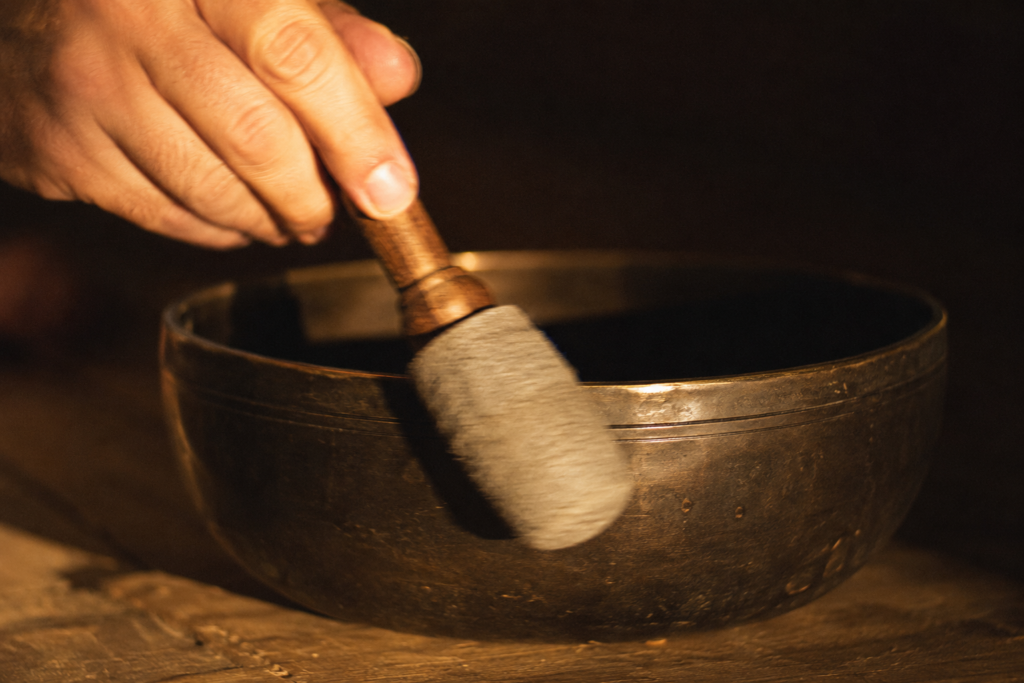
That’s the part the word “sound” quietly hides from you. When a singing bowl plays, it isn’t only wobbling the air on its way to your eardrum. It’s setting a physical object shaking, hard, and if you’re close enough — or if the bowl is resting on you — the shaking arrives in your bones on the same terms it arrives in that dish of water. The droplets don’t hear anything. They just get moved. Lying under a singing bowl, so do you.
It matters which door the sound comes in by. Hearing is a thin, precise sense — a membrane in your ear catching tiny changes in air pressure and handing them to the brain to be named. Being touched by a low frequency is something else entirely. The chest is a drum. The belly, the long bones, the fluid you’re mostly made of — all of it can be set humming by a note pitched low enough and brought close enough, and none of that traffic bothers to route through the thinking, naming, second-guessing part of you first. It goes straight to the body. That’s why a singing bowl can quiet a person who has already tried and failed to think themselves calm. It skips the conversation.
What a singing bowl does to a nervous system
The obvious question, once you’ve felt it, is whether the body does anything useful with all that shaking or whether it just feels pleasant for a minute. The honest answer is that the research is small and young, and I’ll hand it to you at its real size rather than dressed up. A 2023 randomized trial out of Spain, led by Rio-Alamos, ran fifty people through Tibetan singing bowl sound, progressive muscle relaxation, or a waiting list, and tracked heart rate variability — a fair read on whether a nervous system is bracing or settling. The singing bowl group tipped further toward the settled side, more of the rest-and-digest branch coming online, and reported the sharpest drop in anxiety of the three.
An earlier study by Goldsby and colleagues, sixty-two people, found less tension, anger, fatigue and low mood after a singing bowl meditation. That one had no control group, so hold it loosely — it points somewhere without proving the road there. Put the two together and you get something modest and believable, roughly what fifty people on a wooden floor under Annapurna could have told the researchers for free. Something in the body lets go when the bowl is close. Nobody there needed a chart to know it. You feel the letting-go happen in real time, a notch at a shoulder, a breath that finally drops all the way down.
The thing nobody tells the person holding the mallet
Later, back in Mexico, I took a longer course specifically in playing the singing bowls — how to hold them, where to place them on a body, how to read a room by ear. The teacher there said one thing on the first day that rearranged how I thought about the whole practice. She said the person holding the mallet is inside the same field as the person on the floor. The vibration doesn’t check who came to be healed and who came to heal. It fills the room. It goes into both bodies on identical terms.
I’d assumed, without ever once examining it, that a healer gives and a patient receives — a clean one-way street. A singing bowl doesn’t run that way. When I play one now, the low tone settles my own chest as much as it settles anyone I’m working on. There’s something honest in that, and a little humbling. Whatever this is, I’m not standing outside it, dispensing it from a safe distance. I’m in it too, getting worked on by the exact note I’m making. The oldest instruments all seem to know this. You can’t play breath or bronze at someone without it landing on you first.
I noticed it plainly the first time I played for someone who was grieving. She’d asked for a session after a hard loss, and I set the bowls around her and started to work, expecting to hold steady while she came apart and came back. What actually happened was that both of us slowed down together. My own breathing dropped to meet the tone. My shoulders came down. By the end I was as unwound as she was, and I understood the teacher’s sentence in my body instead of my head. The vibration had never once asked which of us was there to be helped.
The rice fields kept the time
I want to be straight about where this happened, because the singing bowl has picked up a lot of incense-and-candles marketing it never asked for and doesn’t need. This wasn’t a monastery. No robed monks, no ancient lineage pressing a secret into my hands. It was a working eco-village — rice growing in terraces down the slope, a kitchen turning that rice into the lunch we ate, a hall with a plain wooden floor and a stack of bowls in the corner gone dull with use. We practiced in the mornings when the light finally came over the ridge. Somebody rang a singing bowl to open and another to close, the way another place might ring a bell for the start of school.
The ordinariness is the part I trust. Nothing about that month asked me to believe anything. A heavy bowl, a felt mallet, a wooden floor, a mountain that didn’t care in the slightest whether I got enlightened. The vibration did what it did whether or not I had a theory ready for it. That’s usually how you can tell a thing is real — it keeps working after you stop believing in it.
What the singing bowl left me with
Months on, I don’t reach for the mystical language when I think about that hall. What stays is plainer and stranger than that. There are states a person can get into where words simply stop landing — grief, panic, the flat gray afternoons when nothing you say to yourself makes any dent at all. I used to believe you had to think your way out of those, argue yourself back to level. The singing bowl makes the opposite case. A low, steady vibration reaches a body underneath the part of you that’s still arguing. It doesn’t explain anything. It doesn’t fix your life. It puts a hand on the animal you’re made of and says, in a language older than language, you’re alright, you can come down now.
I keep a singing bowl in the house. Some evenings, when the day has wound me too tight to even talk about it, I lie down and set it on my chest and strike it once, and I feel the note walk into my ribs a half-second before I hear it, and I’m back on a wooden floor under a mountain I couldn’t see in the dark. Then, slowly, the way it went the first time, the bracing lets go.
If this kind of practice speaks to you, Meditation for Cancer takes the same approach and builds it around a cancer diagnosis instead.
References
• Terwagne D, Bush JWM. “Tibetan singing bowls.” Nonlinearity 24(8):R51 (2011), IOP Publishing — Universite de Liege + MIT. A water-filled bowl’s vibrating walls set the surface oscillating; as the forcing grows, edge-induced Faraday waves break and eject droplets that bounce on the surface.
• Rio-Alamos et al. “Acute Relaxation Response Induced by Tibetan Singing Bowl Sounds: A Randomized Controlled Trial.” European Journal of Investigation in Health, Psychology and Education (2023). Single-blind RCT, n=50 (singing bowl / progressive muscle relaxation / waiting-list control). The singing bowl group showed higher HRV (RMSSD + HF, = greater parasympathetic activation) and the sharpest reduction in self-reported anxiety. Confirmed live via PMC9955072. Cited honestly as a small, short-term RCT.
• Goldsby TL, Goldsby ME, McWalters M, Mills PJ. “Effects of Singing Bowl Sound Meditation on Mood, Tension, and Well-being: An Observational Study.” Journal of Evidence-Based Complementary & Alternative Medicine 22(3) (2016/2017), n=62. Significant reductions in tension, anger, fatigue, depressed mood and anxiety (all P<.001); spiritual well-being increased.