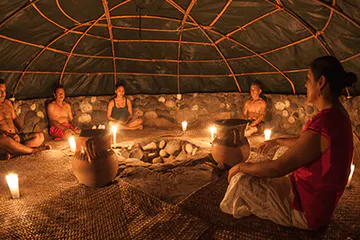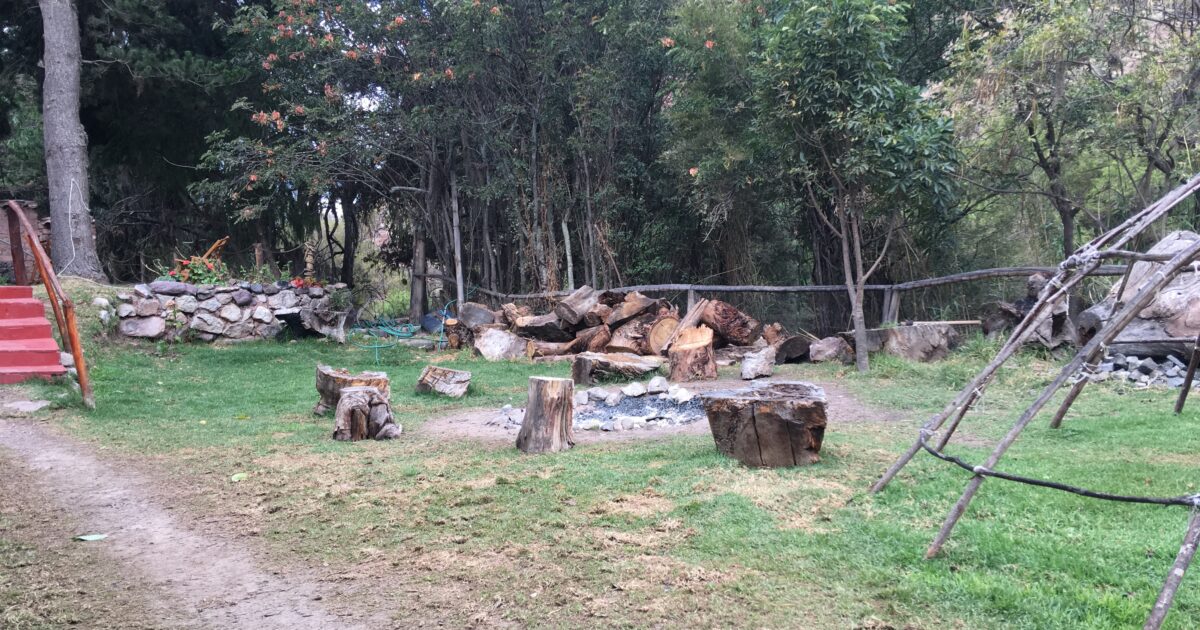
My first temazcal was in Peru, in 2018, at the back end of a plant-medicine retreat. A Lakota-style lodge, Mexican hands running it. Two rounds in, the door swung open, cold light came through the gap, and I walked out like a man released from something. Then somebody mentioned there were two more rounds to come. I remember deciding, with great clarity, that this was not my problem.
The man running the lodge came out after me. He didn’t argue. He didn’t stand in the way of the path. He looked at me — pale blue eyes, I can still see them — and said one sentence. What you’re feeling is only in your head. Then he went back in. Eight years later I still hear it, and in the last year it has become the thing that carries me through the fourth round. That is what a meditation teacher is for, and it is the exact part of this you cannot download.
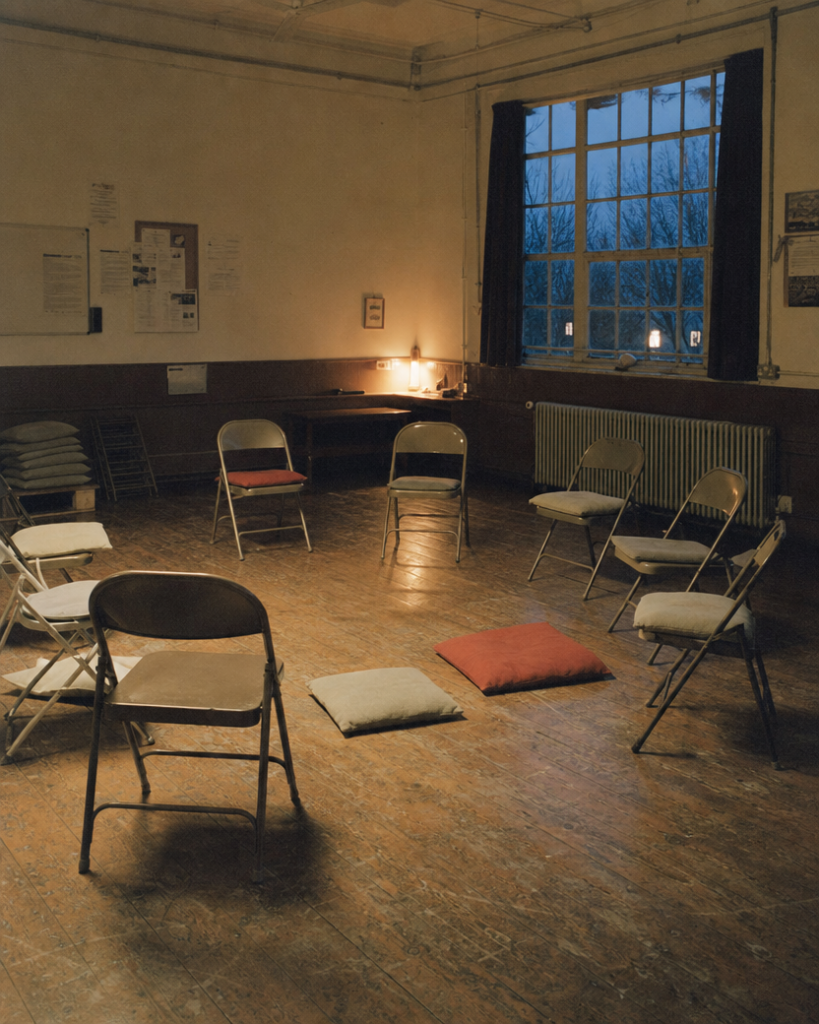
These field notes have been working through what the West dropped when it imported meditation. First the company: every practice I was taught outside Europe happened in a room with other people in it, and we kept the technique and threw away the room. Then the hour, because those traditions do their serious work after dark and we moved the whole thing to seven in the morning. This one is about the person. Putumayo, the hills above Pokhara, Havana, the high desert under Real de Catorce — in every one of those rooms somebody held the shape, and whatever the tradition called him, he was the meditation teacher. Your app has a voice. It doesn’t have a person.
What a meditation teacher actually does in the room
Ask most people what a meditation teacher is for and you’ll get an answer about wisdom. Instruction, insight, the right words at the right moment. Not wrong. Just not the job. Sit in enough old rooms and you notice the work is smaller than that, and far more physical, and it comes down to four things.
The first is that he decides when the door opens. A temazcal runs in rounds, four songs to a round, and at the end of each one the door lifts and new stones come in from the fire. From the inside you have no say in this. None. You can’t negotiate with heat, and the only person who can end a round is the meditation teacher standing outside in the dark with a pitchfork. Somebody holds the clock so that nobody inside has to.
The second is that he watches. In a lodge you can’t see your own hand, so the watching is done by ear — whose breathing changed, who stopped answering when the round came around, who has gone quiet in a way that isn’t peaceful. A meditation teacher who is any good runs that scan the whole time, and most of what he notices he never mentions to anyone. The third is that he comes after you, which is the story above.
The fourth is the one nobody talks about and it might be the most useful. He holds the shape so that you don’t have to. You’re not keeping time. You’re not deciding whether this is going well or whether to stop. You’re not managing the fire, the sequence, the songs, the order people speak in. All of it belongs to somebody else, which means your attention is free to go where the practice wants it to go. That’s the real economics of a meditation teacher, and it’s why a well-run room feels easier than your bedroom floor even though the room is objectively harder.
The meditation teacher who came out after me
Back to the door, and the part I’ve chewed on for eight years: that sentence is terrible advice. What you’re feeling is only in your head sits one syllable from your pain isn’t real, and in a hot dark room full of people trying to prove something to themselves, it’s a dangerous thing to say. Heat illness is not in your head. It’s in your blood and your kidneys, it kills people, and I’ll get to a case where it did.
He could say it because he had eyes on me. He’d been watching me for two rounds. He knew the difference between a man who is cooking and a man who is frightened, and he’d correctly worked out I was the second one. That judgement — made in the dark, in four seconds, from watching one specific person — is what a meditation teacher does that no recording ever will. Your app can’t tell the difference between the two of you. It doesn’t know there are two of you.
The West kept the instruction and dropped the meditation teacher
What we imported was the script. Sit like this, breathe like this, when your mind wanders bring it back. That part travels perfectly, which is exactly why it’s the part that travelled. Somebody recorded it in a nice voice, and now a billion phones deliver the instruction with better diction than most humans manage. What didn’t come with it was the meditation teacher who is supposed to be watching while it’s followed.
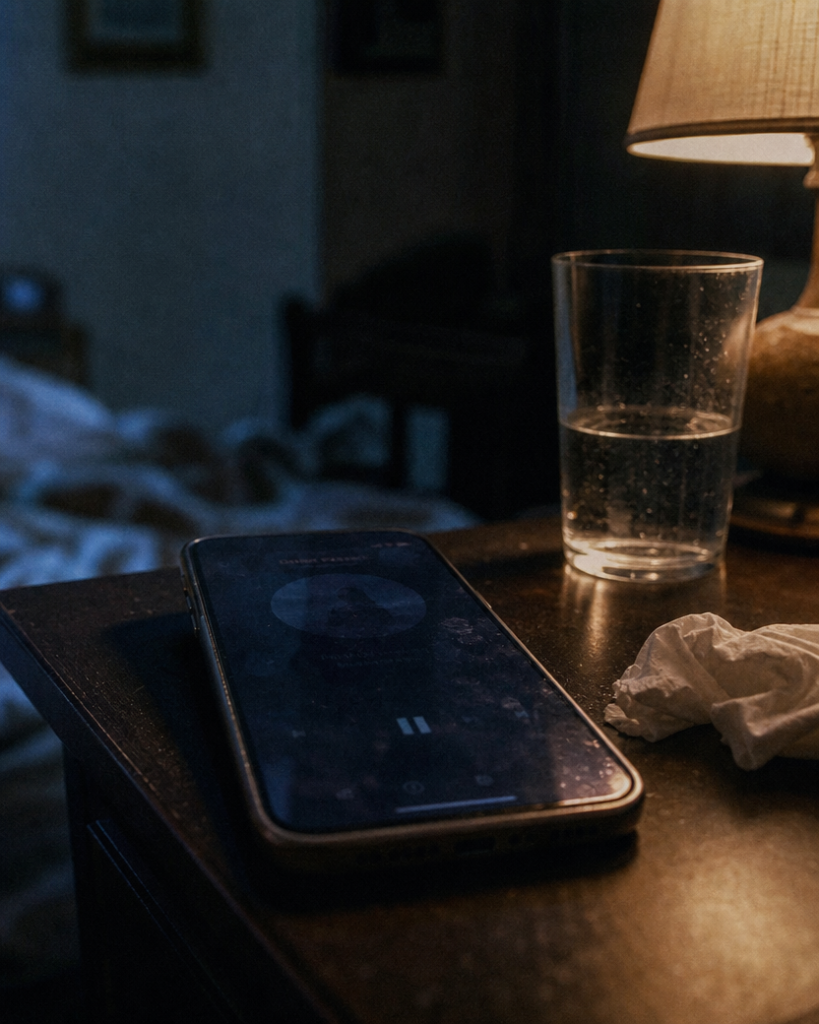
The research on what that person contributes is less mystical than you’d hope. In 2011 David Mohr and colleagues published a model in the Journal of Medical Internet Research they called supportive accountability, and its argument is almost rude in its plainness: people stick with digital health programmes when they’re accountable to a human being. Not any human being. Adherence rises, they wrote, when coaches “are seen as trustworthy” and benevolent, and when they “are perceived as having the necessary expertise.” Expectations have to be about process rather than outcome, and the person has to help set them. Then, at the end, the line that belongs on the box: “Patients with high levels of intrinsic motivation may have no need of coaching support at all.” A meditation teacher is one instance of that person. Not a special case.
The best measurement of the effect is a 2021 individual-patient-data network meta-analysis in JAMA Psychiatry led by Eirini Karyotaki. Forty-two eligible trials, thirty-nine handing over patient-level data, 9,751 people with depression across twelve countries. Guided and unguided internet-based CBT both beat the controls. Guided beat unguided too — by 0.8 of a point on the PHQ-9, confidence interval 1.4 to 0.2. So the guide is real, and the guide is worth less than one point on a nine-item questionnaire. Both true at once.
Now the part that argues the other way
Three things stop this being the tidy article it wants to be, and I’d rather hand them over than have you find them yourself.
The first is inside the Karyotaki paper. That advantage for guided therapy shows up straight after treatment and then goes — no evidence of a difference at six months or twelve. And the strongest thing determining whether guidance helped was how bad you were at the start. For people in the subthreshold range, guided and unguided were close to interchangeable; the gap opened in moderate and severe depression. Read that back and it stings. A meditation teacher matters most when you’re in real trouble, which is exactly when arranging one feels impossible.
The second is the study waved around to prove that meditation teacher training matters. Ruijgrok-Lupton, Crane and Dorjee, in Mindfulness in 2018, found gains “significantly larger for the participant cohort taught by teachers who had completed an additional year of mindfulness-based teacher training and assessment.” Good result. Nine teachers. Thirty-one participants, split unevenly. The authors call it a feasibility pilot and say it should be interpreted with caution. I’m citing it because it’s the best thing we have, and thirty-one people is what the best thing we have amounts to.
The third changed my mind while I was writing. The Global Ayahuasca Survey is the largest dataset anybody has here — around 8,200 people in more than fifty countries, published by José Carlos Bouso and colleagues in PLOS Global Public Health in 2022. They sorted people by setting: a ceremony with traditional shamans, a church context, or an unsupervised one. Adverse physical effects, mostly vomiting, ran at 69.9%, with 2.3% needing medical attention afterwards, and unsupervised use raised that risk. Fine. That’s the result I expected. Then the mental health side, where 55.9% reported adverse effects in the following weeks and months — and there the rates were higher in every non-religious context, traditional shamanic ceremonies included. The only setting that came out lower was the church one, and the churchgoers were healthier before they drank anything, with lower rates of anxiety disorder, depressive disorder and physical health conditions.
So the largest dataset we have does not say that having a meditation teacher in the room protects your mind. It says having nobody supervising is harder on your body. Different claims, and I won’t blur them, because blurring them is how this material always gets sold. One more thing worth holding: 88% of those with adverse mental health effects considered them part of a positive process, and about 12% went and got professional support. Both numbers are in the same paper. Neither cancels the other.
When the meditation teacher is the most dangerous person in the room
October 2009, at a retreat outside Sedona, Arizona. A self-help figure named James Arthur Ray ran a sweat lodge as the finale of a five-day event he’d called Spiritual Warrior. Kirby Brown, thirty-eight, and James Shore, forty, died in that lodge. Liz Neuman, forty-nine, died after more than a week in a coma. Eighteen others were hurt. Prosecutors argued at trial that Ray had pushed the heat to dangerous levels, ignored people asking for help, and watched as participants were dragged out. That was the prosecution’s account; the jury acquitted him of the more serious manslaughter charges and convicted him on three counts of negligent homicide. He served two years.
Now read my four jobs again. Decides when the door opens. Watches. Comes after you. Holds the shape. Every one of the meditation teacher’s four jobs is a description of power, and I wrote them approvingly, because in a good room that’s how they feel. In a bad room they’re the mechanism. The same authority that let one meditation teacher come out into the cold and hand me a sentence I’ve carried for eight years is the authority that keeps somebody in a lodge they should have left. There’s no version of this where you get the first without building the conditions for the second.
Which is why I’d rather give you questions than reassurance. Does he stop things? A meditation teacher worth sitting with ends rounds early, sends people out, cancels sessions, and treats none of it as a failure of the group. Can you decline something in front of everyone at no cost — and watch what happens to the person who says no, not to you. Does the meditation teacher take credit for what happens in the room, because whoever claims the results will later need you to keep having them. One line has no nuance in it at all: anybody who tells you, in a hot room, that your body’s alarm is a weakness to push through is not teaching you anything. Ray’s participants had reportedly been through a thirty-six-hour fast and were being told to ignore what their bodies were saying.
How to find a meditation teacher — and what to do if you can’t
Start with live over recorded, and be unromantic about the ratio. One live class a month with the same meditation teacher, who sees you arrive and sees you leave, does more than thirty recorded sessions with a voice that has never met you. Not because the recording is bad. Because the recording is finished. It was made before you existed and it says the same thing whether you’re settled or coming apart.
Then ask the questions that are hard to fake. My best single question for any meditation teacher: what do you do when somebody in your class has a bad experience? A real answer has steps in it, and usually a name — somebody they refer people to. A bad answer treats the premise as strange, which tells you they either haven’t seen it or didn’t notice it, and I don’t know which is worse. After that, who trained you, and who assessed you while you were teaching? That second one is the one that matters, because being watched and corrected is what turns a long practice into a teachable one. Then ask who their teacher is, and whether they still have one. Present tense.
A meditation teacher you can borrow for six weeks
Suppose there’s nobody. No local class, no tradition anywhere near you, a schedule that laughs at the idea. You can’t manufacture a meditation teacher and I won’t pretend a friend is one. But look again at what the research actually located, because it wasn’t wisdom. It was accountability to a person you consider trustworthy and competent, with expectations you helped set, about process rather than results. That part you can build this week.
Pick one person who isn’t doing the practice with you — a friend, your sister, a colleague you like. Tell them exactly what you’ll do and when: ten minutes, this time of day, these days. Say it out loud and let them repeat it back, because a commitment somebody else can quote is a different object from one living in your head. Then send them one sentence a week for six weeks. Not how it went. What you did. Four days out of five, missed Thursday, kept going. Six weeks, because the retention numbers on meditation apps say you’d otherwise be gone inside the first month, and the people who vanish don’t announce it.
It’s a poor substitute for a room with a fire in it and I won’t dress it up. It isn’t a meditation teacher. It’s the one part of one that the data could actually see, which is more than the streak counter on your phone can claim.
I went back in that night, for what it’s worth. Both remaining rounds, at the Buffalo door where the heat is worst, hands flat on the ground because moving them felt like somebody running a hot iron over my skin. I don’t tell it as a triumph. I tell it because I’d have been out in the parking lot, and the only reason I wasn’t is that a meditation teacher I’d known four hours decided it was his job to come out after me. Your app won’t do that. It’ll be there in the morning, patient, nice voice, good script, still good at everything it’s good at. It just won’t come outside.
Meditation for Cancer builds on this same practice, written specifically for patients, families, and caregivers.