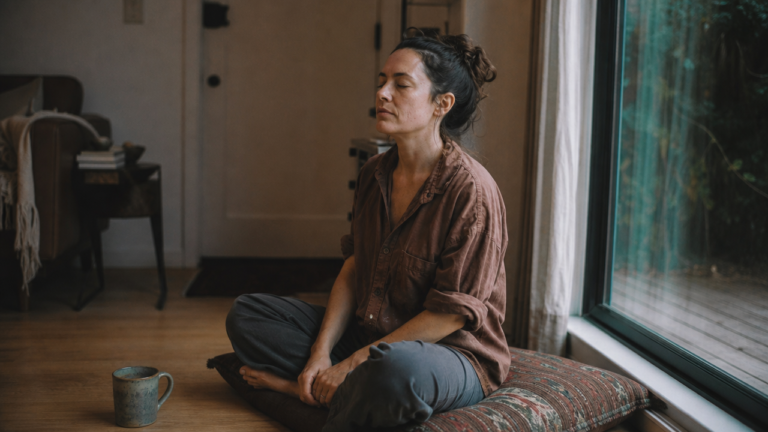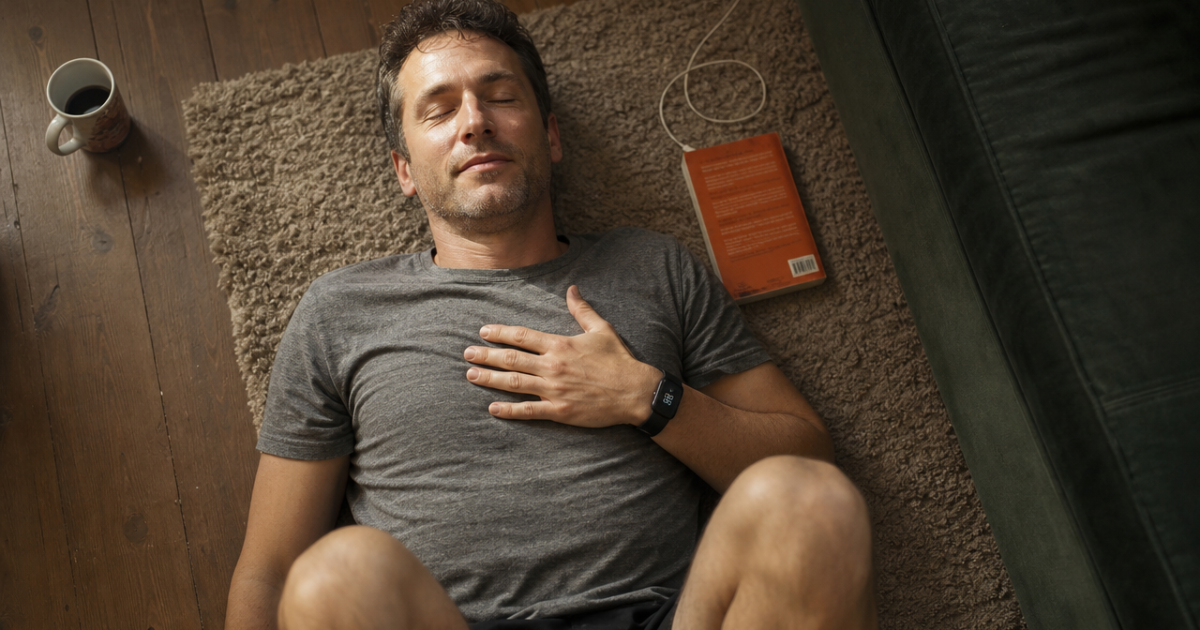
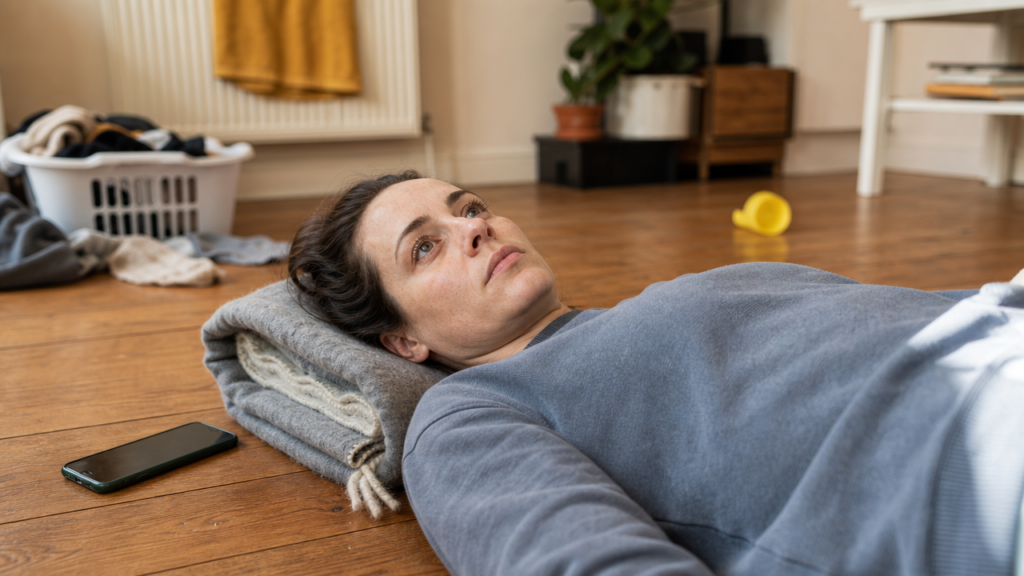
Around minute nine, the verdict arrives. You're on the floor with your attention somewhere near your left knee, a recorded voice is describing the back of your calf, and a thought turns up with complete confidence: this isn't working. Nothing is happening here. You could be answering email.
Nearly everyone who tries a body scan meets that thought. It's the most abandoned practice in meditation — first in the syllabus, last in anybody's actual week. And the reason people quit it is close to the reason it's worth defending. The body scan is the one practice where the absence of a dramatic result is the whole point of the exercise.
The body scan is the first thing MBSR teaches and the first thing people drop
Open the official Mindfulness-Based Stress Reduction curriculum — the 2017 Authorized Curriculum Guide, revised by Saki Santorelli, Florence Meleo-Meyer, Lynn Koerbel and Jon Kabat-Zinn — and the body scan is in the room on day one. The guide's own line for week one: “Home practice is assigned using the first guided recording (body scan meditation) as a means of beginning to learn to become familiar with mindful awareness of the body.” Before the sitting practice. Before the yoga. Forty-five minutes a day, starting that night.
Now look at what people do instead. Christine Parsons and colleagues pooled 43 studies of MBSR and MBCT — 1,427 participants — and compared home practice against what had been assigned. The pooled estimate came out at 64% of the recommended amount, roughly 29 minutes a day. Across the 28 studies that also reported outcomes (898 people), more practice did go with better results, though modestly: r = 0.26, 95% CI 0.19 to 0.34.
That 64% is an average across every practice in the programme, so it can't tell you which one gets dropped. Ask anyone who has run a course. The first thing to go is the long one you have to lie down for.
Where the body scan came from, and it isn't where you think
The body scan gets sold as ancient. It isn't. Bhikkhu Anālayo traced its history in the journal Mindfulness in 2020, and the line runs somewhere more surprising than a sutta. Here's Kabat-Zinn's own account of the influence: “One of the people who influenced my developing the MBSR version of the body scan had been an aerospace engineer before he became a meditation teacher.”
That was Robert Hover, 1920–2008, who taught in the lineage of the Burmese teacher U Ba Khin. Kabat-Zinn's initial training with him was in 1973 — vows not to make any voluntary movement for several hours at a stretch. The sweeping you'd recognise today, starting at the toes of the left foot, up the leg and hip, across to the other foot, then the torso, shoulders, fingertips, both arms, neck and finally the head, comes down through twentieth-century Burmese vipassanā.
Anālayo's conclusion is blunt: the body scan “would presumably have been unknown in early Buddhism.” What it grew out of was a particular reading of the third step in the canonical instructions on mindfulness of breathing — the one about experiencing the whole body. So the practice is about fifty years old in the form you've met, with an engineer's fingerprints on it. That's not a criticism. It's just worth knowing when somebody hands it to you with two and a half thousand years of authority attached.
The evidence on the body scan is thinner than the marketing
Here's where I undercut my own article, because you should have this before you give anything twelve minutes a day.
In 2022, Gan, Zhang and Chen published the first meta-analysis of the body scan on its own, in Applied Psychology: Health and Well-Being. Fourteen randomised controlled trials, no restriction on population, outcomes sorted into seven categories. Measured against passive control, a body scan produced a small effect on mindfulness — Hedges' g = 0.268, 95% CI 0.032 to 0.504 — and nothing that held up elsewhere. The authors' verdict, in their words: “A sole body scan meditation is not effective enough to improve health-related outcomes.” They also report that the quality of the underlying studies was low and heterogeneity high, which is the half people tend to drop when they quote a meta-analysis.
It gets worse before it gets better. In 2013 Sauer-Zavala and colleagues took 141 undergraduates and split them across sitting meditation, a body scan and mindful yoga, three weekly one-hour sessions each. Everyone improved on rumination, self-compassion and well-being, whatever they'd been given. But in the head-to-head comparisons the body scan lost twice: sitting and yoga both beat it on difficulties with emotion regulation, and sitting beat it again on the tendency to take a nonevaluative stance toward what you notice.
The newest trial is kinder and duller. In BMC Psychology this year, 54 healthcare students in southern Thailand were randomised to either sitting meditation or a body scan — ten minutes a day, five days a week, four weeks. Working memory improved over time (F = 27.621, p < 0.001) and so did trait mindfulness, with no significant difference between the two groups (p = 0.365). The sample was 83% female, at a single university, and the authors flag practice effects on the memory test itself.
Part of that is a measurement problem rather than a verdict. Pulling one component out of an eight-week programme and testing it alone is how you find out whether it works as a pill, and none of these practices were built to work as pills — in MBSR the lying-down practice, the sitting, the yoga and the eight weeks of group conversation are all meant to be doing different jobs on the same person at the same time. The finding still counts. It just answers a narrower question than the headline suggests.
Add it up. As a standalone treatment, the body scan has no special powers, and anybody selling it that way is running ahead of the evidence.
The one measurement that makes the body scan interesting
In 2006, Blaine Ditto, Marie Eclache and Natalie Goldman at McGill did something most studies skip: they measured what happens in the body while the practice is going on. Study 1 randomised 32 healthy young adults to a body scan, progressive muscular relaxation, or a wait-list. Study 2 put 30 people through two sessions each, meditating in one and listening to a recording of a popular novel in the other. In both studies, respiratory sinus arrhythmia — the beat-to-beat variation in heart rate that tracks your breathing, and a standard read on the parasympathetic side — rose significantly more during the body scan than during the other relaxing activity.
Then the detail I keep coming back to. Heart rate didn't move. In Study 2 the cardiac pre-ejection period shortened, which means sympathetic activity went up at the same time as the parasympathetic. Both branches, at once, in opposite directions — and the number everybody actually checks, your pulse, sat there looking like nothing had happened.
Small samples, healthy young adults, a single lab session. Don't build a cathedral on it. But hold it next to the most common complaint about the body scan — that it feels like nothing is happening — and you have at least one study where two things were measurably happening and the obvious instrument reported no.
What the body scan is actually for
Stop treating the body scan as medicine and it starts to make sense. It's a reading instrument. Twelve minutes, or forty, of moving your attention through the body at a resolution you never otherwise use, learning the difference between your jaw at nine in the morning and your jaw after a phone call you didn't want to take.
That skill doesn't pay out during the practice. It pays out at three o'clock on a Thursday, when you notice your shoulders are somewhere near your ears and you can tell roughly how long they've been there. Your body isn't broken. It's bracing. A body scan is how you find out what it's bracing at.
It helps to know what it isn't. The comparison practice in that McGill study was progressive muscular relaxation, where you deliberately tense a muscle group and then let it go, and the two get muddled constantly because they both involve a floor and a voice. They're opposite instructions. One asks you to do something to your calf. The other asks you to leave your calf entirely alone and find out what it's like when nobody is managing it. If you finish feeling like you've completed a task, you've probably been doing the other one.
Which is also why it tests badly. Ask a trial whether a body scan lowers anxiety scores in eight weeks and you've asked it the wrong question — you're grading a thermometer on how warm it makes the room.
A body scan you'll actually do: twelve minutes
MBSR asks for forty-five. Parsons's number says people deliver about twenty-nine across everything they've been assigned. So build for the figure that survives a bad week rather than the one on the sheet.
Lie on your back — floor, bed, doesn't matter — or sit with your back supported. Start at the toes of the left foot and give each region twenty to forty seconds: foot, lower leg, knee, thigh, hip, then the same down the right side, then pelvis, belly, chest, back, hands, arms, shoulders, throat, face, scalp. Twelve minutes covers that if you keep moving and don't negotiate.
Recording or silence, either works, and the honest answer about which is better is that the one you'll press play on beats the one you approve of. A recorded voice does the timekeeping, which removes the part where you lie there wondering how long you've been at your knee. Silence gives you nowhere to hide and is harder for the first month. Pick on that basis, not on purity.
Two rules hold the whole thing up. Name the texture, not the verdict — warm, tight, buzzing, heavy, nothing — rather than “bad” or “too tense.” And when you find something, leave it alone. Noticing and adjusting are separate acts, and a body scan trains exactly one of them. When your attention wanders, and it will, come back to the region you left instead of starting again at your feet.
The four ways a body scan goes wrong
You fall asleep. Very common, and more of a reading than a failure: a horizontal body with nothing to do at ten at night will tell you the truth about your sleep debt, which is the same effort paradox I've written about elsewhere. Sit up, move it earlier, or take the information.
You're trying to relax. Now there's a target, and a target makes a test, and a test makes a scoreboard — the identical mistake a streak counter builds into an app. There's no result to achieve inside the practice.
You find something that hurts and flinch off it. That's the actual training, right there: staying at the edge of a sensation for ten more seconds without adding commentary. If ten seconds is more than you've got today, note that and move on. It counts.
You feel nothing at all. Blank patches, a numb thigh, a leg that seems not to be there. Also a reading. Nothing is information about how much attention that part of you has had recently.
Where the body scan stops
Attention on the body isn't neutral for everyone. For people carrying trauma, sustained body-focused attention can bring intrusive memories, panic or dissociation, which is the harder half of the conversation about meditation side effects. If a body scan reliably produces any of those for you, the instruction to stay with it longer is not a treatment plan. Stop, and talk to a clinician who understands contemplative practice.
And if lying still is the obstacle rather than the body itself, walking works, with the attention riding on the movement instead.
You're not bad at the body scan
Nobody feels anything remarkable at minute nine. People who've practised for twenty years also lie there thinking about lunch, then come back, then think about lunch again. The practice isn't asking you to feel something. It's asking you to look — at a resolution you're not used to, at the one object you can't put down.
The gap between how it feels while you're doing it and what it's worth afterwards is wide enough that most people never cross it, and that's the whole reason the practice has a reputation for being boring rather than a reputation for being useful. Nine minutes in, boring is exactly what an accurate instrument feels like.
Twelve minutes. Start at the toes. Your body isn't broken, it's bracing, and a body scan is how you learn to read it.
References
• Anālayo, Bhikkhu (2020). “Buddhist Antecedents to the Body Scan Meditation.” Mindfulness 11(1):194–202, doi 10.1007/s12671-019-01259-8. Read in full as the author's pre-copyedit PDF at the University of Hamburg (buddhismuskunde.uni-hamburg.de). Source of the Kabat-Zinn quote, the Robert Hover / U Ba Khin lineage, and “would presumably have been unknown in early Buddhism.”
• Gan R, Zhang L, Chen S (2022). “The effects of body scan meditation: A systematic review and meta-analysis.” Applied Psychology: Health and Well-Being 14(3):1062–1080, doi 10.1111/aphw.12366, PMID 35538557. 14 RCTs; g = 0.268 (95% CI 0.032–0.504) on mindfulness vs passive control; low study quality; conclusion quoted verbatim.
• Ditto B, Eclache M, Goldman N (2006). “Short-term autonomic and cardiovascular effects of mindfulness body scan meditation.” Annals of Behavioral Medicine 32(3):227–234, doi 10.1207/s15324796abm3203_9. Full abstract read at Oxford Academic. Study 1 n=32, Study 2 n=30; RSA rise, pre-ejection period drop, no heart-rate effect.
• Parsons CE, Crane C, Parsons LJ, Fjorback LO, Kuyken W (2017). “Home practice in MBCT and MBSR.” Behaviour Research and Therapy 95:29–41, doi 10.1016/j.brat.2017.05.004, PMC5501725. 43 studies N=1,427 (practice = 64% of assigned, ≈ 29 min/day); 28 studies N=898 (r = 0.26, 95% CI 0.19–0.34).
• Sauer-Zavala SE, Walsh EC, Eisenlohr-Moul TA, Lykins ELB (2013). “Comparing Mindfulness-Based Intervention Strategies: Differential Effects of Sitting Meditation, Body Scan, and Mindful Yoga.” Mindfulness 4:383–388, doi 10.1007/s12671-012-0139-9. 141 undergraduates, three weekly 1-hour sessions; the two head-to-head losses quoted from the abstract.
• Yaemrattanakul W et al. (2026). “Comparing the effects of sitting meditation and body scan on working memory in undergraduate healthcare students: a single-blind randomised trial.” BMC Psychology 14:1151, doi 10.1186/s40359-026-04923-6, PMC13450059. n=54 analysed; 10 min/day, 5 days/week, 4 weeks; no between-group difference (p = 0.365).
• Also quoted: Dreeben, Mamberg & Salmon (2013), Mindfulness 4:394–401, on the body scan providing “the pedagogical basis of all the practices introduced later.” ⚠️ Read as quoted inside Anālayo's paper, not at the publisher — stated here rather than implied otherwise.
• MBSR Authorized Curriculum Guide © 2017, revised by Santorelli SF, Meleo-Meyer F, Koerbel L, Kabat-Zinn J. Center for Mindfulness, UMass Medical School. The Class One home-practice line quoted verbatim; PDF read in full.