
The invite lands on a Tuesday. Thirty minutes, optional-but-encouraged, a Zoom link and a stock photo of somebody cross-legged on an office floor in socks. Wellness Week. Your Tuesday does not move to accommodate it. Nobody lifts a task off you to make room, the deadline that’s been eating your evenings sits exactly where it sat, and the two roles you’ve been covering since March are still two roles. So you either skip it and feel faintly non-compliant, or you attend and spend twenty of the thirty minutes thinking about the deadline. Either way something about the arrangement feels off, and it’s worth saying plainly what that something is.
Meditation at work is real medicine wearing the wrong label. The practice does something measurable — I’ll give you the numbers, and they’re better than you’d guess. What it does is not what your company was sold. Somewhere between the vendor and the purchase order, meditation at work got repackaged as a productivity tool: a way to get more focus, more output, more absorbency out of the same tired people. That’s the version in the deck. It’s also the weakest-supported claim in the entire field.
What the company thinks it bought
Follow the money and the pitch explains itself. Employee stress costs a business real money in absenteeism, turnover and mistakes. A meditation at work programme costs a fraction of hiring two more people or redesigning a workload, and it arrives with an enormous political advantage: it locates the problem inside the employee. If you’re stressed and the fix is an app licence, then the stress was a skills gap in you rather than a design flaw in the job. Nobody says that out loud. The purchase order says it for them.
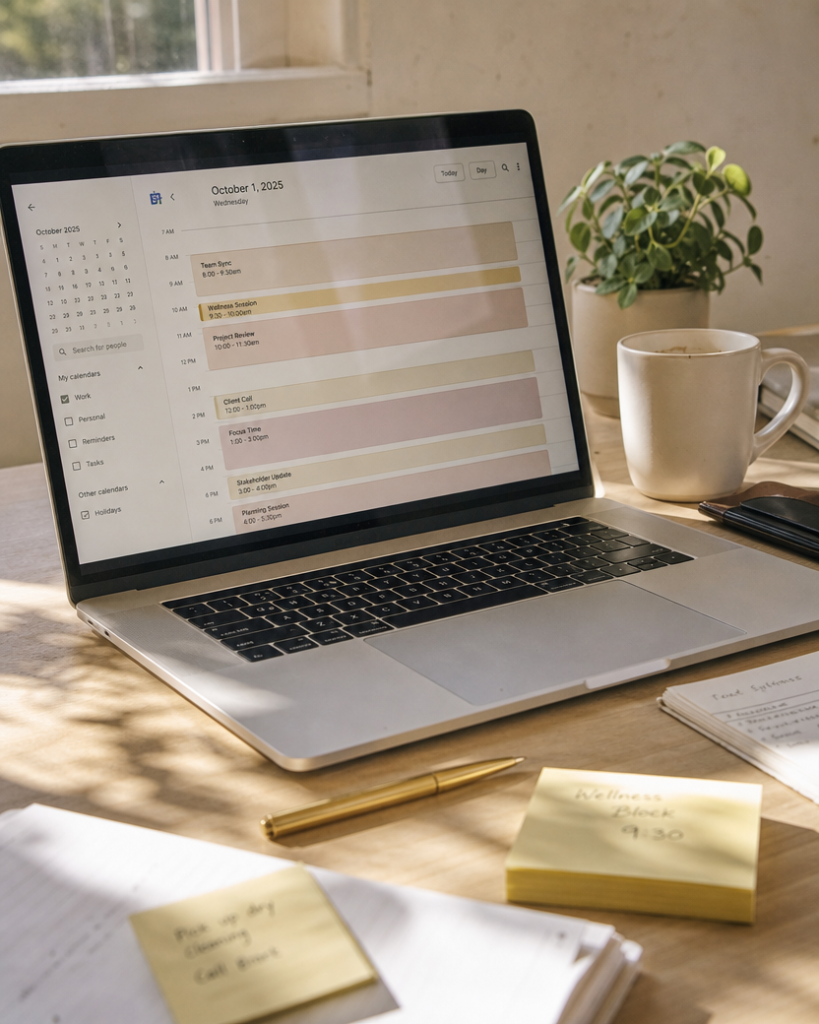
So meditation at work turns up framed as personal optimisation. Learn to regulate. Build resilience. Come back Monday able to absorb more. Here I’ll be blunt, because the polite version of this sentence has been circling for a decade without ever landing: a nervous system that braces at 9 a.m. every Tuesday isn’t malfunctioning. It’s reporting. Your body isn’t broken — it’s bracing, and it’s bracing at something specific. A practice whose entire mechanism is putting you back in contact with your own body will make that report louder, not quieter. Which is roughly the opposite of what got purchased.
The performance claim is where the evidence thins out
In 2025 a team led by Maris Vainre published the biggest look at this question we have, in the journal Stress and Health: 99 randomised controlled trials, 16,054 participants. If meditation at work makes people perform better, that’s where it should show up. Against a passive control — people who got nothing at all — task performance did improve a little, a Hedges’ g of 0.25. Small, but present. Against an active control, meaning people who got some other intervention rather than nothing, the effect was 0.12 and not statistically significant. Four studies, a confidence interval running from −0.3 to 0.55. Nothing you could bank on.
The authors’ own verdict is the part I’d print on the calendar invite. Confidence in the review’s results, graded by the standard GRADE method, is “very low” — high risk of bias in nearly every trial, substantial heterogeneity, and 41 registered trials whose results were never reported at all. Prediction intervals crossed zero in every domain they looked at, which in plain terms means negative effects can’t be ruled out. That isn’t a scandal. It’s the ordinary state of an evidence base that got marketed several years ahead of itself. When somebody tells you meditation at work is proven to lift performance, they haven’t read this paper.
The finding that never makes the slide deck
Then there’s the result I find genuinely funny. In 2018 Andrew Hafenbrack and Kathleen Vohs published a run of experiments in Organizational Behavior and Human Decision Processes — the mainstream management journal, not some fringe outlet. Their finding is right there in the title: mindfulness meditation impairs task motivation but not performance. A short meditation reliably reduced people’s motivation to get on with mundane tasks. Pleasant ones too. Performance itself held steady in almost every experiment, because the same practice helped people detach from the stress and focus once they’d started. Two effects, pulling against each other, cancelling out.

Stay with the mechanism, because it’s the whole argument of this piece. They traced the motivation drop to two things: less focus on the future, and lower arousal. Meditation pulls you into the present and takes the fizz out of the body. Motivation for tedious work runs largely on future-focus and fizz — on the anxious hum of the thing not being done yet. Remove that and the tedium of the tedious task becomes very difficult to ignore. Meditation at work doesn’t make you want to do the pointless job. It makes the pointlessness legible. An employer buying meditation at work as a compliance tool has bought a device that quietly asks its employees whether the task is worth doing.
What meditation at work actually delivers
None of that makes the practice useless. It makes the label wrong, which is a different complaint, and I want to be fair to the evidence in both directions. On the health side the strongest synthesis comes from Ruben Vonderlin and colleagues, published in Mindfulness in 2020: 56 randomised trials, 2,689 participants against 2,472 controls. Workplace programmes reduced stress, burnout, mental distress and physical complaints, and improved wellbeing, compassion and job satisfaction. Effect sizes ran from Hedges’ g 0.32 to 0.77 — small to large — and they held at follow-ups out to twelve weeks.
Put the two bodies of evidence side by side and the picture is unusually clean for this field. Meditation at work helps the person. The case that it improves the work is thin. Which is exactly what you’d predict of a practice whose real function is to increase contact with your own state, including the states your job manufactures. An honest sales line would read: this will help you feel less wrecked, and it may leave you less willing to be wrecked. Nobody is putting that on a purchase order.
A caveat on the Vonderlin numbers, since I keep asking you to hold sources at their true size. Most of those outcomes are self-reported. The follow-ups stop at twelve weeks. The review’s own moderator analyses couldn’t consistently explain why some programmes worked far better than others, and its results on work engagement and productivity were limited by too few studies and a couple of distorting outliers. Real signal — modest, self-reported, short-range.
A meditation at work you can do between two calls
Practically, most workplace programmes fail for a dull reason: a booked thirty-minute session is the first thing to die in a bad week. So don’t build meditation at work on a calendar slot. Build it into the seams. Between two calls, before your hand goes back to the mouse — feet flat on the floor, back against the chair, eyes open and soft on some neutral patch of desk. Three breaths where the out-breath runs longer than the in. Then notice, changing nothing, what your jaw is doing, what your shoulders are doing, and how high in your chest the breath is sitting. That’s the whole thing. Forty seconds.
Two rules keep it alive on contact with an actual job. First: notice, don’t fix. The instruction is to read the dial, not to force the needle down — turn meditation at work into another performance target and you’ve rebuilt the original problem in miniature. Second: don’t dose it right before you need drive. The Hafenbrack finding cuts both ways, and if you sit for five minutes before a hard conversation you may well arrive calm and oddly uninterested in having it. Put the practice after the demanding thing, or in the flat stretches of the day. Keep your edge for the moment you need it.
One more, less comfortable. Think about whose device it’s on. If your meditation at work runs through an employer-provided app with your name on the licence, you’re doing an intimate practice inside a system your employer administers, and somebody’s dashboard may show your streak. Use it if it’s what you’ve got. Just don’t mistake the app for the practice — the seam-sized version above needs no account, no login and nothing to keep up.
Four weeks, then read the result honestly
Here’s the test I’d actually run. Do the forty-second version of meditation at work several times a day for four weeks — no app, no streak, no ambition. Then check two readings: what your body does on Sunday evening, and what it does at the one moment in the week you quietly dread. If both have softened, good. Keep going; the practice is doing what the research says it does. If the practice has gone well and those two readings haven’t shifted at all, that is the important outcome, and it isn’t a failure of your meditation at work.

It means the reading is stable, and a stable reading is information. Something in the job is producing it — the volume, the manager, the ambiguity, the shift pattern, the fact that you’re covering a second role because nobody was hired into it. Meditation at work sharpens the instrument. It doesn’t rewire the room the instrument is standing in. A month of meditation at work that ends with “I can feel precisely what this job does to me, and a month ago I couldn’t” is a month that worked.
Where the practice stops and the job starts
There’s a line here worth naming out loud, because organisations blur it constantly. Meditation at work cannot fix understaffing. It can’t fix a fourteen-hour shift, an unsafe patient ratio, a manager who shouts, or pay that doesn’t cover the rent. When a meditation at work programme gets rolled out instead of fixing any of that, the practice is being handed over as a sedative, and that use is worth refusing even while you keep the practice itself. Take the class. Keep the complaint. The two were never in competition, whatever the framing in the invite implies.
And one limit that has nothing to do with work. If you haven’t slept properly for weeks, if dread is waiting for you when you wake, if panic arrives out of nowhere or you’ve stopped wanting things you used to want — that is not a longer sit. That’s a GP or a clinician, this month, and meditation at work is a poor substitute for either. Practice can also stir things up rather than settle them, which I’ve written about elsewhere and won’t soften here.
Take the practice. Keep the question.
So go to the session if you want to. There’s something real inside it, at a size the research genuinely supports: less stress, less burnout, more of your own life audible to you while you’re living it. Take the forty seconds between two calls and keep them for years. Meditation at work is worth having on its honest terms, which are smaller and more interesting than the terms it was sold on.
What I’d hold onto is the question the practice hands back. A calmer, clearer nervous system doesn’t file fewer complaints about a bad situation. It files better ones. If your body keeps reporting the same thing at the same hour every week after a month of steady practice, believe the report. That isn’t the practice failing you. That’s the practice working, and the answer being about the job.
Meditation for Cancer builds on this same practice, written specifically for patients, families, and caregivers.
References
• Vainre M, Galante J, Dalgleish T, et al. (2025). “Mindfulness-Based Programmes for Work Performance: A Systematic Review and Meta-Analysis of Randomised Controlled Trials.” Stress and Health 41(6) — doi.org/10.1002/smi.70123 (99 RCTs, 16,054 participants, median n=92. Task performance up to 4 weeks post-intervention: vs passive controls Hedges’ g = 0.25, 95% CI 0.06–0.44, p = 0.01 across 22 studies; vs ACTIVE controls g = 0.12, 95% CI −0.3–0.55, p = 0.43 across only 4 studies. Contextual performance g = 0.40; adaptive performance g = 0.19; no significant effect on counterproductive behaviour.)
• Hafenbrack AC, Vohs KD (2018). “Mindfulness Meditation Impairs Task Motivation but Not Performance.” Organizational Behavior and Human Decision Processes 147:1–15 — doi.org/10.1016/j.obhdp.2018.05.001 (Multiple experiments: mindfulness inductions reduced motivation to tackle mundane tasks in Experiments 1–4 and pleasant tasks in Experiment 2; decreased future focus and decreased arousal serially mediated the effect; task performance was unaffected in all experiments but one, explained by mindfulness aiding detachment from stressors and so improving task focus.)
• Vonderlin R, Biermann M, Bohus M, Lyssenko L (2020). “Mindfulness-Based Programs in the Workplace: a Meta-Analysis of Randomized Controlled Trials.” Mindfulness 11:1579–1598 — doi.org/10.1007/s12671-020-01328-3 (Random-effects synthesis across 56 studies, n = 2,689 participants and n = 2,472 controls. Between-group effects: MBPs reduced stress, burnout, mental distress and somatic complaints and improved mindfulness, well-being, compassion and job satisfaction, “all with small to large effect sizes ranging from Hedges’ g = 0.32 to 0.77”; results maintained at follow-ups ≤ 12 weeks.)