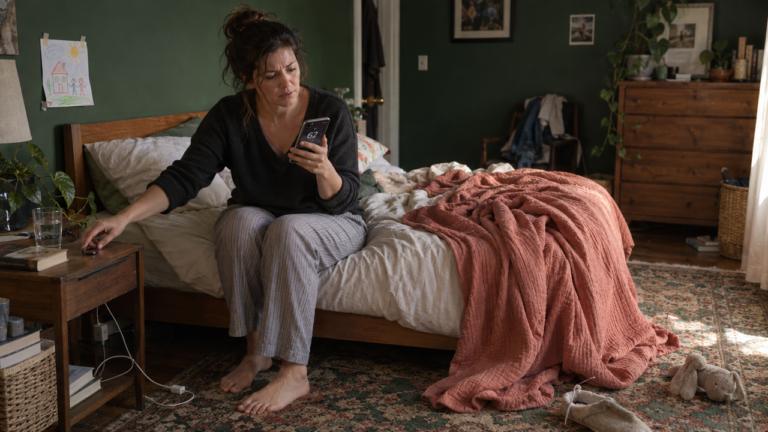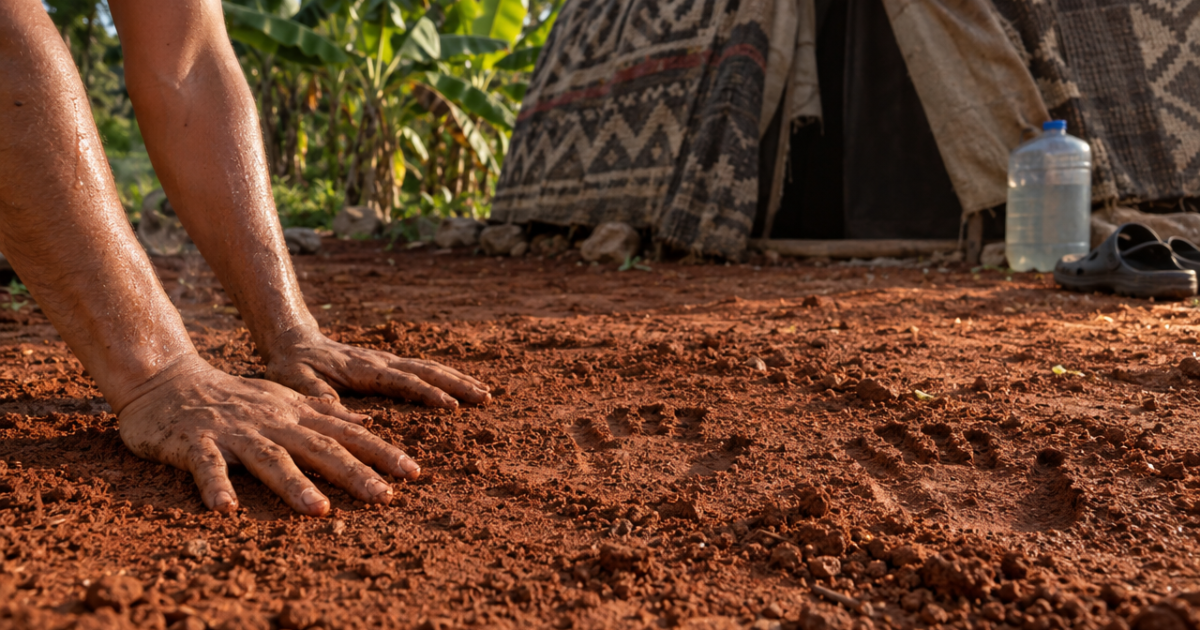
Temazcal, or Swear Lodge dates back to early civilizations. Sweat Lodge is used in the Native American tribes as well as in Mexico, but early mentions from the 13th Century of sweating rooms where plants are used can be found in Europe also.
The doorway of a temazcal is low, so nobody walks out of one. You come out close to the earth, out of the heat and the steam and the dark, and the first thing you notice is the air. Here in the Yucatán it can be 36 °C outside with 80% humidity, and it still feels cold on your skin.
You're glad. Plainly, stupidly glad you made it through. Then you go down.
That moment beside the lodge is the oldest grounding meditation I know. Nobody announces it and nobody times it. Inside, my ears and face burn, and moving an arm can feel like a hot iron on the skin. When the door opens for the last time and I'm out, my body wants one thing before anything else: to be low, on the earth, and still.
This is the first of four short pieces about the way home from the heat. In September I wrote about retreat integration and used the order the body follows after a temazcal as its spine: ground, rest, rinse, eat. Each new piece takes one of those steps further. This one is the ground, and the word that has grown up around it online. A grounding meditation means very different things depending on who's selling it.
Two things called grounding meditation
Search for grounding meditation and you'll find two practices sharing one name.
The first is about attention. Feel your feet on the floor, notice the weight of your body in the chair, name five things you can see. Therapists teach versions of it for panic, and it overlaps with what I wrote about meditation for anxiety. This kind of grounding meditation asks for nothing except your attention and whatever you happen to be standing on.
The second is earthing. Its claim is physical: bare skin on soil, or a conductive patch or mat wired to the earth, lets electrons move from the ground into your body, and that changes your physiology. Better sleep, less pain, lower stress hormones, blood that flows more easily. It comes with products.
The two blur together all the time. A grounding meditation script tells you to imagine roots growing down from your feet, and the shop page beside it sells you the mat. I trust them differently, and I'll show you why.
What does grounding meditation feel like after a sweat lodge?
Not like an exercise. Beside the lodge there's no grounding meditation script. The people I sit with call the temazcal the womb of the earth, and coming out of it really does feel like a birth: from the heat, the wet and the dark into open air, as if a new life had just started. You don't imagine roots. You're lying on the actual ground, still too hot to think much, and for a while that's all there is.
I've been in lodges in Peru, Guatemala, Oaxaca, Jalisco, near Mexico City and in Hungary, and the way into them differs a lot, as I described in mantra meditation. The way out has always started the same way for me. Low.
Why the body goes down first in a grounding meditation
There's a plain physical reason a grounding meditation after heat starts low, and it has nothing to do with electrons.
In 2023, Peter Kaiser and colleagues at the Medical University of Innsbruck went through seventeen years of records at their trauma centre and found 209 patients injured in connection with sauna bathing. Slips and falls were the most common cause. Dizziness or fainting came second, at 30% of the recorded causes, and most of the head and face injuries came from those. Their advice for preventing the fainting was simple: drink enough water before and after.
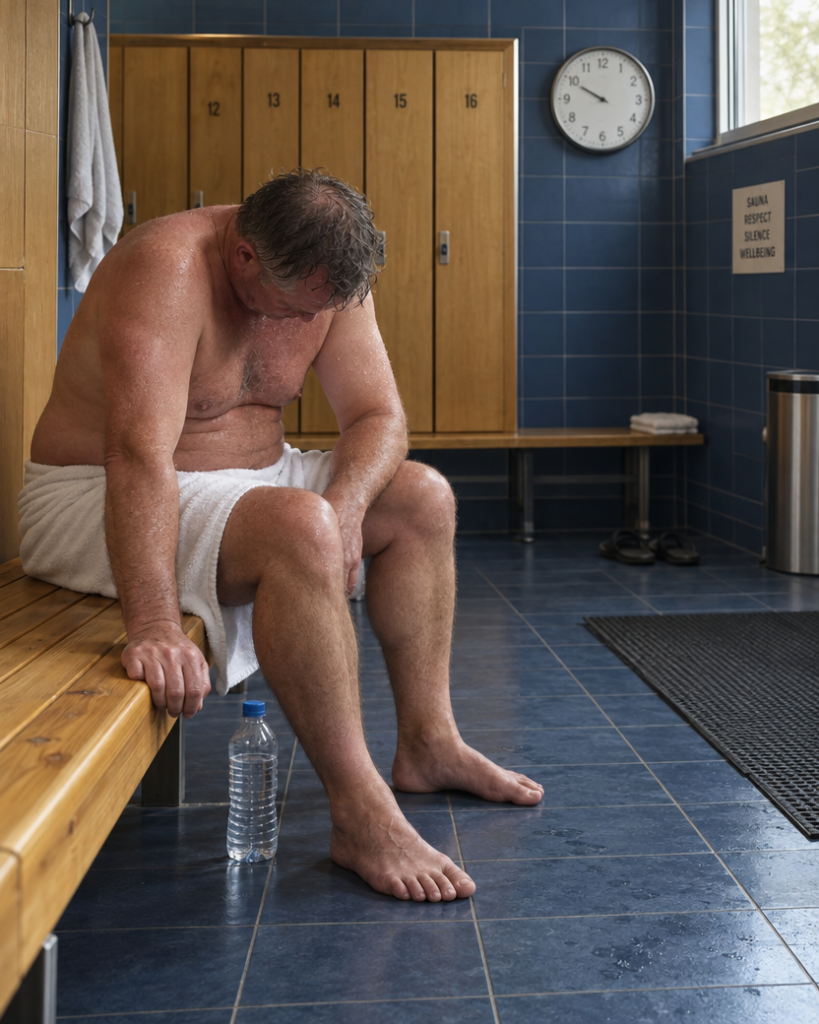
A sauna isn't a temazcal. The heat is dry, the room is wood, and the Innsbruck records can't tell you why each person went down. But the pattern is easy to recognise. Heat followed by standing up is the combination that puts people on the floor the hard way. Beside the lodge you skip that step. You come out low, you stay low, and you get up when your body is ready to.
I never thought of that grounding meditation beside the lodge as a safety measure. It's probably one anyway.
Is a grounding meditation just lying down?
Partly, yes, and I don't think that's a small thing. A grounding meditation after heat starts with gravity: your weight going down, the surface taking it, your heart no longer having to push blood uphill to a head that's standing two metres off the floor. Whether that surface needs to be soil is a separate question, and that's where the research comes in.
What the earthing studies behind grounding meditation found
Much of the earthing literature traces back to a small group of researchers and to Clint Ober, a retired cable-television executive who began experimenting with conductive bed pads at the end of the last century. Here are four of the studies, read directly.
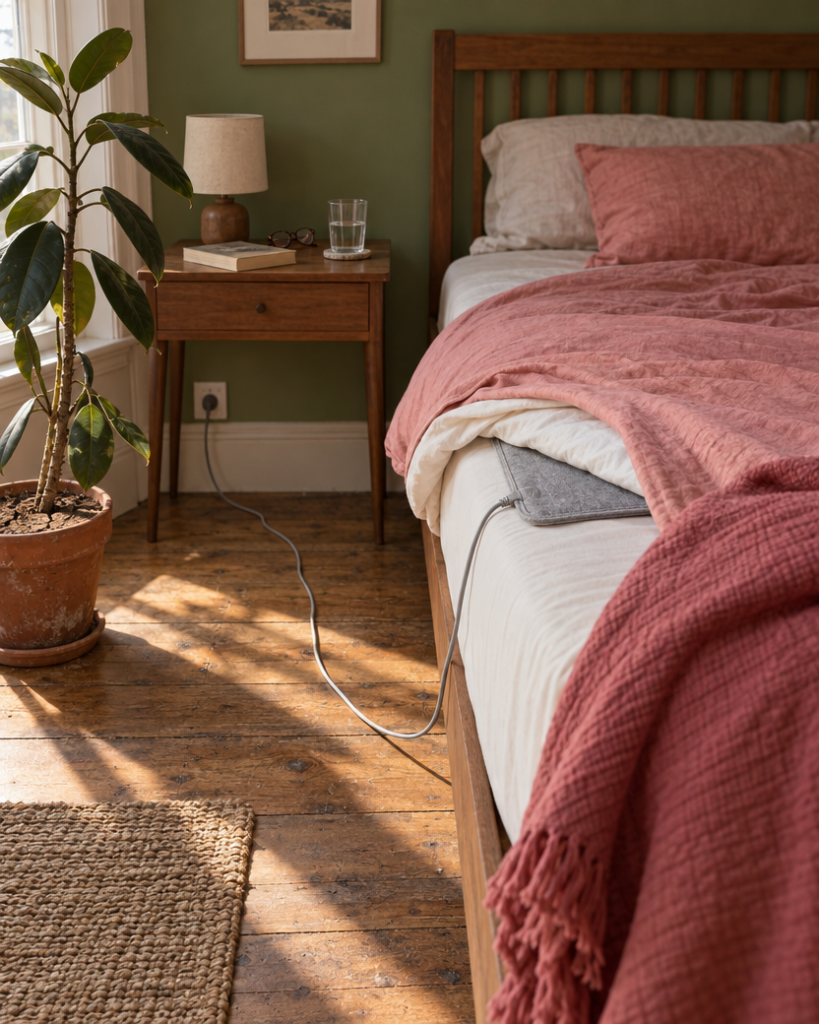
In 2004, Ghaly and Teplitz grounded twelve people with sleep problems, pain and stress in their own beds for eight weeks, using a conductive mattress pad. Night-time cortisol came down, and nearly everyone reported sleeping better and hurting less. There was no comparison group. The same twelve people were measured before and during.
In 2013, Gaétan Chevalier and colleagues sat ten healthy adults in reclining chairs in a dim, soundproof room for two hours, with conductive patches on the soles of their feet and the palms of their hands, wired to a stainless-steel rod pushed into the earth outside. Under the microscope their red blood cells carried more surface charge and clumped together less. The authors called grounding one of “the simplest and yet most profound interventions” for reducing cardiovascular risk. On the evidence of ten people and two hours, that's a big sentence.
In 2019, the same lead author ran a six-week trial with sixteen massage therapists at the Chopra Center in California. They weren't grounded in the first week, were grounded at work and in bed for the next four, and were ungrounded again for the last; the trial is described as randomised and double-blind. While grounded, they reported less pain, fatigue and low mood, and more energy.
And in 2012, Chevalier, Stephen Sinatra, James Oschman and two Polish colleagues pulled the work together in a review for the Journal of Environmental and Public Health, arguing that losing contact with the Earth's surface electrons may be a major contributor to modern ill health.
Read like that, it sounds as if a grounding meditation on bare soil should do things a meditation on a wooden floor can't. So I kept reading.
Now the part that argues the other way
I'd like the soil to make grounding meditation special. I've spent years lying on it after the lodge. That's exactly why I don't trust my own wish here.
Start with who did the research. The 2012 review ends with a disclosure: Chevalier, Sinatra and Oschman were independent contractors for the company sponsoring earthing research, and owned a small percentage of its shares. The 2019 trial shares its lead author with that review, and so does the 2013 blood study. None of that makes the findings false. It does mean that much of the case I could find was made by people with a stake in the answer.
Then look at the size. Twelve people and no control group. Ten people for two hours. Sixteen massage therapists rating their own pain. These are pilot studies, and the claims hung on them are large.
I went looking for an independent systematic review of earthing, with a risk-of-bias assessment, in a peer-reviewed journal. I didn't find one. The reviews I did find were written by people working in the field or promoting it. So I won't tell you that a grounding meditation on soil does something one on a floor can't, because I can't find anyone who has shown that fairly.
Maybe it's the outdoors and not the electrons
There's a cleaner study that points somewhere else. In 2019, Hunter and colleagues asked 36 city dwellers to spend at least ten minutes, three times a week, somewhere outdoors that gave them a sense of contact with nature, whenever it suited them, for eight weeks. Their salivary cortisol fell by 21.3% an hour beyond its normal daily decline. The best return per minute came between 20 and 30 minutes, and whether people sat or walked made no difference to the cortisol drop.
Nobody in that study was asked to take their shoes off. It was small and observational, without a control group, so it proves little on its own. But if 36 people's stress hormones dropped outdoors with their shoes on, a wire to the ground isn't the only candidate for what helps. For a grounding meditation that's good news, because the outdoors is free.
What I can't settle
Beside the lodge everything happens at once: air that feels cold, open sky, stillness, relief, other people lying a few metres away, and bare skin on bare earth. That company is the part I said was missing from the meditation room. I can't separate those things, and no study I found has tried, after heat or anywhere else. So when I say grounding meditation, I mean the weight and the attention. The electrons I'll leave to whoever can test them without selling them.
How to do a grounding meditation after heat, or after a long day
You don't need a temazcal for a grounding meditation. A sauna, a hot bath, a hard run in the sun, or a day that left you running hot in a different way. The order is the same.
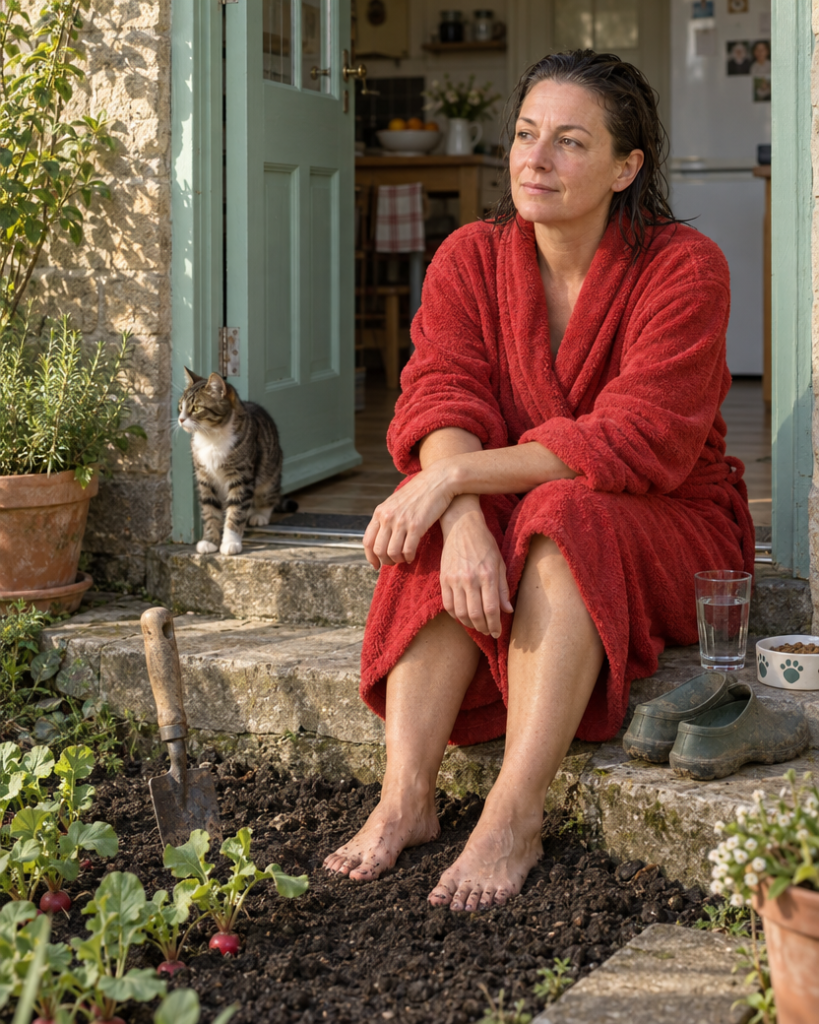
- Get low before you get up. Every grounding meditation after heat starts here. Sit or lie down first, then come up in stages: lying, sitting, kneeling, standing. If the room tilts, go back a stage.
- Use whatever surface is there. Grass, a garden, a beach, a bathroom floor. If you can get outside, do; the Hunter study suggests twenty to thirty minutes outdoors is a good dose, with or without shoes.
- Put your attention on weight. Where does your body touch the ground, and which parts press down hardest? That's the whole grounding meditation. If you want to take it further, it turns into a body scan.
- Let the out-breath run longer than the in-breath. Two or three rounds of cyclic sighing fit here.
- Drink water. That's the Innsbruck team's advice, and they've seen what happens when people skip it.
- If you're curious about a grounding mat, buy it knowing who did the research. Then notice honestly whether a night on it feels any different from a night on the same bed without it.
When a grounding meditation isn't the answer
If you feel faint, confused or sick, or your heart is racing and it doesn't settle within a few minutes of lying down somewhere cool, that's not something to meditate through, and no grounding meditation is meant for it. Get help, and call your local emergency number if it gets worse. Heat isn't for everyone either. A 2001 review of sauna bathing by Hannuksela and Ellahham lists unstable angina, a recent heart attack and severe aortic stenosis as reasons to stay out, and warns that alcohol in the heat raises the risk of low blood pressure, heart rhythm problems and sudden death. If you have a heart condition or take blood pressure medication, talk to your doctor before a sauna or a sweat lodge.
Back on the earth beside the lodge
Inside a temazcal you've been sitting on bare earth the whole time. Almost every lodge I've sat in has had a floor of soil, not concrete or tile. A friend of mine lines his with earth the ants have already turned over, and it's so fine and soft it's like sitting on a carpet made of ground.
So when you come out and go down, it isn't your first contact with the earth that night. It's the same earth, with sky over it instead of blankets, and air that feels cold at 36 degrees. I don't know what the soil adds. I do know what it's like to stop there, low and still and glad to be alive, before standing up into anything. That's the grounding meditation I trust, and nobody has to sell it to you. When you're ready, the next step home is to lie back and look up.
References
Chevalier G, Patel S, Weiss L, Chopra D, Mills PJ (2019). The effects of grounding (earthing) on bodyworkers' pain and overall quality of life: a randomized controlled trial. Explore, 15(3), 181–190. https://doi.org/10.1016/j.explore.2018.10.001
Chevalier G, Sinatra ST, Oschman JL, Delany RM (2013). Earthing (grounding) the human body reduces blood viscosity: a major factor in cardiovascular disease. Journal of Alternative and Complementary Medicine, 19(2), 102–110. https://doi.org/10.1089/acm.2011.0820
Chevalier G, Sinatra ST, Oschman JL, Sokal K, Sokal P (2012). Earthing: health implications of reconnecting the human body to the Earth's surface electrons. Journal of Environmental and Public Health, 2012, 291541. https://doi.org/10.1155/2012/291541
Ghaly M, Teplitz D (2004). The biologic effects of grounding the human body during sleep as measured by cortisol levels and subjective reporting of sleep, pain, and stress. Journal of Alternative and Complementary Medicine, 10(5), 767–776. https://doi.org/10.1089/acm.2004.10.767
Hannuksela ML, Ellahham S (2001). Benefits and risks of sauna bathing. American Journal of Medicine, 110(2), 118–126. https://doi.org/10.1016/s0002-9343(00)00671-9
Hunter MR, Gillespie BW, Chen SY (2019). Urban nature experiences reduce stress in the context of daily life based on salivary biomarkers. Frontiers in Psychology, 10, 722. https://doi.org/10.3389/fpsyg.2019.00722
Kaiser P, Seeher U, Krasniqi A, Keiler A, Crazzolara R, Meryk A (2023). Injuries related to sauna bathing. Injury, 54(7), 110825. https://doi.org/10.1016/j.injury.2023.05.056