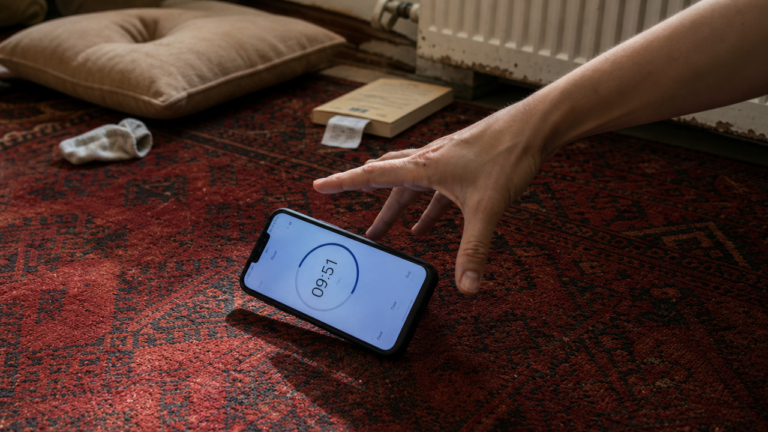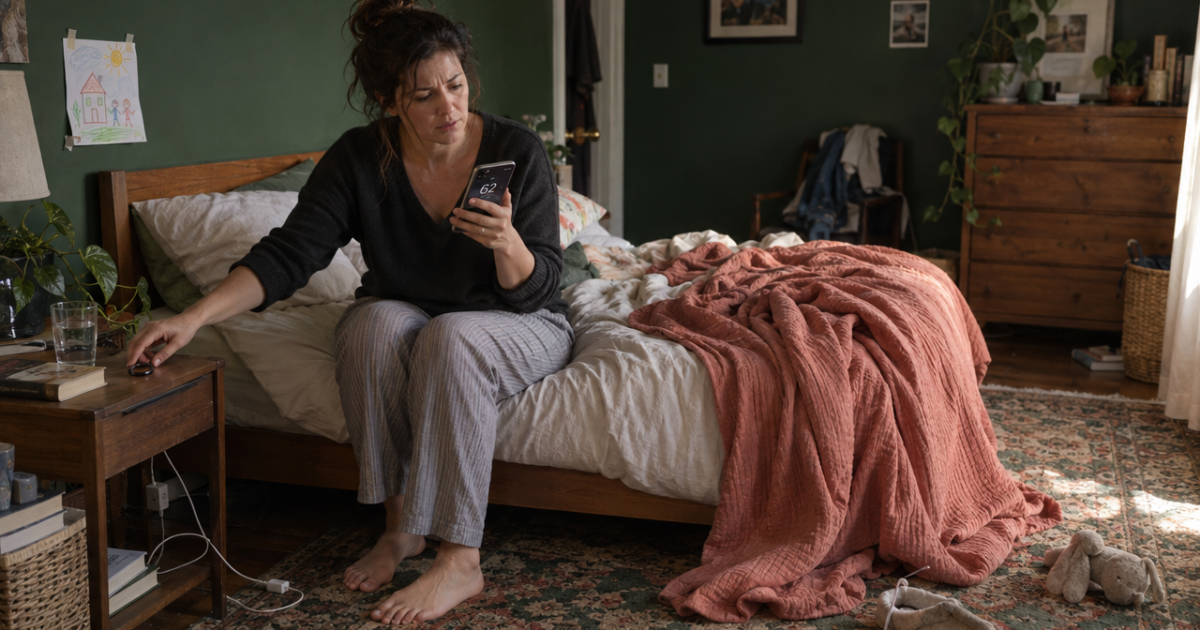
The ring on your finger knew before you did. You haven't opened the curtains yet, and the app has already decided how you slept, how recovered you are and, if you sat for twenty minutes last night, whether that sitting showed up in your heart rate variability. This morning the number is lower than yesterday's.
So did the meditation fail?
That question is new, and I mean that literally. Meditation tracking, the habit of letting a device score your practice, is barely fifteen years old. In the places where I learned to sit still, nobody ever asked it. A yagé night in the Putumayo ends when the taita stops singing. A temazcal ends after the fourth round. In the eco-village near Pokhara where I did my teacher training, the bowl rang and the session was over. Nobody walked out of any of those with a score.
Last week's Field Notes piece was about the meditation timer, the first thing the West added to practice that the traditions never had. This one is about the second addition: the number that comes afterwards. Meditation tracking in all its forms, the score, the graph, the weekly report with its little arrow pointing up or down.
What meditation tracking actually measures
Most meditation tracking today runs on one of two signals. The first is behaviour: how many minutes, how many days in a row, how many sessions this month. That's what nearly every app counts, and I wrote about its loudest form, the streak counter, back in August.
The second signal is physiological, and newer. A watch or a ring reads the tiny gaps between your heartbeats and reports heart rate variability, usually as a figure in milliseconds called RMSSD. Broadly, higher variability goes with a body that can shift gears easily. Lower goes with strain: illness, a late meal, alcohol, a short night, a hard training day.
You can see why it's tempting as a meditation score. If sitting calms the nervous system, shouldn't the number move? Sometimes it does. Just as often it moves for reasons that have nothing to do with the sitting, and the device has no way to tell you which.
Then there's the weekly report. Most meditation tracking apps now send one: total minutes, average session length, a comparison with last week, sometimes a badge. It looks harmless, and mostly it is. It also changes the question you bring to Sunday evening. The question used to be whether you sat. Now it's whether you beat last week.
Is the number from meditation tracking accurate?
At night, better than you might expect. In 2025, Dial and colleagues had 13 healthy adults wear five consumer devices at the same time across 536 nights, all checked against an ECG. For heart rate variability, the Oura Gen 4 ring came closest, with an average error of about 6%. WHOOP was acceptable at about 8%. Garmin's Fenix 6 came in around 10.5%, and the Polar Grit X Pro around 16%, with wide scatter from night to night.
Thirteen healthy adults is a small sample, so read those figures as a rough guide. Still, the sensor is mostly fine, depending on what's on your wrist. The trouble with meditation tracking starts after the measurement, when a number about your whole night gets read as a grade on twenty minutes before bed. A 6% error is small. Misreading what the number is about can be far bigger, and no validation study fixes that.
Why meditation tracking can make you enjoy the practice less
In 2016, Jordan Etkin at Duke University published six experiments in the Journal of Consumer Research on what happens when people measure something they do. The finding cuts both ways. Measurement made people do more of the activity. It also made them enjoy it less, because counting turned something done for its own sake into something that felt like work. Over time, that lost enjoyment showed up as people doing less, and feeling worse.
Her studies used everyday activities like walking and reading. Meditation wasn't one of them, so I'm stretching her result over a practice she didn't test, and I'll come back to that. But read the mechanism slowly and tell me it doesn't sound like meditation tracking. You sit down to rest. Something counts you. And the sitting turns, quietly, into a task you can do well or badly.
Meditation is about the worst place for that shift. Most of the teachers I've sat with spend years getting you to stop grading the moment. Meditation tracking asks you to grade it afterwards, in a font big enough to read before coffee.
When meditation tracking becomes the thing you worry about
Sleep researchers already have a name for the extreme version. In 2017, Kelly Baron and colleagues described three patients in the Journal of Clinical Sleep Medicine who had become so preoccupied with their sleep-tracker data that the tracking was part of the problem. They called it orthosomnia, from the Greek for straight or correct, because the patients were trying to perfect the data.
One of them had a lab sleep study showing normal deep sleep, and still asked “why does my Fitbit say I am sleeping poorly?” The authors note that consumer trackers couldn't reliably tell sleep stages apart, and that their patients' faith in the device was hard to shift anyway.
That's sleep, and it's three people. If you've read my piece on meditation for sleep, though, you know effort and rest don't mix. Meditation tracking moves the same trap somewhere new. You can now try hard to relax, and get marked on it.
Nobody in the temazcal hands you a score

Here's what I keep coming back to. The traditions I've learned from weren't careless about results. They put the evidence somewhere a device can't reach.
None of them made the result a number, and none of them gave it to you alone. A temazcal ends after the fourth round, and people come out into the air together. Whatever happened gets talked about, or doesn't, among the people who were there. On a yagé night, the taita decides when it's over. The group and the teacher were the measuring instruments. They were slow, social and not very precise.
There's a reason the old instruments were slow. Whatever a ceremony or a retreat changes in someone tends to show up days or weeks later, in how they speak to their kids, how they sleep, whether they pick the fight. Nobody in those traditions expected the evidence to arrive the next morning. Meditation tracking expects exactly that, and it trains the expectation into you, one notification at a time.
Meditation tracking swaps both for something fast, private and extremely precise about the wrong thing. Your ring can give you your RMSSD to the millisecond. It can't tell you that you were less sharp with your sister at lunch, and that's the kind of result a good teacher would actually ask you about.
Now the part that argues the other way
I've made the case against the score. Here's the case for it, and parts of it are strong.
First, the traditions counted too. Britannica describes the rosary as prayers “recited and counted on a string of beads,” and notes the practice turns up in nearly every major religion, including the Buddhist mala, especially common among Tibetan Buddhists. So counting isn't a Western invention. What's new is counting the outcome. A mala counts repetitions you did. It never told anybody how calm they'd become.
Second, measured physiology can be the practice itself. In HRV biofeedback, you breathe slowly while watching your heart rate variability live on a screen. In 2017, Goessl, Curtiss and Hofmann pooled 24 studies with 484 participants in Psychological Medicine and found a large drop in self-reported stress and anxiety, a Hedges' g of 0.83 against control conditions. The authors still called for better-controlled studies. Notice where the number sits, though: during practice, as a guide, rather than after it as a verdict. That distinction is most of what I'd keep.
Third, my main evidence doesn't test meditation. Etkin studied walking and reading. Baron described three people with sleep trackers. I looked for a trial comparing meditators who use meditation tracking against meditators who don't, and I couldn't find one. So I can't tell you meditation tracking makes practice worse. I can tell you the mechanism is well documented next door, and that nobody seems to have checked our room.
And some people really do sit more with data. If a weekly graph is the only thing that gets you onto the cushion, that's a real gain. Etkin's own studies found measurement increased how much people did.
How to use meditation tracking without letting it grade you
If you keep the ring, and plenty of people should, this is how I'd set up meditation tracking.
Count the act, and leave the outcome alone. Minutes and days are fine; they're your mala. A calm score after each session is the part to switch off or ignore. You were there. You don't need a device to tell you how it went.
Look at the week, not the morning. One night's HRV moves with wine, a late dinner, a cold coming on or a hard workout. A single number after one sitting tells you almost nothing about the sitting. A session that felt like nothing happened is weak evidence either way, and so is a single reading.
Use live numbers as practice. If you like data, try a biofeedback session where you breathe slowly and watch the screen while you do it. That's the version with evidence behind it.
Run a week without it. Take the ring off for seven days, or hide the meditation tracking screen, and notice whether you sit more or less, and how the sitting feels. That's the experiment nobody has run for you. You can run it on yourself, starting tonight.
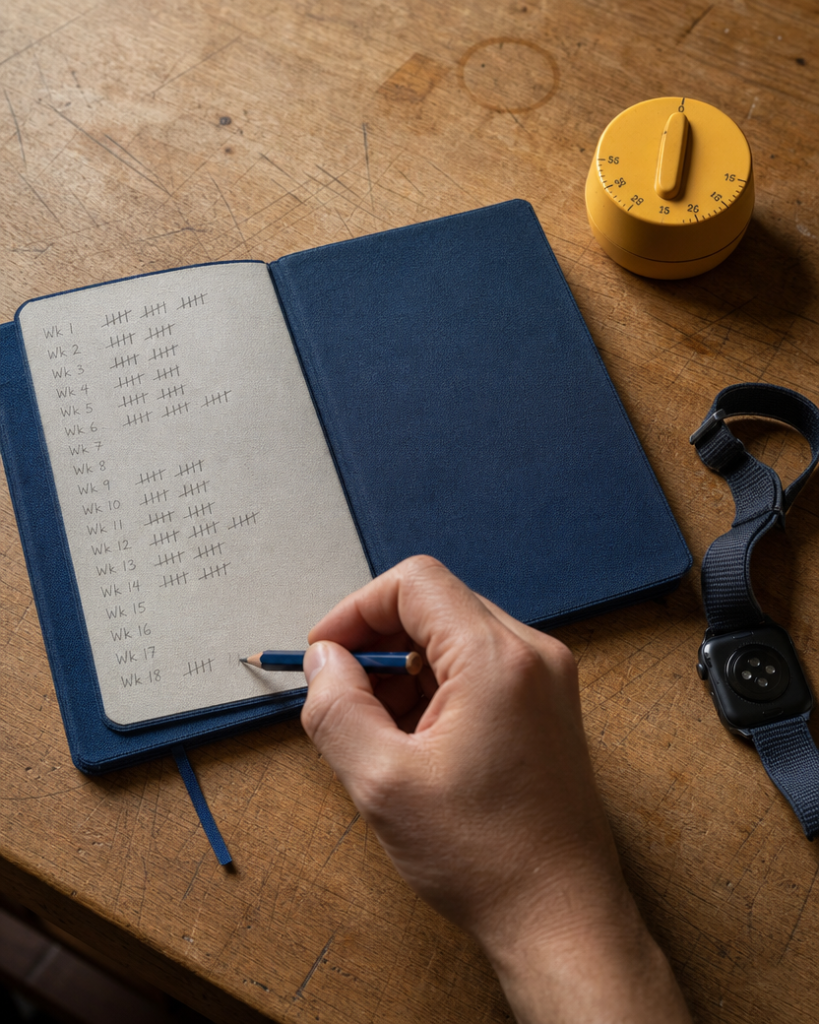
If the week off feels like relief, that tells you something. If you sit less and miss the graph, that tells you something too, and it's a fair reason to switch meditation tracking back on. Either way you'll have a result that came from you, and the ring had no say in it.
Bring the question to a person. Ask whoever you sit with what they've noticed in you. It's slower and less precise than meditation tracking. It also measures what you came for.
When the numbers are a doctor question, not a meditation tracking question
A consumer wearable isn't a diagnostic device, and meditation tracking isn't a health check. If your resting heart rate or HRV has shifted sharply and stayed there for more than a few days, especially alongside fatigue, fever, palpitations, chest pain or fainting, see a doctor and take the data with you. Don't try to meditate the number back up. And if tracking your sleep or your practice has turned into checking, worrying and lying awake, raise it with a GP or a sleep specialist. Cognitive behavioural therapy for insomnia exists for that loop.
The number in the morning
Back to the ring and this morning's lower number. It might mean you slept badly, ate late or are coming down with something. It almost certainly doesn't mean last night's twenty minutes failed. The device has no idea what those twenty minutes were for.
I'm not asking you to throw the ring in a drawer. I'm asking you to notice who's doing the measuring. For most of the history of meditation, it was you and the people around you, over months. For the last fifteen years or so, it's also been an algorithm, every morning, before breakfast.
Meditation tracking gave us something no tradition offered: a private, instant verdict. Keep the counting if it gets you to sit. Be suspicious of the verdict. The old measures were slow, and they needed other people. They also measured the right thing.
References
Dial MB, Hollander ME, Vatne EA, Emerson AM, Edwards NA, Hagen JA (2025). Validation of nocturnal resting heart rate and heart rate variability in consumer wearables. Physiological Reports, 13(16), e70527. https://doi.org/10.14814/phy2.70527
Etkin J (2016). The hidden cost of personal quantification. Journal of Consumer Research, 42(6), 967–984. https://doi.org/10.1093/jcr/ucv095
Baron KG, Abbott S, Jao N, Manalo N, Mullen R (2017). Orthosomnia: are some patients taking the quantified self too far?. Journal of Clinical Sleep Medicine, 13(2), 351–354. https://doi.org/10.5664/jcsm.6472
Goessl VC, Curtiss JE, Hofmann SG (2017). The effect of heart rate variability biofeedback training on stress and anxiety: a meta-analysis. Psychological Medicine, 47(15), 2578–2586. https://doi.org/10.1017/S0033291717001003
Britannica Editors. Rosary. Encyclopædia Britannica. https://www.britannica.com/topic/rosary