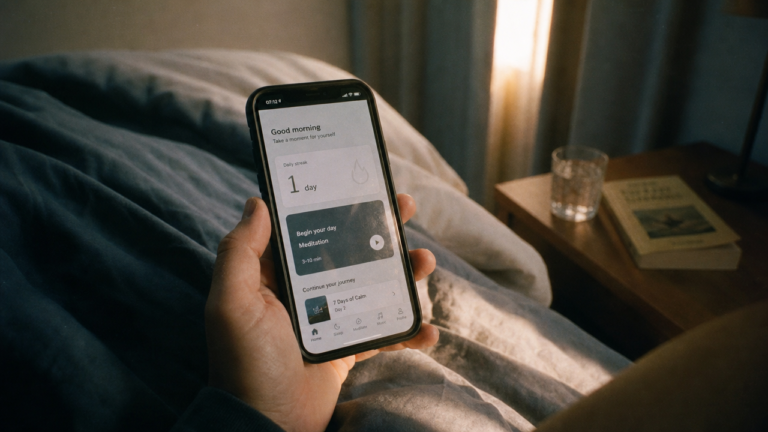
The lodge in Peru had four rounds in it. I didn’t know that going in, because nobody had said so, and nobody said so afterwards either. I worked it out from the inside, the way you work out how deep a river is by walking into it. There was no clock in that lodge and no phone within a hundred metres of it. The door opened when the man running it decided the door opened, and between those openings there was heat, and singing, and however long it took.
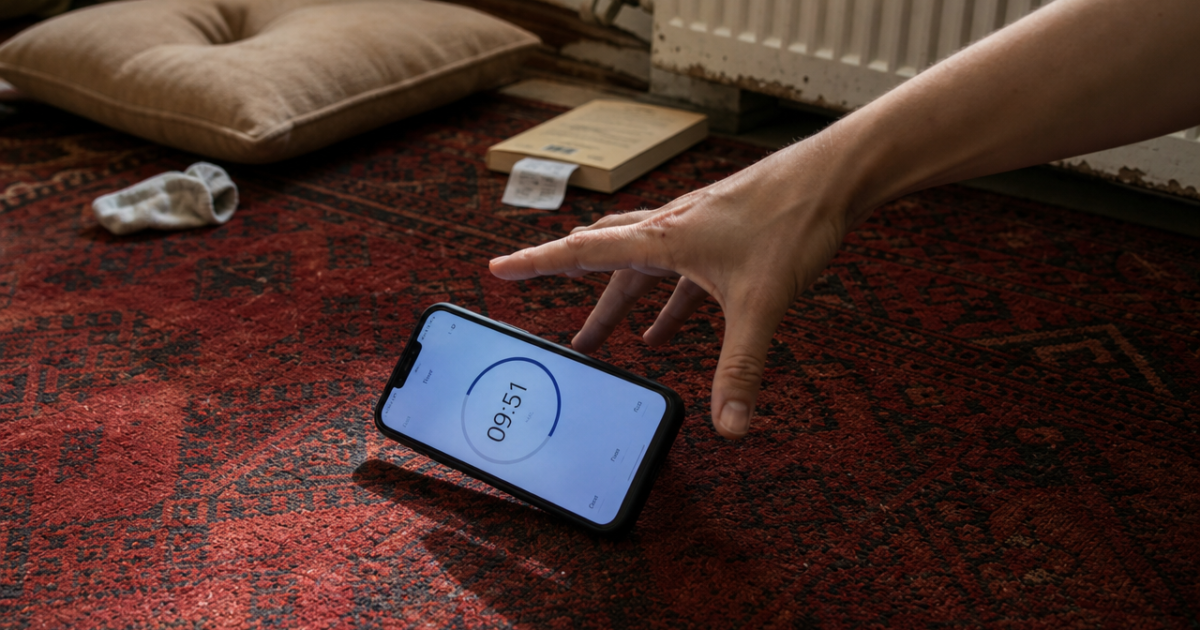
Some weeks later I was sitting on a floor in a quiet room with a cup of tea going cold beside me, and the first thing I did — before my eyes were shut, before I’d taken a single breath on purpose — was pick up a phone and choose a number. Ten minutes. I chose it the way you choose a parking bay. That small decision is what this article is about, because a meditation timer is the one piece of equipment in the entire practice that none of the traditions I’ve sat in ever handed me, and I’ve come to think it changes more than we admit.
What the traditions handed me instead of a meditation timer
Go through them one at a time and the pattern is hard to miss. The temazcal ends on the fourth round. In the Putumayo, the yagé night ended when the taita stopped singing and the trees started coming back out of the dark; the harmonica arrived somewhere in the middle of it and left again, and at no point did anyone announce a schedule. In Cuba the batá stop when the thing they are doing is finished, which is a sentence that sounds evasive until you’ve been in the room, at which point it’s the most obvious thing in the world. Below Annapurna, in an eco-village stacked into rice terraces, the bowls ran for as long as the bowls ran.

Not one of those had a meditation timer in it. More to the point, not one of them asked me how many minutes I could spare. The unit of measurement was never time — it was the event. A round. A song. A night. You don’t ask how long a conversation is going to be before you agree to have it, and none of those traditions thought of what they were doing as a duration you agree to in advance.
Which leaves the obvious question. If the practice worked for a few thousand years without one, what exactly did we add when we added the meditation timer, and what did we get in exchange?
Before I get carried away: the traditions did measure time
They did, and anyone who’s sat a Zen retreat will already be composing the correction, so let me write it myself. A period of zazen has traditionally been measured by a stick of incense. Not metaphorically — physically. The Science Museum Group in London holds a Chinese incense clock, object number 1952-184: three trays, two maze stencils, a latticework lid. The museum’s own description of how these things worked is better than anything I could paraphrase — “the length of incense sticks was standardised and the perfumes which could be incorporated within them enabled the user to keep time simply by using their sense of smell.” People have been measuring contemplative time for a very long time. They measured it in smoke.
So the honest version of my argument isn’t that nobody counted. It’s that a stick of incense and a meditation timer are different machines doing different jobs, and the differences are the whole point. The stick was lit by the house, for everyone in the room at once — you didn’t choose it around your calendar. It doesn’t count down anywhere you can see it, so there’s nothing to check. And when it’s gone it leaves ash and a smell, not a number. Nobody logged it. Nobody compared this week’s sticks to last week’s.
A meditation timer does the opposite thing on all three counts. You choose it, personally, per session, usually by deciding what you can afford. It counts down on a screen you have deliberately placed within reach. And it can hand you a figure afterwards, which some part of you will file. That’s three new ingredients in a practice that had none of them, all introduced in about the last forty years, all arriving so quietly that nobody argued about it.
What a meditation timer does to a sit while you’re inside it
Here’s the part about the meditation timer I find genuinely interesting, and it comes out of time-perception research rather than anything contemplative. Dan Zakay and Richard Block proposed what they called an attentional-gate model, presented at a symposium in Liège in 1994. The idea is that we have something like an internal pacemaker throwing off pulses, and between the pacemaker and the counter that tallies them sits a gate. In their words, “This gate is a cognitive mechanism controlled by the allocation of attention to time. If more attention is allocated, the gate opens wider or more fully.” More pulses get through. The interval is judged longer. Pay attention to time and time swells.
Now put that next to the other thing their paper says, which is that empty stretches already run long: “empty time should produce higher duration estimates than filled intervals.” Sitting still with nothing to do is about the emptiest interval a person can construct on purpose. It’s already the worst case. And into that worst case we introduce a meditation timer, a device whose only function is to make the passage of time a live question.
The experience is stranger than a simple stretch, and there’s a measurement of that too. Sylvie Droit-Volet and colleagues published two studies in PLOS ONE in 2019 with meditation-trained participants judging intervals during a meditation exercise. Short intervals, in the range of seconds, got underestimated. Long ones, in the range of minutes, got overestimated. And through all of it the participants reported that time passed faster while meditating than during the control exercise. Both things at once: a twenty-minute sit can feel like it went quickly and still measure long in your gut. That contradiction is a normal feature of how humans handle time, and a meditation timer sharpens both halves of it.
Then there’s the bell. Whatever else a meditation timer is, it’s a device that ends the practice with a reward sound, and rewards train behaviour. Sit with that for a second. The most emotionally charged moment of your daily practice is the moment it stops. I’ve caught myself — more than once — in the last ninety seconds of a sit, not meditating at all, just waiting to be released. That’s not meditation with a small flaw in it. That’s a different activity wearing meditation’s clothes, and it’s the same failure mode I wrote about with app streak counters: the number quietly becomes the thing you’re doing.
What the research says about how long, and why the meditation timer implies the wrong answer
If the number on the meditation timer matters, then bigger numbers should buy better outcomes. That’s the assumption baked into every eight-week programme that assigns forty-five minutes a day, and it’s the assumption behind the quiet guilt you feel setting the meditation timer to five. It’s been tested directly more than once now, and it hasn’t held up.
A meditation timer set to twenty didn’t beat one set to ten
Robert Palmer, Corey Roos, Nilofar Vafaie and Hedy Kober ran 372 adults through a four-arm trial published in Scientific Reports in 2023 — ten minutes of mindfulness, twenty minutes of mindfulness, and ten- and twenty-minute control conditions where people read a National Geographic article instead. Their conclusion, verbatim: “Dose–response relationships were minimal, suggesting that 10 and 20 min of meditation may improve state mindfulness comparably.” Double the time on the meditation timer, get roughly the same movement in state mindfulness.
Gerald Fincham, Kenneth Mavor and Barbara Dritschel found the same shape of result in Mindfulness in 2023. Four arms again — roughly ten or roughly thirty minutes, sitting or moving, practised daily for two weeks, 161 people completing. Well-being went up and distress went down in all four groups, and, in their words, “there were no significant differences between the conditions as a function of meditation dose or type.” Nobody practised more regularly at ten minutes than at thirty, either. Tripling the meditation timer bought nothing measurable.
And a meditation timer set to five beat one set to twenty
This is the one that stopped me. Sarah Strohmaier, Fergal Jones and James Cane randomised 71 healthy adults with little prior experience into four twenty-minute practices, four five-minute practices, or an audiobook control, all in person over two weeks, with every group listening to the same total length of material each session. Both practice groups beat the control. Then the result nobody ordered: “Unexpectedly, shorter practice had a significantly greater effect on trait mindfulness (d = 2.17; p < .001) and stress (d = − 1.18; p < .01) than longer practice, with a trend in the same direction for depression and anxiety.”
A d of 2.17 is not a rounding error. The authors are careful about what it means — their conclusion is that “shorter practices may initially be more helpful for novice practitioners in MBPs with minimal teacher contact,” which is a narrow claim about beginners working without much of a guide, and I’m not going to inflate it into anything grander. But it does mean that a beginner who sets the meditation timer to twenty because twenty sounds more serious may be handing themselves the worse of two options while feeling virtuous about it.
One more, because it’s about what the number actually produces. Christopher Berghoff and colleagues gave 77 college students either a ten-minute or a twenty-minute daily prescription for two weeks and had them keep diaries. The finding: “no significant group difference in total days meditated or overall time spent meditating.” Doubling the number they were told to set the meditation timer to didn’t produce more practice. It didn’t even produce more minutes. Whatever people were going to give, they gave, and the number on the instruction sheet barely touched it.
And the largest look at what people really do comes from Christine Parsons and colleagues, who pooled 43 studies and 1,427 participants in Behaviour Research and Therapy in 2017. Across all of it, home practice came to “64% of the assigned amount, equating to about 30 minutes per day, six days per week.” Two-thirds. Everyone quietly negotiates the number down, every eight-week course in the world runs on that negotiation, and nobody says so out loud.
Now the part that argues the other way
I’d be selling you something if I stopped there, so here’s the case against my own piece, and some of it is decent. Berghoff’s study, the one where doubling the prescription changed nothing about adherence, also found that the twenty-minute group reported larger increases in self-compassion than the ten-minute group. Palmer’s team found an exception too: among participants who already scored high on trait mindfulness, twenty minutes reduced state anxiety more than ten did. Longer may well do something specific for people who already have a practice — which is roughly the opposite of the guilt-driven way most beginners choose their number.
Parsons is the sturdier objection to everything I’ve said about the meditation timer. That meta-analysis found a small but real association between how much people practised and how much they improved: r = 0.26, confidence interval 0.19 to 0.34. Practice amount is not irrelevant. It’s correlational, it’s self-reported, and 0.26 is modest — but it points the way you’d expect, and I won’t pretend otherwise. More practice, on average, goes with better outcomes.
And all of these studies share a shape. Novices, mostly. Two weeks, mostly. Online or in a lab. Not one of them has been near a temazcal, a sesshin, or a night in the Putumayo. Whatever the four-hundred-and-something people in these trials are telling us about ten versus twenty minutes on a Tuesday, they are telling us nothing about what happens in the fourth round.
Which brings me to the study I went looking for and couldn’t find. Every trial here compares one duration with another duration. Nobody, as far as I can tell, has compared meditating with a meditation timer against meditating without one — same people, same instruction, the only difference being whether a number was set in advance. That’s the experiment this entire article is asking for, and I can’t hand it to you. So take what follows as an argument from what the device is and does, not as a demonstrated result. A cleaner claim here would have made this section stronger. It’s usually worth being suspicious of the version that’s clean.
How to use a meditation timer without letting it run the practice
I’m not telling anyone to throw away their meditation timer. I use one. Without it I’d sit for four minutes, decide that was probably about right, and get up — and there’s a reason every tradition put the ending in somebody else’s hands. The fix isn’t abolition. It’s demoting the meditation timer from author of the practice to servant of it, and that’s six or seven small changes, none of them dramatic.
Turn the meditation timer away from you. Screen face down, or the phone in a drawer across the room, or an old wind-up kitchen timer on a shelf behind your head. You want the sound at the end. You do not want the display, because the display is an invitation and the attentional gate is already wide open.
One bell, and nothing else. No interval chimes, no voice telling you to gently bring your awareness back, no ambient track swelling towards the finish. A meditation timer that swells towards the finish lets you start packing early, and the last two minutes of a sit are the two you’re most likely to lose.
Set the number lower than feels respectable, then stay past it if you want to. This is the single change that flips what the meditation timer means. Set it to seven and the bell is a floor you’re allowed to stand on, not a line you have to reach — and some mornings you’ll hear it and keep going, which is a thing that basically never happens when the number was ambitious. Twelve minutes is a reasonable default if you want one handed to you. Forty-five is a programme requirement, not a law of nature.
Don’t log it. Not the minutes, not the days, not a weekly total. If you’ve already got a streak running somewhere, that’s a separate conversation and I’ve had it in print already, but the short version is that the number you’re accumulating stops being a record of the practice and starts being a reason for it. A meditation timer that reports back isn’t a timer any more. It’s a scoreboard.
Once a week, no meditation timer at all. Sit, get up when you get up, and only then look at a clock. You’ll be badly wrong about how long it was — that’s the entire exercise. Being wrong about the duration is the clearest evidence you’ll ever get that the duration wasn’t what you were doing.
When you catch yourself counting down
You will. Some part of the mind starts estimating what’s left and won’t stop. Name it — counting, or waiting, one word is plenty — and put your attention back on whatever your anchor is, the breath or the feet or the weight of your hands. Then leave it alone. Don’t recalculate, don’t peek to see how badly you misjudged it, and don’t restart the meditation timer because the last four minutes “didn’t count.” They counted. The noticing and the coming back is the repetition you’re there to do. It’s the same move whether you drifted into tomorrow’s meeting or into the question of how much longer this is going on for.

One line that isn’t about timers at all. If sitting quietly reliably brings on panic, intrusive memories or a sense of leaving your own body, a longer number is not the answer and neither is a shorter one. That’s a conversation for a clinician who understands contemplative practice. Sitting with it for longer is not a treatment plan.
The fourth round
What the lodge had, and what no meditation timer on earth can reproduce, is an ending that arrives because something finished. Not because a number ran out. The heat, the singing, the dark, four rounds and then the door, and afterwards lying flat on the ground outside with the stars and the cloud moving and — the only way I’ve ever found to say it — no time and no space in it. You can’t schedule that into a Tuesday morning. I’m not going to pretend you can.
But you can stop letting the number be the point. The meditation timer was never the practice; it’s a piece of furniture we added because modern life has edges and something had to hold them. Set it, hide it, and go and do the thing it’s supposed to be protecting. Your body isn’t broken and you’re not bad at sitting still. You’ve been graded on the wrong quantity by a machine you brought into the room yourself.
Twelve minutes. Face down. Sit.
The book adapts this exact practice for chemo days, waiting rooms, and the caregivers doing this every day: Meditation for Cancer.
References
• Strohmaier S, Jones FW, Cane JE (2021). “Effects of Length of Mindfulness Practice on Mindfulness, Depression, Anxiety, and Stress: a Randomized Controlled Experiment.” *Mindfulness* 12:198–214 (published online 6 October 2020). doi 10.1007/s12671-020-01512-5. Pre-registration NCT03797599. N = 71 healthy adults with limited prior experience; four 20-min practices vs four 5-min practices vs an audiobook control, in person over 2 weeks, same total listening time per session. Quoted verbatim in copy: “Unexpectedly, shorter practice had a significantly greater effect on trait mindfulness (d = 2.17; p < .001) and stress (d = − 1.18; p < .01) than longer practice, with a trend in the same direction for depression and anxiety,” and the conclusion “shorter practices may initially be more helpful for novice practitioners in MBPs with minimal teacher contact.”
• Palmer R, Roos C, Vafaie N, Kober H (2023). “The effect of ten versus twenty minutes of mindfulness meditation on state mindfulness and affect.” *Scientific Reports* 13:20646. doi 10.1038/s41598-023-46578-y. 372 adults after quality-control exclusions; four arms (10-min and 20-min mindfulness, 10-min and 20-min control reading a National Geographic article). Quoted verbatim: “Dose–response relationships were minimal, suggesting that 10 and 20 min of meditation may improve state mindfulness comparably.” The exception — higher trait mindfulness, 20 min reduced state anxiety more — is carried in the counter-argument section.
• Fincham GW, Mavor K, Dritschel B (2023). “Effects of Mindfulness Meditation Duration and Type on Well-being: an Online Dose-Ranging Randomized Controlled Trial.” *Mindfulness* 14:1171–1182. doi 10.1007/s12671-023-02119-2, PMID 37304656. ACTRN12619000422123. 161 completers; ~10 or ~30 min, sitting or movement, daily for 2 weeks. Quoted verbatim: “there were no significant differences between the conditions as a function of meditation dose or type,” plus no difference in how regularly people practised.
• Berghoff CR, Wheeless LE, Ritzert TR, Wooley CM, Forsyth JP (2017). “Mindfulness Meditation Adherence in a College Sample: Comparison of a 10-Min Versus 20-Min 2-Week Daily Practice.” *Mindfulness* 8:1513–1521. doi 10.1007/s12671-017-0717-y. N = 77 (56 female, mean age 20.16). Quoted verbatim: “Results indicated no significant group difference in total days meditated or overall time spent meditating.” The finding that cuts the other way is in the article too: “participants in the 20-min group reported larger increases in self-compassion relative to those in the 10-min group.”
• Parsons CE, Crane C, Parsons LJ, Fjorback LO, Kuyken W (2017). “Home practice in Mindfulness-Based Cognitive Therapy and Mindfulness-Based Stress Reduction: A systematic review and meta-analysis of participants’ mindfulness practice and its association with outcomes.” *Behaviour Research and Therapy* 95:29–41. doi 10.1016/j.brat.2017.05.004, PMID 28527330. 43 studies, N = 1,427 for the practice estimate; 28 studies, N = 898 for the association. Quoted verbatim: home practice was “64% of the assigned amount, equating to about 30 minutes per day, six days per week [95% CI 60-69%]”; association r = 0.26 (95% CI 0.19–0.34), described by the authors as “small but significant.”
• Droit-Volet S, Chaulet M, Dutheil F, Dambrun M (2019). “Mindfulness meditation, time judgment and time experience: Importance of the time scale considered (seconds or minutes).” *PLOS ONE* 14(10):e0223567. doi 10.1371/journal.pone.0223567, PMID 31626645. Two studies; meditation-trained participants judged intervals of 15–50 s or 2–6 min after the first 15 minutes of a 30-minute exercise. Finding used in copy: “an underestimation of time for the short interval durations and an overestimation of time for the long intervals, although the participants always reported that time passed faster with meditation than with the control exercise.”
• Zakay D, Block RA (1995). “An Attentional-Gate Model of Prospective Time Estimation.” Presented at the I.P.A. Symposium, Liège, 7–8 November 1994; page 167 onward. Read as the authors’ own PDF hosted on Richard Block’s Montana State University page (montana.edu/rblock). Quoted verbatim in copy: “This gate is a cognitive mechanism controlled by the allocation of attention to time. If more attention is allocated, the gate opens wider or more fully,” and “empty time should produce higher duration estimates than filled intervals.”
• Science Museum Group, Chinese Incense Clock, object 1952-184 (China, 1600–1950; 3 trays, 2 “maze” stencils, latticework lid, leveller). collection.sciencemuseumgroup.org.uk/objects/co729/chinese-incense-clock.