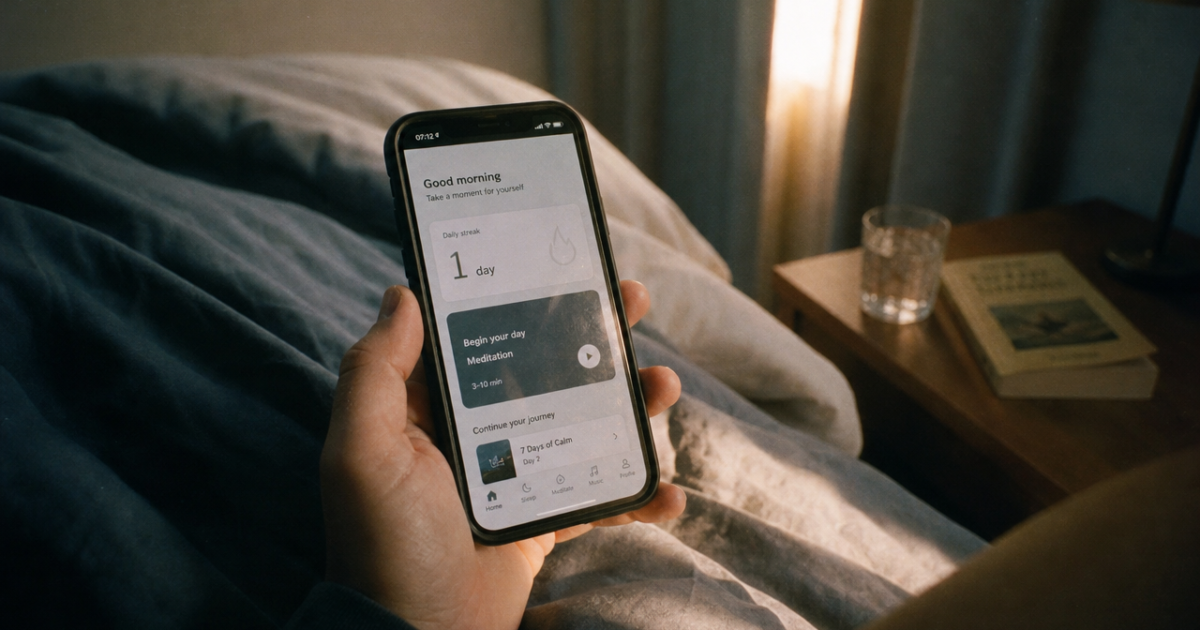
Open the meditation app and it hands you a number before it hands you anything else. Fourteen. Forty. Two hundred and six. You haven’t taken a breath yet, the teacher hasn’t said a word, and already you’ve been graded. Most mornings that number is a small warm thing and you barely register it. Then comes the morning it says 1 where it said sixty the day before, and something drops in your chest that has nothing to do with meditation and everything to do with a scoreboard.
Let me be fair to the meditation app here, because most of the criticism thrown at these things is lazy. They work. That isn’t a polite concession before the real argument — it’s what the trials actually found, and I’ll put the numbers in front of you in a moment. The trouble sits somewhere much smaller and much stranger than the app itself. It sits in the little flame in the corner of the screen, quietly counting.
What a meditation app is genuinely good at
In 2021, three researchers — Éva Gál, Simona Ștefan and Ioana Cristea — pooled every randomized controlled trial they could find in which a meditation app was the main intervention rather than a side dish. Thirty-four trials. Seven and a half thousand people. Against control conditions, the meditation apps moved perceived stress by a standardized effect of 0.46, depression by 0.33, anxiety by 0.28, and psychological well-being by 0.29. In plain terms: small to moderate improvements, replicated across dozens of separate trials. For something you downloaded in a queue at the airport, that’s a better return than almost anything else on your phone.

Now the part the marketing pages leave out, which comes from the same paper. Two outcomes didn’t budge. General well-being and psychological distress both came back non-significant — the effect was there in the numbers but too small and too uncertain to call real. And the authors closed with a caution in their own words: read the results carefully, given the small number of studies, the uncertain risk of bias, and how much the trials differed from each other. So a meditation app helps, modestly, with some specific things. It isn’t medicine. It also isn’t nothing, and anyone who tells you these meditation apps are pure snake oil hasn’t read the meta-analysis.
The number nobody prints next to the download button
Here’s where it gets uncomfortable. In 2019 a team led by Amit Baumel published a study in the Journal of Medical Internet Research that did something the efficacy trials can’t: it watched what people do with mental health apps in the wild, when no researcher is checking in. Ninety-three Android apps, each with at least ten thousand installs, tracked through a usage panel. The median thirty-day retention across all of them was 3.3 percent. For the mindfulness and meditation category specifically, it was 4.7 percent.
Sit with that for a second. Out of every hundred people who install a meditation app today, roughly five will still be opening it a month from now. The other ninety-five are gone — not because they decided the practice was worthless, but because life closed over the top of it. The authors put it drily: although install numbers look impressive, only a small portion of users actually used the apps for any length of time. I’ll flag the limits honestly, because they matter. That’s Android-only panel data from 2019, and it counts opening an app rather than sitting down to breathe. Hold it loosely. But hold it, because it puts the two studies in an odd room together. A meditation app works when people keep using it. Almost nobody keeps using it.
The morning your meditation app tells you that you failed
You know exactly how the break happens, because it’s never dramatic. A child throws up at four in the morning. A flight gets moved. You fall asleep on the sofa in your clothes with the lamp still on. Nothing philosophical occurs, no crisis of faith in the practice — you simply have a day, the way people have days. Then you open the meditation app the following morning and the number is gone. Back to one. The little flame has gone out and been redrawn as an outline.
And now the thing you downloaded to help you be gentler with your own mind has handed you a small, precise, timestamped piece of evidence that you are inconsistent. I’ve had this conversation more times than I can count with people who come on retreat — someone will mention, half joking and not joking at all, the day they lost a streak they’d been building for months, and how they didn’t open the app again for weeks afterward. The practice hadn’t stopped working. Their relationship to the scoreboard had. That’s a strange way to lose something you liked.
The streak counter is measuring the wrong thing
There’s a piece of research from University College London that should probably be printed on the home screen of every meditation app ever built. In 2009, Phillippa Lally, Cornelia van Jaarsveld, Henry Potts and Jane Wardle asked ninety-six volunteers to pick one simple daily behaviour — something to eat, drink, or do — and repeat it in the same context every day for twelve weeks. Each day the participants rated how automatic the behaviour felt. The researchers were watching for the point where a person stops deciding to do a thing and simply does it.
Two findings came out of it. The first is the one people quote badly. The time it took to reach ninety-five percent of that automatic plateau ranged from eighteen days to two hundred and fifty-four days, depending on the person and the behaviour. Not three weeks. Not any tidy number you’ve seen on a poster. Somewhere between three weeks and eight months, and nobody can tell you in advance which end you’re on.
The second finding is the one that matters this morning, and the abstract states it flatly: missing one opportunity to perform the behaviour did not materially affect the habit formation process. One missed day did essentially nothing. The curve kept climbing. So the streak counter — which resets to zero, redraws your flame as an empty outline, and shows you a clean slate where months of practice used to be — is telling you the precise opposite of what the data found. I’ll keep this honest: Lally’s participants were doing things like drinking a glass of water after breakfast, not meditating, and only sixty-two of the ninety-six produced a curve the model could fit. It’s a signal about how habits form, not a law. But it’s a clear signal, and it points the other way from the flame.
What the streak is actually for
None of this makes the streak sinister. A streak is a retention metric wearing the costume of encouragement, and retention is a completely reasonable thing for a business to want. Given the 4.7 percent number above, you can see why they built it. The company needs you to come back tomorrow, and the flame is the politest available way of asking. Fine. What it isn’t, and was never designed to be, is a teaching.
Because a real practice measures something the meditation app has no access to. Whether you noticed the tightness across your jaw at eleven in the morning and let it go before it became a headache. Whether you got through the conversation with your mother without your shoulders climbing to your ears. Whether you can sit in traffic now without the low hum of fury you used to think was just your personality. None of that produces a number. All of it is the reason you started. The meditation app can log the ten minutes; it cannot see the thing the ten minutes was for.
And there’s a quieter cost to being scored daily by software. The practice slowly turns into a performance — something you complete rather than something you do — and the mind that shows up to a task it must not fail is a very different animal from the mind that shows up because sitting down feels good. You can feel the difference in the body within about thirty seconds. One arrives braced. The other just arrives. No meditation app has ever been able to tell those two apart, and they are the whole difference.
How to keep the meditation app and lose the scoreboard
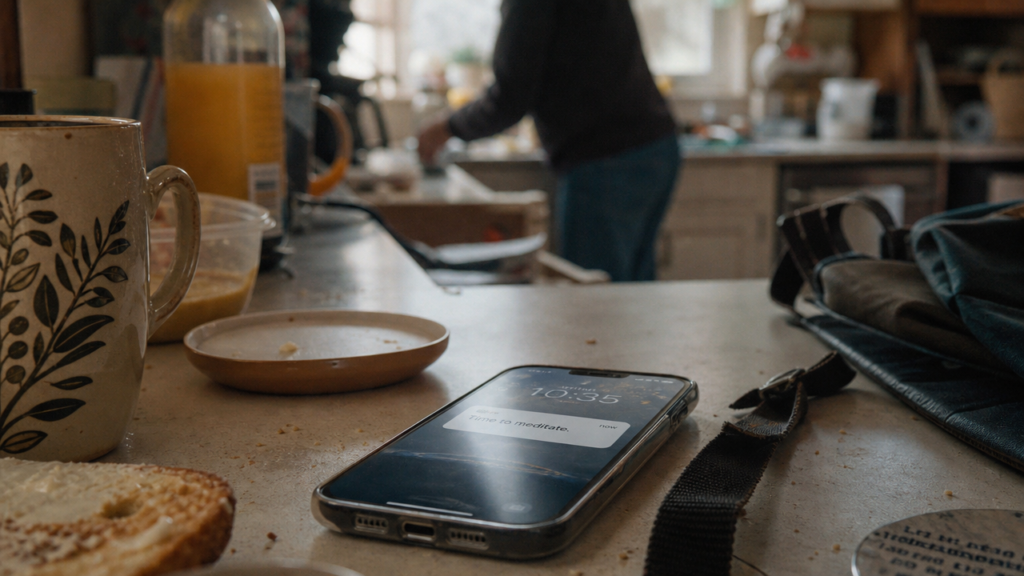
I’m not going to tell you to delete it. Given the evidence, deleting the meditation app is a strange response to a problem caused by one feature inside it — like throwing out a good knife because you dislike the handle. Keep the app. Change what you let it do to you. Start by going into the settings and turning off the reminder notifications, all of them. A notification that says time to meditate is your phone deciding when your nervous system needs attention, which is exactly backwards, and it arrives with the same buzz as your bank and your group chat. Your meditation app does not know what kind of morning you’re having. Several of the big meditation apps now let you hide the streak entirely. If yours does, hide it today.
Then change the unit you count in. Days are a brutal measure because there are so many of them and each one is pass or fail. Weeks are humane. Two sessions in a week is a practice. Four is a strong week. Zero is a week you had other things happening, and it ends on Sunday like every other week. If you want a number to look at, count how many weeks out of the last twelve had at least one session in them — that single change turns a scoreboard you fail into a picture of a practice that’s been quietly holding for three months.
And keep one version of the practice that doesn’t involve the phone at all, so the whole thing can’t collapse when the battery dies or the subscription lapses. Three slow breaths in the parked car before you go into the house. A short sit on the edge of the bed with your feet flat on the floor. Attention on your feet while you walk from the office to the car park. None of these get logged anywhere, which is the point of them. The meditation app is a door. It’s a good door — the trials say so. It was never meant to be the room.
The streak you broke is not the practice you lost
So if you’re reading this with a dead flame in the corner of an app you’ve been avoiding for a fortnight, here’s where the evidence actually leaves you. The meditation apps help, modestly and for real. Ninety-five out of a hundred people stop using them within a month, so you are in unremarkable company. Whatever you think you proved about yourself the day you stopped, you proved nothing — you did the ordinary thing. And the best study we have on how habits form says the day you missed did not materially affect anything.
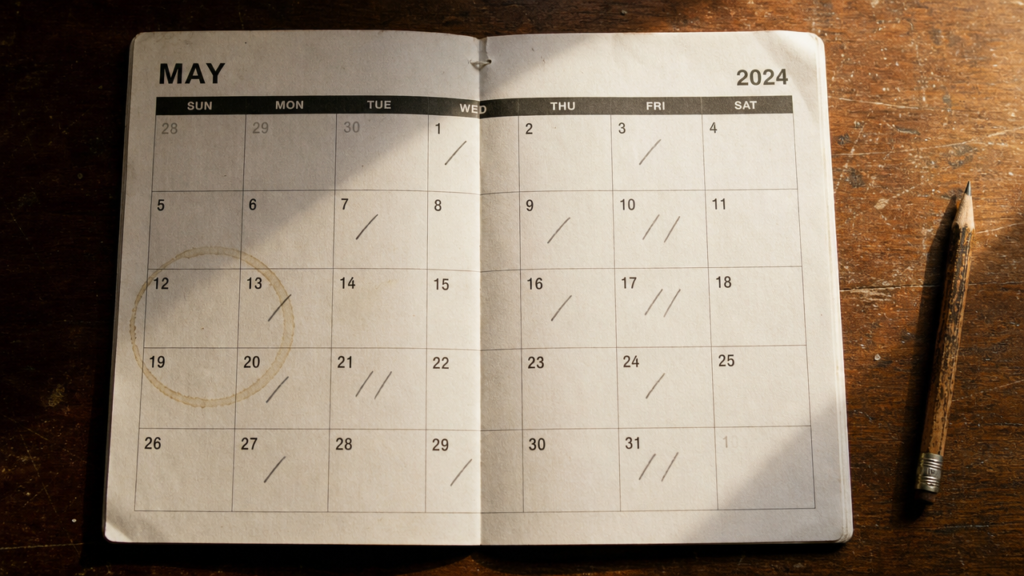
Open the meditation app tomorrow. Let it say 1. Watch what happens in your chest when it does, because that flinch is worth more attention than the number that caused it — it’s the same reflex that grades you on everything else, showing up in the one place you’d built specifically to be free of it. Then press play anyway. The counter starts again at one. The practice never went back to zero.
References:
• Gál É, Ștefan S, Cristea IA (2021). “The efficacy of mindfulness meditation apps in enhancing users’ well-being and mental health related outcomes: a meta-analysis of randomized controlled trials.” Journal of Affective Disorders 279:131–142 — doi.org/10.1016/j.jad.2020.09.134 (PMID 33049431).
• Baumel A, Muench F, Edan S, Kane JM (2019). “Objective User Engagement With Mental Health Apps: Systematic Search and Panel-Based Usage Analysis.” Journal of Medical Internet Research 21(9):e14567 —pmc.ncbi.nlm.nih.gov/articles/PMC6785720/.
• Lally P, van Jaarsveld CHM, Potts HWW, Wardle J (2010). “How are habits formed: Modelling habit formation in the real world.” European Journal of Social Psychology 40(6):998–1009 — doi.org/10.1002/ejsp.674.
If this kind of practice speaks to you, Meditation for Cancer takes the same approach and builds it around a cancer diagnosis instead.