
Somebody sits down with a free app for the first time, closes their eyes, follows the voice for ten minutes, and stands up feeling worse than when they started. Wired instead of calm. Or hollow. Or oddly far from the room, as though the furniture moved back a foot while their eyes were shut. Then they do what almost everyone does. They decide the problem is them — too busy a mind, no discipline, bad at the one thing that was supposed to be easy — and they quit without mentioning it to anyone. I’ve watched that quiet exit happen at retreats more than once, and the person leaving is usually apologising.
That exit has been counted. Meditation side effects have been measured in decent-sized samples, and the numbers run higher than the app store lets on: in one 2021 study, 83% of participants reported at least one. I’ll give you the context for that figure in a minute, because it needs some, and the honest reading is far less alarming than the headline. The context most beginners get is nothing at all. No label on the bottle. No line about when to stop and call someone. A streak counter and a soft voice asking you to come back to the breath.
What the research says about meditation side effects
The broadest look at meditation side effects so far ran in Acta Psychiatrica Scandinavica in 2020. Farias and colleagues screened 6,742 citations, kept 83 studies, and pooled 6,703 people who had meditated. Overall prevalence of adverse events came out at 8.3%. The split underneath that average is the interesting part. Experimental studies reported 3.7%. Observational studies — the ones where somebody actually sat down and asked practitioners what had happened to them — reported 33.2%. Nine times the rate, same phenomenon. If you don’t ask, you don’t find.
The commonest categories in that review: anxiety, in 33% of the studies; depression, 27%; cognitive anomalies, 25%; gastrointestinal problems and suicidal behaviours at 11% each. The authors’ conclusion is worth quoting flat, because it should change how you read every meditation side effects claim you meet after this one. Adverse events during or after practice are “not uncommon,” and they “may occur in individuals with no previous history of mental health problems.” You don’t have to arrive fragile.

In 2021 Willoughby Britton’s group at Brown built the thing that had been missing: an instrument. The 44-item Meditation Experiences Interview, administered by an independent assessor to 96 people who had finished an eight-week mindfulness-based cognitive therapy program. Every item was checked five ways — did it happen, did meditation cause it, how long did it last, did it feel bad, did it interfere with your life. Eighty-three percent of them reported at least one meditation side effect. Fifty-eight percent had one that felt bad. Thirty-seven percent had one that got in the way of functioning. Lasting bad effects landed somewhere between 6 and 14%.
Now the sentence the headlines skipped. That paper’s own conclusion says practice in these programs carries distress and negative impacts “at similar rates to other psychological treatments.” It reframes everything. Meditation side effects are what an active intervention looks like once somebody bothers to measure it. Therapy has side effects. Exercise has side effects. Anything strong enough to change how you sleep is strong enough to go sideways on you. The scandal was never the rate. It’s that the rate never got printed anywhere a beginner would see it.
One more number on meditation side effects, this one from outside the clinic. Schlosser and colleagues surveyed 1,232 regular meditators in 2019, everyone with at least two months of practice, average age 44.8, and 25.6% reported a particularly unpleasant meditation-related experience. Cross-sectional online survey, self-selected sample — so that’s prevalence and association, not cause. I’d rather say that plainly than round a quarter of experienced practitioners into a scarier headline than the data earns.
What meditation side effects actually feel like
The best map here is Lindahl 2017, a mixed-methods study of Western Buddhist practitioners and teachers across Theravāda, Zen and Tibetan lineages. It produced a taxonomy of 59 meditation-related experiences across seven domains: cognitive, perceptual, affective, somatic, conative, sense of self, and social. Buried in the method is the finding that matters most to anyone trying to interpret their own bad week. The same experience turned up as wonderful for one practitioner and destabilising for another, with distress and impairment running, in the authors’ words, from “minimal and transient to severe and enduring.”
So the body starts twitching. Heat climbs the spine. The visual field brightens, or time stretches, or a memory you haven’t touched in twenty years arrives uninvited and fully loaded. Or the boundary between you and the room thins out. None of that, by itself, tells you whether things are going well or badly, which is exactly why meditation side effects go unrecognised for so long. In most traditions, half that list gets read as progress.
The two meditation side effects that need naming
Britton’s data tie the lasting problems to signs of dysregulated arousal, and it arrives in two flavours. Hyperarousal: the system revs instead of settling. Sleep thins. The startle response climbs. You come off the cushion more lit up than a double espresso would leave you, and it doesn’t come down for hours. Dissociation: the room goes faintly unreal, or you do. People describe watching themselves from a short distance, or a numbness where feeling used to live, or a flat glassy calm that has nothing warm in it.
Both get misread as attainment, and that’s the trap at the centre of all this. A practitioner who feels detached from their own life gets congratulated on their equanimity. Someone whose system won’t stand down at midnight is told they’re processing. Of all the meditation side effects on the list, those two are the likeliest to be praised by the very person you’d go to for help.
Who runs into meditation side effects more often
Schlosser’s survey found three things associated with an unpleasant experience: having attended a meditation retreat; practising only deconstructive techniques such as Vipassana or koan work, which carried 65% higher odds than mixed practice; and higher levels of repetitive negative thinking. Men reported more than women, 28.5% against 23%. Religious participants reported fewer. Association in a self-selected survey, again, so hold it loosely.
Read the first two together, though, and they point at one variable: intensity. Ten days of silence, four in the morning starts, twelve hours a day on the cushion. That isn’t a longer version of your ten-minute morning sit; it’s a different substance at a different dose, and it gets sold to people in their first year. The meditation side effects that turn into something lasting cluster at that end of the scale, not down at the ten-minutes-with-an-app end.
The repetitive-negative-thinking finding — a small effect, but a real one — has a practical shape too. If your mind’s factory setting is to grind a single thought flat, then forty silent minutes with nothing else to do isn’t obviously the medicine. Some people need an object. A body, a sound, a task. That’s a design problem rather than a character flaw, and it’s where a good share of meditation side effects begin.

What to do when you get meditation side effects
None of this is medical advice and I’m not your clinician. It’s what a practice looks like when it’s run with a label on the bottle.
Cut the dose before you cut the practice. The reflex after a bad sit is to push harder or to quit, and both are wrong. Drop from twenty minutes to five. Open the eyes, gaze soft and low. Sit in a chair with your back against something solid. If five is too much, take one breath and stand up. Most meditation side effects that show up in ordinary daily practice ease off when the dose comes down. The trouble is that nobody tells a beginner the dose is theirs to set.
Move the anchor outward. Attention on the interior of the body is the strongest tool in the kit, and for a nervous system already running hot it’s frequently the wrong one. Put the attention somewhere external instead — sound in the room, the weight of your feet, the temperature of the air on your hands. Walking works when sitting won’t, and it hands you an anchor that’s hard to lose, which is why it’s the first thing I suggest to anyone whose sitting practice has started producing meditation side effects.
Pick your moment. A new practice, or a longer one, lands differently depending on which week of your life you start it in. Sitting down to build a demanding practice in the middle of an acute loss, a divorce, a diagnosis — that’s the week people most want it and the week it most often backfires, because the practice lifts the lid at precisely the point the lid is doing a job. None of which means don’t practise then. It means smaller, shorter, eyes open, and ideally with somebody who knows what week you’re in. The meditation side effects people describe from those stretches are rarely a matter of technique.
Skip the retreat. Longer isn’t further along. If your daily practice is unsteady, a ten-day silent course isn’t the fix, it’s the amplifier. Retreats concentrate meditation side effects more reliably than any other variable in the survey data.
Say it out loud. Most people who run into a rough patch survive the experience itself and then get wrecked by the story they tell themselves about it. They decide they’re broken, or spiritually behind, and go quiet. A teacher who can’t hear “this made me worse” without hearing an insult is the wrong teacher for this.
Know the stop line. Sleep that keeps collapsing, arousal that won’t settle hours after the sit, dissociation that follows you out of the room, old memories arriving with the force of the original event, any thought of harming yourself — that’s a clinician, today, and not a longer sit. There’s a specific address for this now, too. Cheetah House, the 501(c)(3) nonprofit Britton runs out of that same research line, describes itself as a community “invested in the recovery from and reduction of adversities resulting from meditation practices.” Individual consultations, training for teachers, a referral list. Ten years ago, people with serious meditation side effects had nowhere to go and were told to sit more.
Why nobody warned you about meditation side effects
Meditation crossed into the West stripped of what used to travel alongside it. A teacher who had seen this before. A community with names for the rough stretches. A tradition holding a map of the terrain past the pleasant part. What replaced all of that was a download and a subscription. The maps existed, including the ones covering meditation side effects. They didn’t make the trip.
Every intervention with a measurable effect ships with a list of what it can do to you. Meditation apps ship with a streak. I don’t think that’s a conspiracy so much as a market, and no onboarding flow ever converted better by mentioning that some people feel worse in week two. But it does real damage, and the silence does more of it than the meditation side effects do. Warned, a person shortens the sit and carries on. Unwarned, they conclude they failed at the easy thing and never come back.
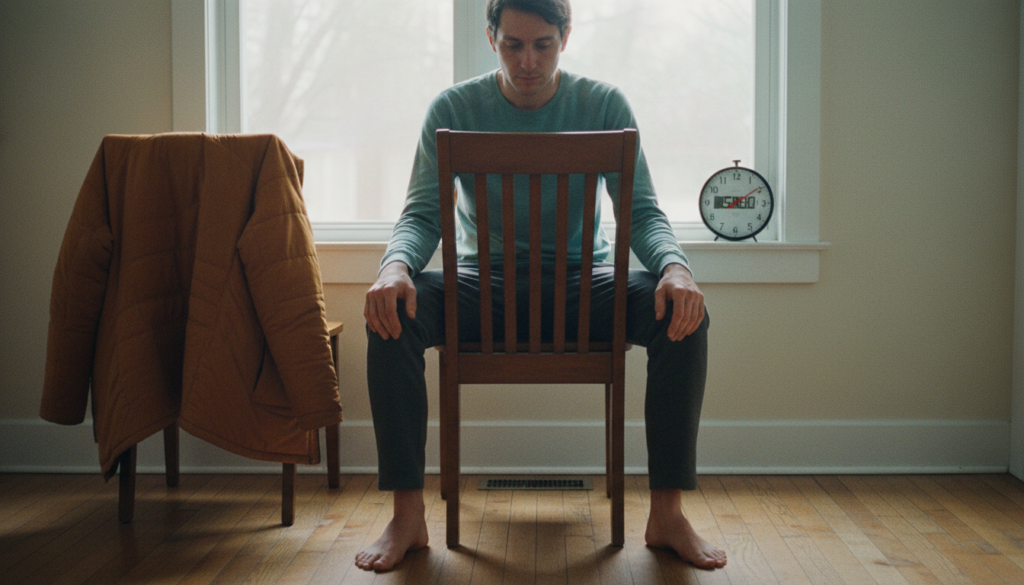
So here’s the label I’d staple to the bottle. This practice does something to you, which is the entire reason to do it. Because it does something, roughly a quarter of experienced practitioners report a rough patch at some point, and the large majority of meditation side effects are transient and manageable at a sane dose. A small share aren’t, and those need a person rather than a longer sit. Knowing all of that in advance takes nothing away from the practice. It’s the difference between a strange fourteenth minute meaning “I’m broken” and meaning “ah — that one. Shorter tomorrow.”
Resources:
• Farias M, Maraldi E, Wallenkampf KC, Lucchetti G (2020). “Adverse events in meditation practices and meditation-based therapies: a systematic review.” Acta Psychiatrica Scandinavica 142(5):374–393. doi:10.1111/acps.13225 — pubmed.ncbi.nlm.nih.gov/32820538/ (6,742 citations screened, 83 studies, 6,703 meditators; overall AE prevalence 8.3% [95% CI 0.05–0.12], 3.7% experimental vs 33.2% observational; anxiety 33% of studies, depression 27%, cognitive anomalies 25%, GI problems and suicidal behaviours 11% each; conclusion: AEs “are not uncommon” and “may occur in individuals with no previous history of mental health problems”).
• Britton WB, Lindahl JR, Cooper DJ, Canby NK, Palitsky R (2021). “Defining and measuring meditation-related adverse effects in mindfulness-based programs.” Clinical Psychological Science 9(6):1185–1204. doi:10.1177/2167702621996340 — pubmed.ncbi.nlm.nih.gov/35174010/ (44-item Meditation Experiences Interview [MedEx-I] administered by an independent assessor after three variants of an 8-week MBCT program, n = 96; 83% reported ≥1 meditation-related side effect; negative valence 58%, negative impact on functioning 37%; lasting bad effects 6–14%, associated with dysregulated arousal — hyperarousal and dissociation).
• Lindahl JR, Fisher NE, Cooper DJ, Rosen RK, Britton WB (2017). “The varieties of contemplative experience: A mixed-methods study of meditation-related challenges in Western Buddhists.” PLoS ONE 12(5):e0176239. doi:10.1371/journal.pone.0176239 — pubmed.ncbi.nlm.nih.gov/28542181/ (interviews with Western Buddhist practitioners and experts across Theravāda, Zen and Tibetan traditions plus a follow-up survey; taxonomy of 59 meditation-related experiences across 7 domains — cognitive, perceptual, affective, somatic, conative, sense of self, social — and 26 categories of influencing factors; distress and impairment ranged from “minimal and transient to severe and enduring”).
• Schlosser M, Sparby T, Vörös S, Jones R, Marchant NL (2019). “Unpleasant meditation-related experiences in regular meditators: Prevalence, predictors, and conceptual considerations.” PLoS ONE 14(5):e0216643. doi:10.1371/journal.pone.0216643 — pmc.ncbi.nlm.nih.gov/articles/PMC6508707/ (cross-sectional online survey, 1,232 regular meditators with ≥2 months’ practice, mean age 44.8 ± 13.8, 53.6% female; 25.6% [n=315, 95% CI 23.1–28.0] reported a particularly unpleasant meditation-related experience; predictors: retreat attendance, deconstructive-practice-only — 65% higher odds — and higher repetitive negative thinking; men 28.5% vs women 23%; religious participants reported fewer). VERIFIED via direct PMC fetch.
This is the kind of practice at the center of Meditation for Cancer — for the days when composure isn't the goal.