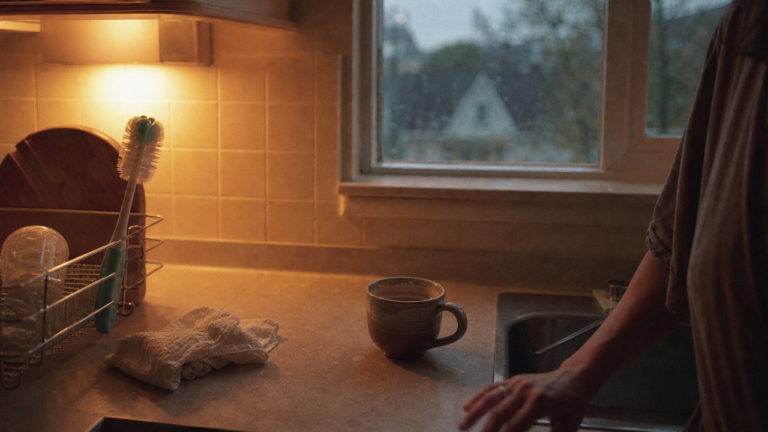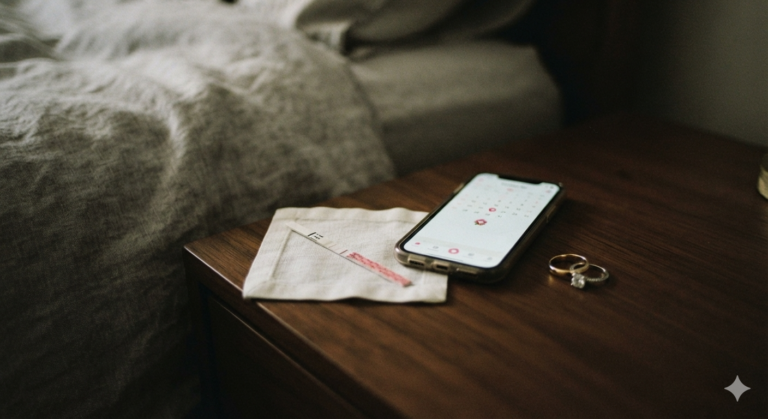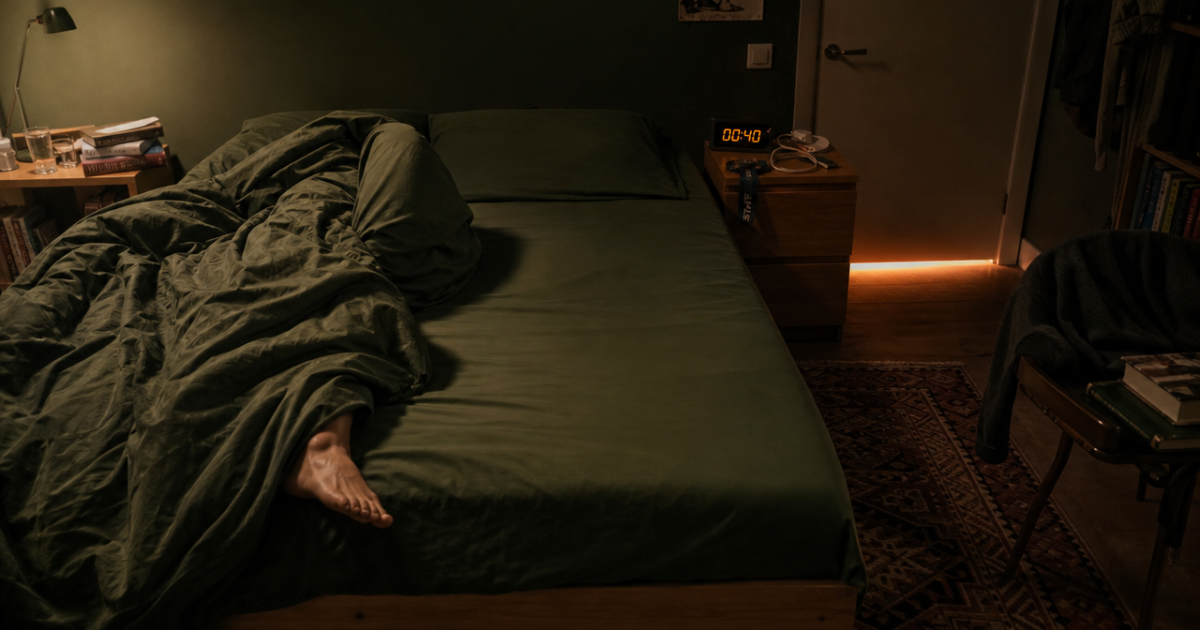
It's twenty to midnight. She's been in bed since half past ten, because somebody on a forum said the body does its best repair work before midnight, and now she's lying on her side doing sums. If she falls asleep right now, that's seven hours and ten minutes. Not eight. Is that close enough? Down the hall a laptop fan is still whirring. He'll come in around one, set an alarm for six, and nobody will ask him a single thing about it.
That is more or less how sleep and fertility get talked about in most homes where a couple is trying: as her homework. Her hours, her magnesium, her blackout blind, her screen curfew. I understand how it happens. She's already the one tracking the cycle, so she ends up being handed everything else that could be tracked as well.
The best numbers we have on sleep and fertility don't point at her side of the bed, though. They point down the hall.
What a big study of sleep and fertility found in men
Since 2013 a team at Boston University has been running a study called PRESTO, short for Pregnancy Study Online. It enrols couples who are trying to conceive, before anything has happened, and then it simply waits. Nobody is treated. Nobody is assigned to anything. People fill in questionnaires, and every eight weeks they report whether they're pregnant yet.
In 2018 Lauren Wise and her colleagues published the men's sleep data in Fertility and Sterility. They took 1,176 couples who had been trying for six cycles or fewer when they joined, and one question the men had answered on day one: on average, how many hours a night did you sleep over the past month?
The measure they used is called a fecundability ratio. It compares the chance of conceiving in any one cycle against a reference group, and the reference here was men sleeping eight hours. Men on seven hours came out at 0.97. Men on six, 1.06. Both are effectively the same as eight. Men sleeping fewer than six hours a night came out at 0.62.
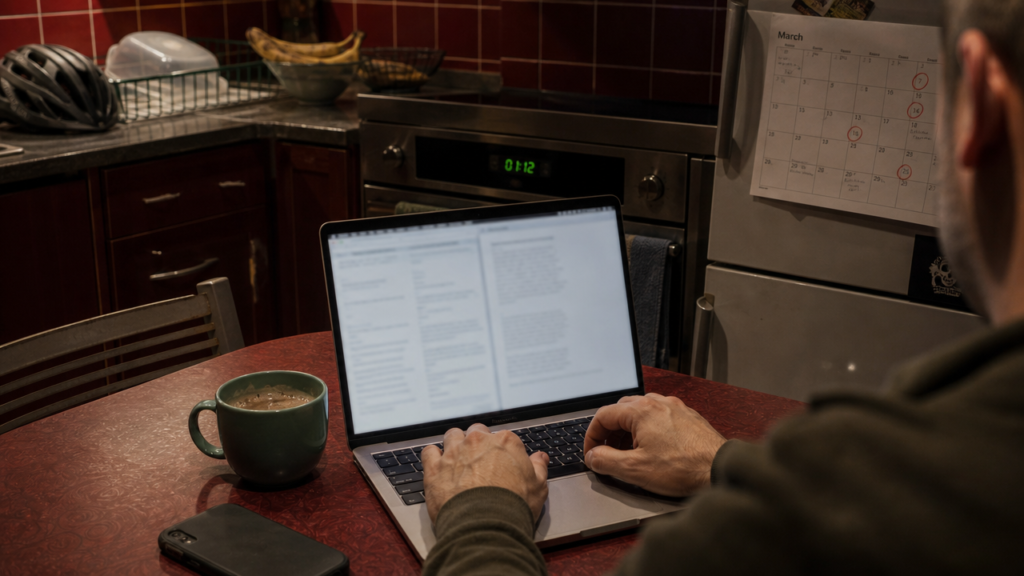
Put into a sentence: in any given month, couples where he was sleeping under six hours conceived at roughly 62% of the rate of couples where he was sleeping eight. That's after the researchers adjusted for the obvious suspects. For a single question on a form, it's a large gap, and it's the clearest sleep and fertility signal I've seen for either partner.
Two details made me read the table twice. The result held among men who never worked nights or rotating shifts (0.60), so it isn't a shift-work story wearing a disguise. And it held among men with no history of infertility at all (0.62). Ordinary men, ordinary couples, one ordinary habit that nobody at the clinic tends to ask about. If you've read what I wrote about male infertility, you'll recognise the pattern: his half of the picture exists, and it goes unexamined.
The sleep and fertility result that was worse in fathers
Then the third detail, which I keep turning over. Among men who already had children, the ratio fell to 0.46.
The paper doesn't explain that, and I won't pretend it does. My own guess, and it's only a guess, is that a man who already has a four-year-old is short on sleep for reasons that also leave him short on energy, patience and evenings alone with his partner. Which is exactly the problem with any observational finding on sleep and fertility. The short night might be doing the damage. It might just be travelling with the thing that is.
In women, the hours on the tracker barely registered
A year later the same group published the women's sleep and fertility data, in the same journal, with a far bigger sample: 6,873 women. Against eight hours of sleep, the fecundability ratios for under six, six, seven, and nine or more hours were 0.89, 0.95, 0.99 and 0.96. Every one of those confidence intervals crossed 1. In plain words, across nearly seven thousand women the number of hours she slept didn't carry a clear signal.
Something else did. The women had also been asked how often, over the previous two weeks, they'd had trouble sleeping. Those who'd had trouble more than half the time had a fecundability ratio of 0.87. Modest, yes. But it was there, and the authors noted it was a little stronger in women who reported more depressive symptoms and more perceived stress.
I think this is the most useful thing the research on sleep and fertility has to say to a woman who's trying, and it runs almost opposite to the advice she usually gets. The figure on the app in the morning wasn't what mattered. The nights spent lying awake were. And lying awake, more often than not, is a nervous system that won't stand down. I wrote about that in stress and fertility: a body that's bracing doesn't switch off because the clock says it's time.
Why counting hours can make sleep and fertility worse
If the signal is trouble sleeping rather than hours slept, then turning sleep into one more number to hit is working against you. Anyone who has lain there calculating seven hours and ten minutes knows how that night ends. Effort is the one thing that reliably keeps a person awake. I went through the mechanics of it in a piece on meditation for sleep, and it applies twice over when the thing riding on tonight feels like a baby.
So if her tracker is part of what keeps her up, the kindest sleep and fertility advice I can give is short. Take it off the bedside table for a month.
Now the part that argues the other way
I've told you how I read the data. Here's why you shouldn't treat my reading as settled, and why no sleep and fertility headline should be treated that way either.
PRESTO is observational. Men who sleep under six hours aren't a random slice of men. Plenty of them will be working long hours, under pressure, leaning on caffeine, sitting more and home less. The researchers adjusted for a long list of factors, but nobody can adjust for what they didn't measure. Short sleep may be a marker for a certain kind of life, rather than the thing doing the harm.

Sleep was asked about once, at enrolment, as a monthly average recalled from memory. Most of us are poor judges of our own nights.
The confidence interval on that 0.62 runs from 0.45 to 0.87. That's real enough to take seriously and loose enough that I wouldn't repeat "38% lower" as if it were carved into anything.
Then there's the semen data, which complicates the tidy version. In Chongqing, Qing Chen and colleagues followed 796 male college students and measured their semen and hormones in 2013, and again a year later. They found an inverted U. Seven to seven and a half hours of sleep went with the best semen volume and total sperm count. More than nine hours went with a 39.4% lower total sperm count. Six and a half hours or less went with 25.7% lower, though the confidence interval on that short-sleep figure dipped just below zero, so it wasn't clean. And they found no association at all between sleep and reproductive hormones. The neat mechanism people like to quote, that short sleep lowers his testosterone and low testosterone lowers fertility, is not what this study showed. Students aren't couples trying to conceive, either, and a sperm count isn't a pregnancy. It's sleep and fertility research at one remove, and I'd weigh it that way.
And the biggest gap of all: I couldn't find anyone who has run the actual experiment. No trial I could locate randomly assigned couples to sleep more and then counted who conceived. Everything about sleep and fertility in this article is association. It tells you where to look. It can't promise what you'll find there.
Sleep and fertility on the night shift
If one of you works nights, the sleep and fertility question gets sharper, and you'll want to know where you stand. So here it is without softening. In 2014 Laura Stocker and colleagues pooled 15 studies covering 123,403 women and compared shift workers with women on ordinary daytime hours. Shift workers had more menstrual disruption, meaning cycles shorter than 25 days or longer than 31, and that held after adjustment. They also looked more likely to take over a year to conceive, but that link faded once confounders were accounted for (adjusted odds ratio 1.11, with an interval running from 0.86 to 1.44). The PRESTO women's data found no association between shift work and fecundability at all.
One finding didn't fade. Night shifts specifically were associated with more early pregnancy loss, an adjusted odds ratio of 1.41. If you've had a loss while working nights, please don't read that number as a verdict on you. It's a pooled association across studies of very different workplaces, and it cannot tell you why any single pregnancy ended. The authors themselves concluded that the evidence isn't strong enough for doctors to advise women to stop shift work. If nights are your job, that's a conversation for your doctor with your history in front of them, not for a blog.
Sleep and fertility as a two-person project
So, practical, and deliberately narrow. None of this will make anyone pregnant. A sleep and fertility plan can only move the effort to where the numbers point, and share it out.
Ask him the question. Out loud, over breakfast rather than at midnight: honestly, how many hours have you been getting? If the answer is under six most nights, that is the single sleep and fertility change with the most data behind it, and it belongs to him. The sperm he has in ninety days' time is being made now, which I went into in the piece on the sperm production cycle.
Pick one lights-out time, and make it for both of you. Not a curfew for her while he finishes emails in the next room. If there's one piece of sleep and fertility advice I'd put on the fridge, it's that the bedtime is shared or it isn't a plan.

Aim for enough, not for perfect. The CDC's figure for adults between 18 and 60 is seven or more hours. Seven counts. The women's sleep and fertility data above found seven hours no different from eight, and the Chongqing students did best on seven to seven and a half.
Treat bad nights as information, not as failure. If she's awake at three most nights, that's telling you about load: worry, work, the monthly countdown. It isn't a mark against her. For insomnia that has settled in for months, the American College of Physicians recommends cognitive behavioural therapy for insomnia, CBT-I, as the first treatment for adults, ahead of pills. It's a structured course, and it's worth asking a GP about by name.
And if either of you snores loudly, stops breathing for a beat in the night, or falls asleep at the wheel of an afternoon, that's a medical conversation to have soon, with a doctor, whatever the tracker says.
When sleep and fertility stop being the question
Here is the stop-line, and it matters more than anything above. The American Society for Reproductive Medicine says evaluation should begin after 12 months of regular, unprotected sex if she's under 35, and after 6 months if she's 35 or older. That evaluation should include him. Better sleep is not a reason to wait longer, and if you've already been told it's unexplained, a better bedtime won't replace the tests you haven't had yet.
The other side of the bed
Most of what gets written about sleep and fertility is addressed to one person in the bed. The biggest sleep and fertility dataset I could find suggests the conversation has been happening on the wrong pillow. He's the one whose short nights carried the clearest signal. She's the one whose trouble sleeping said something about stress, not about hours.
Nobody's to blame for either finding. What both of them ask for is a shared job. Go to bed at the same time tonight. Both of you.
References
Wise LA, Rothman KJ, Wesselink AK, et al. (2018). Male sleep duration and fecundability in a North American preconception cohort study. Fertility and Sterility, 109(3), 453–459. https://doi.org/10.1016/j.fertnstert.2017.11.037
Willis SK, Hatch EE, Wesselink AK, et al. (2019). Female sleep patterns, shift work, and fecundability in a North American preconception cohort study. Fertility and Sterility, 111(6), 1201–1210. https://doi.org/10.1016/j.fertnstert.2019.01.037
Stocker LJ, Macklon NS, Cheong YC, Bewley SJ (2014). Influence of shift work on early reproductive outcomes: a systematic review and meta-analysis. Obstetrics & Gynecology, 124(1), 99–110. https://doi.org/10.1097/AOG.0000000000000321
Chen Q, Yang H, Zhou N, et al. (2016). Inverse U-shaped association between sleep duration and semen quality. Sleep, 39(1), 79–86. https://doi.org/10.5665/sleep.5322
Qaseem A, Kansagara D, Forciea MA, et al. (2016). Management of chronic insomnia disorder in adults: a clinical practice guideline from the American College of Physicians. Annals of Internal Medicine, 165(2), 125–133. https://doi.org/10.7326/M15-2175
Practice Committee of the American Society for Reproductive Medicine (2023). Definition of infertility: a committee opinion. Fertility and Sterility, 120(6), 1170. https://doi.org/10.1016/S0015-0282(23)01971-4
Centers for Disease Control and Prevention. About Sleep. https://www.cdc.gov/sleep/about/index.html