In my last field note I left you on your back on the earth beside the lodge, under whatever the sky had that night. You don't stay there forever. At some point you notice the earth stuck to your sweaty skin, and you get up and rinse it off with fresh, cold water. That rinse is the subject of this piece. So is the cold shower the internet has turned it into.
It's the third of four short pieces about the way home from the heat: ground, rest, rinse, eat. In September I used that order as the spine of a longer piece on retreat integration. Each of these goes one step further into a single part of it. The first was about grounding meditation, the second about lying down. This one is about water.
Here's what I expected to write. Cold shower advice online promises a lot: better mood, fewer colds, more discipline, a dopamine hit that lasts all morning. I expected to say most of that is thin, and that the cold shower after a temazcal is a wash and nothing more. Half of that held up. The other half surprised me.
Why there's a cold shower after the lodge at all
Start with the floor. The floor of almost every temazcal I've sat in is earth. I've been in very few built ones with a concrete floor, or brick, or terracotta. A friend of mine lines the floor of his lodge with earth that ants have turned over, and it's incredibly fine and soft, like sitting on a carpet made of soil.
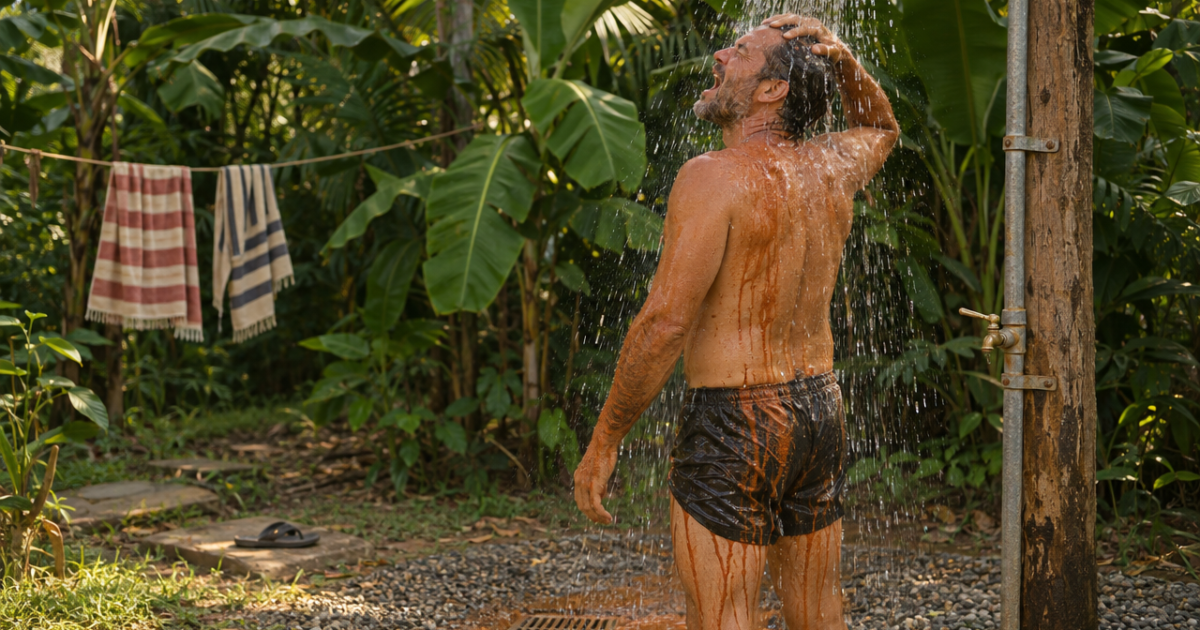
You sit on it for four rounds and sweat more than you thought a body could. When you come out, that earth is on you. On your legs, your back, your hands, wherever you leaned or lay. So after the rest beside the lodge, you go and take a cold shower. Fresh water, and the earth runs off you.
It's a very good feeling. That's the honest summary of what I know about the cold shower from the inside, and I've never needed a reason beyond it.
One more piece of context, because it changes what cold means. Where I've done most of my temazcals, it can be 36 °C outside with 80% humidity, and after the heat inside, even that air feels almost cold on your skin. The water doesn't have to be icy. It only has to be cooler than you are.
What does a cold shower do right after heat?
This was the first thing I looked up, because it's the closest the lab gets to the lodge. In a 2026 crossover study, Owen and colleagues put 16 healthy adults through two 15-minute sauna bouts at 85 °C, on two separate visits. Between the bouts they cooled down for ten minutes in 23 °C air. On one visit, that was all. On the other, the break included 90 seconds in 20 °C water, up to the neck.
The water made a clear difference. By the end of the second sauna, core temperature was 0.48 °C lower and heart rate was 17 beats a minute lower, 108 against 125, when people had used the cold water. They also said they felt less hot and more able to face the second round.
It's an immersion study, in a lab, with sixteen people. It isn't a cold shower beside a lodge in Mexico. But it gave the rinse a job I hadn't named. The water carries the earth off, and it takes the heat down faster than air does.
What the cold shower studies found
The biggest cold shower trial is Dutch. In the winter of 2015, Buijze and colleagues randomised 3,018 adults who didn't usually shower cold into four groups. Three groups were told to shower as warm and as long as they liked, then finish with 30, 60 or 90 seconds at the coldest the tap would give, every day for 30 days. The fourth group carried on as normal. Tap water there was running at about 10 to 12 °C that winter.
The headline result was a 29% reduction in sickness absence from work in the cold shower groups. Illness days, the other half of the main outcome, didn't differ. And the length of the cold shower didn't matter. Thirty seconds did as well as ninety.
Next I read a 2025 meta-analysis by Cain and colleagues: randomised trials of cold water in healthy adults, 11 studies, 3,177 people. Ten of the eleven used baths or plunges. Only one was a cold shower trial, and it was the Dutch one. Stress was lower 12 hours after cold water, but not straight away, not after an hour, and not after 24 or 48 hours. Inflammation markers went up right after, which is what a body does with a stressor. Sleep quality and quality of life looked better. Mood didn't.
So when someone tells you what a cold shower does, check where the number came from. Most of the evidence comes from sitting in cold baths.
Can a cold shower help your mood?
This is the claim I hear most, and the one I most wanted to check. A lot of it traces back to a 2008 paper by Shevchuk in a journal called Medical Hypotheses, and the paper is exactly that: a hypothesis. It proposes a cold shower at 20 °C for two to three minutes, after five minutes of gradual adaptation, once or twice a day. The only test it describes was done by, in the author's words, “a statistically insignificant number of people.” It ends by calling for proper studies.
The most thorough answer I found came eighteen years later. In a 2026 review, Ngandeu Schepanski and colleagues pooled 13 studies with 4,105 people: cold showers, plunges and winter swimming. The pooled numbers leaned towards cold water for depressive symptoms, stress and mood. Then several of them shrank when only controlled studies were counted, and most studies carried a high or worse risk of bias. Anxiety showed little consistent benefit. The authors' conclusion is plain. The evidence doesn't establish that cold water improves mood, and it shouldn't be treated as a standalone treatment for psychiatric disorders.
I agree with them. If you're depressed, a cold shower is not your treatment. It might be one part of a morning that helps. That's a smaller claim, and it's the one the data can carry.
Now the part that argues the other way
I came in thinking the rinse after the lodge was a wash, and the cold shower craze online mostly noise. The Dutch trial doesn't let me keep the second half so easily.
Three thousand people is a big trial for this field, and it was randomised. Nearly a third fewer days off sick is a number any employer would notice. Something else in the paper stayed with me. Of the people in the cold shower groups, 91% said they wanted to keep going, and 64% did, showering cold on a regular basis after the 30 days were over. The benefit people mentioned most was more energy, and many compared it to caffeine. Most of them also found it uncomfortable. They kept going anyway.
Then there's the chemistry everyone quotes. In 2000, Šrámek and colleagues sat young men in water up to the neck at 32, 20 and 14 °C, for an hour each time. At 14 °C, plasma noradrenaline rose by 530% and dopamine by 250%. Those numbers are real, and you'll find them in half the cold shower posts online. What you won't find there is the setup. An hour, sitting in 14 °C water. A minute under the tap is a much smaller dose.
So yes, cold water does something to a body. What I doubt is the size of the claims made for a cold shower.
The Dutch trial also has limits its own authors spelled out. Everything was self-reported. Nobody could be blinded, so a placebo effect can't be ruled out. The volunteers were healthy, motivated and physically active, and 96% rated their health good or excellent. Fewer days off work without fewer days ill might mean people felt more able to go in. That's worth something. It's a different thing from getting sick less.
What I can't settle about the cold shower
Beside the lodge, the cold shower is one part of a sequence: the heat, the earth, lying down, the water, then food, with other people a few metres away. I looked for a study of a cold shower after a sweat lodge, or after any heat in a hot, humid climate, and didn't find one. The closest is Owen's sauna study, run in 23 °C lab air. So I can't tell you the cold rinse does more for you than a warm one would. I can tell you the heat comes down faster, and the earth comes off either way.
There's also a 2017 review by Tipton and colleagues with a title I like: “Cold water immersion: kill or cure?” They looked across what's claimed for cold water, from treating heatstroke to calming inflammation, and concluded that the evidence varies a lot. Some claims, they wrote, still rest on anecdotal speculation. Cold water is a strong stimulus. Whether it helps or harms depends on the dose, and on who's standing in it.
How to try a cold shower at home
You don't need a lodge for this, and you don't need an ice bath. The cold shower routine with the best evidence is also the gentlest one.
- Shower warm first, as long as you like. Then turn it to cold for the last 30 seconds. In the Dutch trial, 30 seconds did as well as 90.
- Breathe out, long and slow, as the cold hits. The first reflex is a gasp. A long exhale, like the one in cyclic sighing, gives the gasp somewhere to go.
- If 30 seconds is too much, start shorter and add a few seconds each day. Even the 2008 hypothesis paper built in five minutes of gradual adaptation.
- Don't use it to override your body. If you're still shivering long afterwards, or your hands and feet stay cold for hours, that was too much. Lasting cold in the body, hands or feet was the most common complaint in the Dutch trial.
- If you have a sauna or a hot bath, try a short spell of cool water between rounds, the way Owen's volunteers did, and notice how the second round feels.
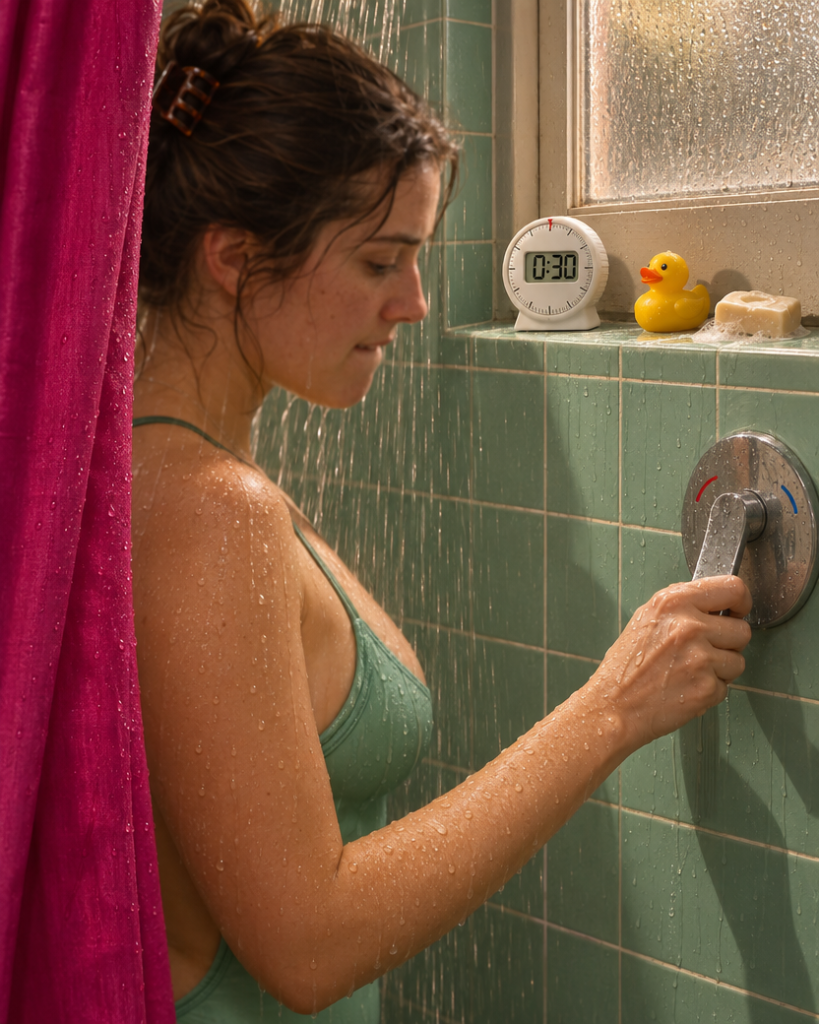
Treat your cold shower as a small ritual, the way I'd treat any of the daily rituals for the nervous system: same time, same order, short enough that you'll still do it in February. And if there's a temazcal or a cenote near you, I wrote earlier this year about water and steam in the temazcal.
When a cold shower isn't a good idea
Cold water sets off the cold shock response: a gasp, fast breathing, a jump in heart rate and blood pressure. In Tipton's review, cold water immersion appears as a precursor to drowning and to cardiac arrest. A cold shower at home is far milder than a cold lake, but the reflex is the same one. If you have a heart condition or high blood pressure, ask your doctor before you start. The Dutch trial left out people with severe illness for a reason.
After heat, whether it's a sauna, a sweat lodge or a hot bath, if you feel faint or dizzy, sit or lie down before any water touches you. Don't stand under a cold shower while you're light-headed. Don't plunge into open water alone. And if you're depressed, see someone. Cold water isn't a treatment for it, and the review authors say so.
Back under the water beside the lodge
When I rinse off after a temazcal, I'm washing the earth off. The water's cooler than I am, the earth runs down my legs, and the heat starts to leave. It's a very good feeling, and that's all I've ever asked of it.
What the studies add is a job I hadn't named, and a warning about scale. The water takes the heat down faster than air. Thirty seconds of cold at the end of a warm shower is a small, reasonable thing. An hour in 14 °C water is something else, and it's where the big numbers come from.
Then you're clean, and cool, and hungry. There's juicy fruit to eat after. That's the next piece.
References
Buijze, G. A., Sierevelt, I. N., van der Heijden, B. C., Dijkgraaf, M. G., & Frings-Dresen, M. H. (2016). The effect of cold showering on health and work: A randomized controlled trial. PLOS ONE, 11(9), e0161749. https://doi.org/10.1371/journal.pone.0161749
Cain, T., Brinsley, J., Bennett, H., Nelson, M., Maher, C., & Singh, B. (2025). Effects of cold-water immersion on health and wellbeing: A systematic review and meta-analysis. PLOS ONE, 20(1), e0317615. https://doi.org/10.1371/journal.pone.0317615
Ngandeu Schepanski, S., Batta, F., Schröter, M., Ngoumou, G. B., Koch, A. K., & Seifert, G. J. (2026). Cold-water exposure and psychological outcomes in adults: A systematic review and meta-analysis. Frontiers in Physiology, 17, 1926423. https://doi.org/10.3389/fphys.2026.1926423
Owen, T. F., Giles, C. J., Leaney, S. F., Coombs, G. B., & Oliver, S. J. (2026). Thermal and cardiovascular responses to sauna are attenuated by adding cold water immersion to cooling breaks. Experimental Physiology. Advance online publication. https://doi.org/10.1113/ep093626
Shevchuk, N. A. (2008). Adapted cold shower as a potential treatment for depression. Medical Hypotheses, 70(5), 995–1001. https://doi.org/10.1016/j.mehy.2007.04.052
Šrámek, P., Šimečková, M., Janský, L., Šavlíková, J., & Vybíral, S. (2000). Human physiological responses to immersion into water of different temperatures. European Journal of Applied Physiology, 81(5), 436–442. https://doi.org/10.1007/s004210050065
Tipton, M. J., Collier, N., Massey, H., Corbett, J., & Harper, M. (2017). Cold water immersion: Kill or cure? Experimental Physiology, 102(11), 1335–1355. https://doi.org/10.1113/EP086283