Field Notes — Bogotá to Putumayo, Colombia
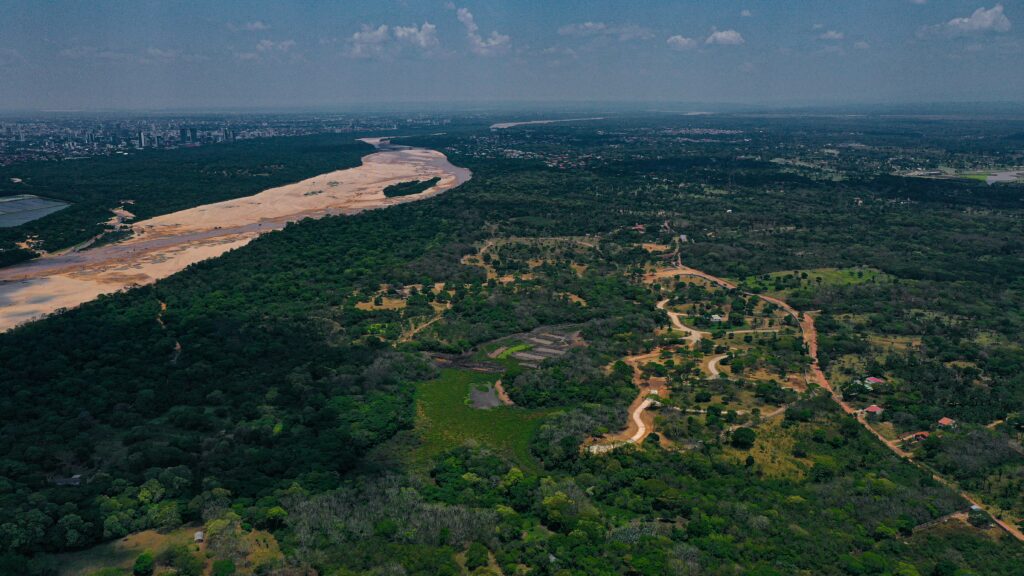
The flight south out of Bogotá takes a little over an hour, and it undoes the city fast. From the window you watch the savanna fold itself into mountains, and the mountains hold for a while — brown, creased, serious about themselves — and then somewhere over the southern spine of the Andes the green begins, and after that the green does not stop. It thickens. It climbs the slopes and fills the valleys and swallows the roads. By the time the plane starts its descent there is nothing below you but canopy and the brown loops of rivers, and you understand, before your feet have touched the ground, that you are arriving somewhere that was never going to meet you halfway.
I had spent three days in Bogotá before that flight, walking the steep streets of La Candelaria, drinking coffee at 2,600 meters while the altitude argued with my lungs. I wrote about that city in an earlier field note — about its murals, its noise, its particular way of standing between you and the rest of the country. What I didn’t say then is that Bogotá, for me, has always been a door. You pass through it on your way to somewhere else, and for the past six years that somewhere else has usually been the Putumayo.
Putumayo is the department in Colombia’s southwest corner, where the country leans against Ecuador and Peru and the Andes step down into the Amazon basin. People who can place it on a map usually know it from the news of decades past, and that history is real; I’m not going to gloss it. But the Putumayo that receives travelers today is another proposition entirely: foothill country, river country, a green so dense and continuous that the eye has nowhere to rest. Some say this is where the Amazon begins. The people who live there put it differently. A friend and teacher of mine — a man I’ve worked with in this region for six years — said it on one of my first visits, and he did not mean it as poetry: “This is the land where life is born.”
But before the land, there is the road.
* * *
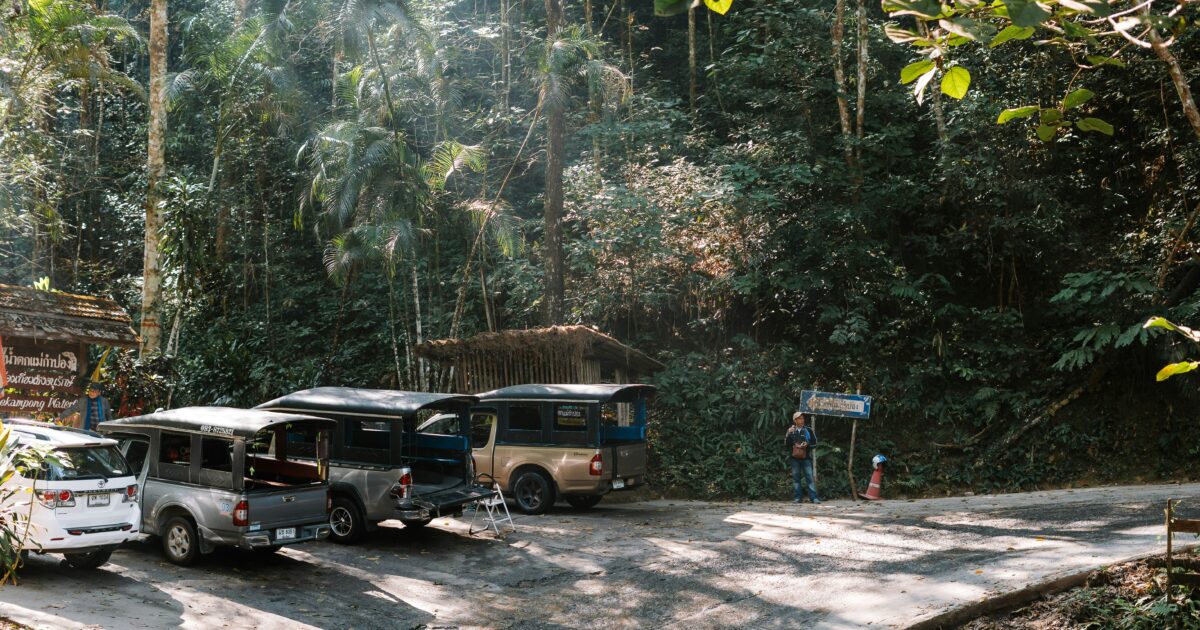
The drive from the small southern airport takes four hours when it goes well and six when it doesn’t, and at the beginning it behaves like any road. Pavement, lane markings, the brief optimism of infrastructure. You pass through a town or two, dogs asleep in doorways, motorbikes carrying entire families and a week of groceries, roadside stands selling fruit I still can’t reliably name. There is always a driver, and he is always more relaxed than the road deserves, and he keeps one hand on the wheel and one conversation going with the radio.
Then, maybe two hours in, the asphalt gives up. No sign marks the spot. The road doesn’t apologize or explain. One stretch is paved and the next is packed earth and stone, and the truck drops to the speed the land has decided on, which is never the speed you had planned. Your phone loses its last bar at around the same time, as if the two of them had an agreement. And here is the strange gift of it: the moment the road slows you down, you start looking out the window instead of through it.
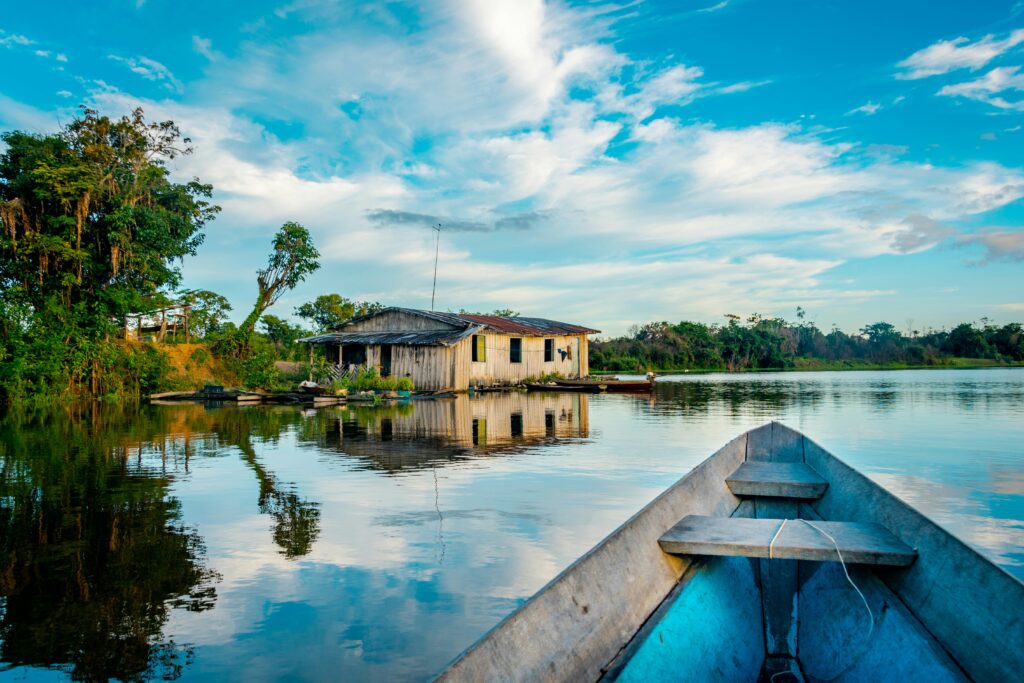
What you see is water. That’s the thing nobody tells you about the edge of the Amazon — you expected the green, but no one mentioned the water. It is everywhere. Rivers crossing under the road, streams cutting the hillsides open, waterfalls dropping out of the cloud line like something being poured. The air itself carries so much moisture that the mountains ahead of you stay half-dissolved in it, and the whole landscape exists in three tenses at once: being rained on, having just been rained on, visibly preparing to be rained on. Nothing about it is still. Nothing about it is finished.
At some point the truck crosses a river on a bridge that is more idea than structure, and if you ask the driver to stop — I always ask him to stop — you can climb down to the bank and stand there for a few minutes. The rivers in this part of Colombia run fast, fed by altitude and rain, and their beds are full of enormous boulders, rocks the size of cars rounded smooth as eggs. There is no gentleness in that smoothness. It is the record of force applied without interruption for longer than my head can hold. You look at those boulders and something lands in you about consistency that no sentence ever managed to deliver. The water that shaped them is still moving. It did not stop when the work was done, because there is no done.
The last hour of the drive is the slowest and the greenest. The road narrows until the vegetation touches the truck on both sides, and the air coming through the window changes texture — thicker, warmer, carrying rain and leaf and something sweet breaking down underneath it all. Smell is the sense we never plan for. Cities have taught us to ignore it. Out here it comes back online like a light switched on in a room you forgot your house had, and from that point on it leads. You arrive at the settlement by nose as much as by road.
* * *
Stand still on a jungle path for half a minute and count what finds you. The first time I tried it, I got to five — five separate insects making their way across my boots, each one with somewhere to be — before the half minute was up. You don’t have to do anything to be found by the life in this place. You are not a visitor looking at a landscape. You are a warm object that has entered a system, and the system noticed you before you noticed it.
That density registers in the body as a kind of pressure. Not unpleasant, not frightening — just impossible to overlook, a constant low-level awareness that everything around you is alive and busy and was busy yesterday, when you weren’t here. The strangeness of it took me a while to name. You arrive from a world where your attention is the most contested resource there is, where every surface and screen is designed to catch you and hold you, and you step into a world that is completely indifferent to whether you pay attention or not. The jungle is not performing. Nothing here needs you to look at it. And somehow that indifference is the most restful thing your attention has met in years.
Then night falls, and the real instruction begins.
Nobody warns you that the jungle at night is loud. Not crickets-in-the-garden loud — loud like a stadium, a layered wall of frogs and insects with no gaps in it, a continuous biological roar that runs from dusk until just before dawn. The first night you lie in your hammock and you do not sleep. The sound has no rhythm you can settle into, no pause your ears can rest inside. You lie there cataloguing it, resisting it, negotiating with it. Every first-time visitor I have ever brought to this region says the same thing at breakfast, in the same faintly betrayed tone: it kept me awake.
By the second night, something has started to shift. By the third, you sleep — and this is the part worth slowing down for, because the sound has not changed. Not one frog lowered its voice on your behalf. What changed is your relationship to it. Some part of you stopped treating the noise as an intrusion and started treating it as the place itself, and once that happened you could rest inside it the way you rest inside the sound of your own house. You stopped hearing against the night and began hearing within it. No one taught you to do this. You were not given a technique or an instruction. The place asked something of you, and your body, after some resistance, agreed.
And just before dawn, the night shift ends. The frogs and insects fall away over a few minutes — not gradually, more like a door being closed room by room — and there is a short gap, a genuine silence, before the birds take over the same air with completely different material. After a few mornings you find yourself waking for the changeover on purpose. It is the best concert hall I know, the program changes twice a day, and there is no recording of it anywhere.
* * *
I have spent years thinking about why this corner of Colombia works on people the way it does, and I keep arriving at the same slightly uncomfortable conclusion: the part of the trip we treat as the cost — the long drive, the rough road, the lost signal, the sleepless first night — is the part doing the most work.
We have built a culture of arrival. We want the destination without the distance, and increasingly we can have it: you can stand on the far side of the world within a day of deciding to, carrying your home in your pocket, your habits intact, your nervous system still keeping the schedule of the place you left. The body arrives and nothing else does. Then we wonder why two weeks somewhere extraordinary can leave so little mark — why the photos look like we were there, and the rest of us never quite was.
The road into the Putumayo doesn’t permit that kind of arrival. It is too long, too slow, too rough to sleep through, and it strips you in the right order — speed first, then signal, then the option of being somewhere else in your head. What it takes from you is exactly what you won’t need where you’re going. By the time the truck stops, you have already been worked on. The land starts preparing you the moment you leave the airport, the way a long walk prepares you for a difficult conversation, and when you finally stand in front of whatever you came for, you are somebody slightly different from the person who boarded the flight in Bogotá.
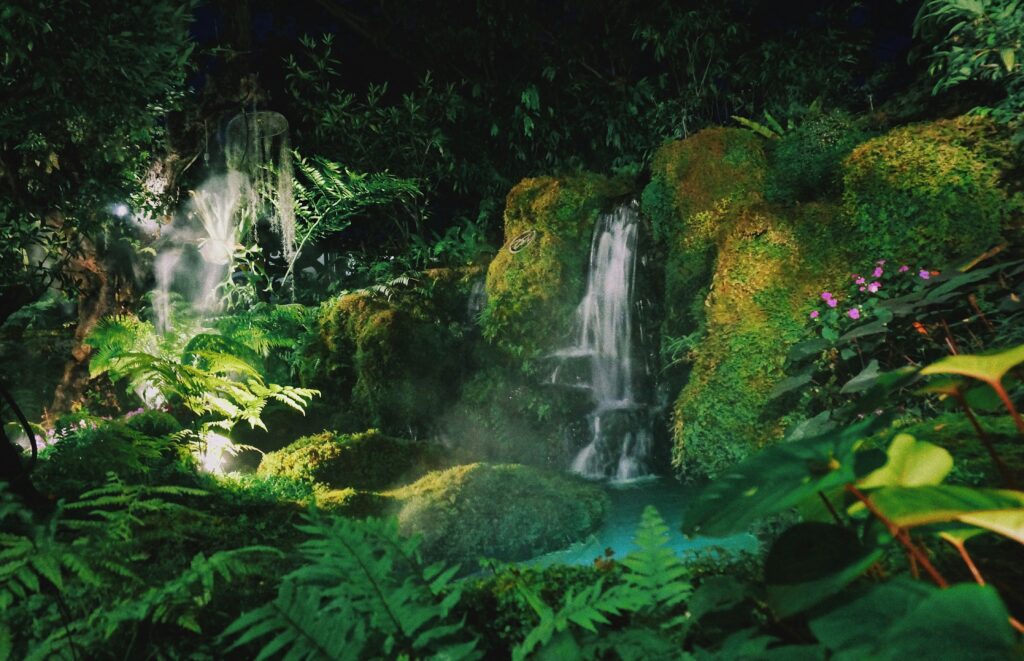
My friend’s phrase comes back to me on every trip. The land where life is born. For years I heard it as a statement about the place — the water, the green, the sheer crowdedness of living things. Lately I hear it as a statement about what the place does. Things begin there. Something in you that has been running on pavement, at pavement speed, drops down to the speed of packed earth, and at that speed it becomes possible to notice your own life again — the actual one, the one that runs underneath the schedule.
You don’t need a ceremony for this, or a guide, or any of the apparatus people associate with that part of the world. You need the road. The long one. The one that gives up its asphalt two hours in and offers you no say in the matter.
When people ask me how the trip was, I notice I rarely start with the destination anymore. I tell them about the boulders, smooth as eggs and older than any human idea. I tell them about the third night, when the frogs stopped being noise and became the room I slept in. The places that change us start working long before we get there. The only thing they ask is that we come the slow way.
Buy the new book: Fertile Again! by Arumi Nomad
Meditation for Cancer builds on this same practice, written specifically for patients, families, and caregivers.