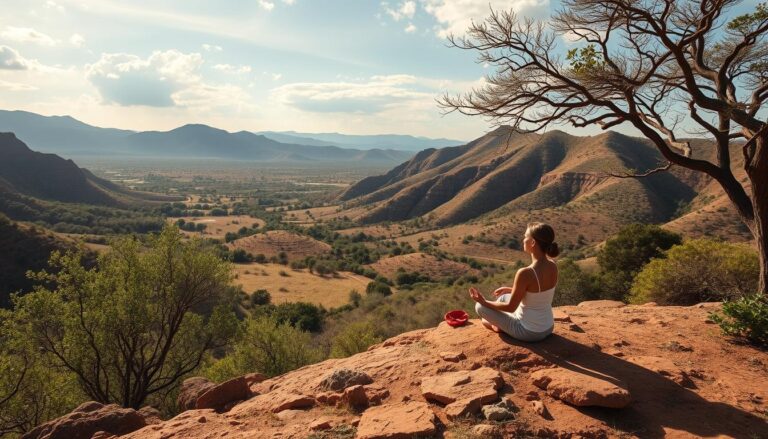
You sat down to meditate, once. Maybe more than once. You set a timer, crossed your legs, closed your eyes, and waited for the calm everyone kept promising. What showed up instead was an itch on your ankle, a to-do list unrolling behind your eyelids, and a body that wanted to be anywhere but here. Ten minutes felt like an hour. You opened your eyes early, a little defeated, and quietly filed the whole thing under not for me. Some people can sit like a statue and drop straight into stillness. You, apparently, are not one of them.
Here’s what nobody told you in that moment. The problem was never you. It was the chair. Meditation got handed down to us wrapped in a single image — a person sitting perfectly still, spine straight, not a muscle moving — and somewhere along the way we started treating the stillness as the whole point. It isn’t. The point is attention, and attention doesn’t care in the slightest whether your body is frozen or moving. For a lot of restless, wired, modern nervous systems, sitting still is the hardest possible place to begin. A walking meditation begins somewhere far kinder: on your feet, already moving, doing the one thing your body was built to do.
The stillness myth is why so many people quit
Think about what you’re actually asking of yourself when you sit down to meditate cold. You take a body that’s been braced all day — shoulders up near the ears, jaw tight, running on a low hum of stress you stopped noticing hours ago — and you order it to hold completely still. For a calm nervous system, stillness is rest. For a keyed-up one, stillness is a pressure cooker with the lid clamped down. All that restless energy has nowhere to go, so it turns inward and gets louder. The fidgeting, the racing thoughts, the sudden certainty that you’re doing this wrong — none of that is failure. That’s a stressed body being told to sit in a room with itself and no way out.
This is exactly the wall a walking meditation walks straight around. Instead of damming the restless energy, you give it a place to flow. The legs move, the body has a job, and the mind — let off the impossible hook of policing a still body — can finally rest on something simple. You’re not fighting the urge to move anymore. You’re spending it. And the moment that fight stops, the calm you were chasing on the cushion tends to arrive on its own, unannounced. Not because a walking meditation is the runner-up to the real thing. Because for a body like yours, on a day like today, it may well be the realer one.
What a walking meditation actually is
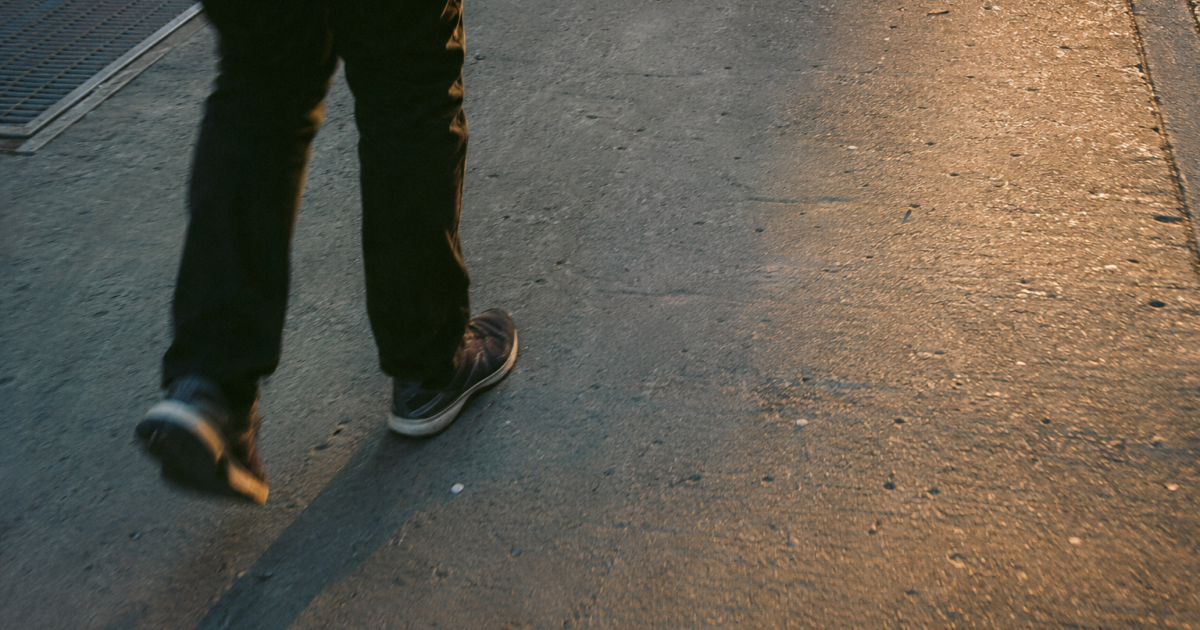
Strip off the mystique and walking meditation is almost embarrassingly plain. You walk, slowly-ish, and you pay attention to the walking. That’s the entire practice. The soles of your feet meeting the ground and lifting off it again. The small handover of weight from one leg to the other. The swing of your arms, the air on your face, the rhythm your steps fall into without being asked. When your mind wanders off — and it will, over and over — you notice, and you bring your attention back down to your feet. It’s the same move as sitting meditation, exactly the same, except the anchor isn’t the breath. In a walking meditation the anchor is your body, walking.
That one swap of anchor matters far more than it sounds. The breath is a subtle thing, easy to lose track of, and for an anxious person watching the breath can quietly crank the anxiety up a notch. Footsteps are loud by comparison. Obvious. Rhythmic. Your body hands you a fresh sensation with every single step, dozens a minute, so there’s always something solid to come back to. That’s the reason a walking meditation is so often the easier door — for beginners, for restless people, for anyone who’s tried to sit and felt the practice slide through their fingers within a minute. The anchor is bigger, plainer, and it keeps moving right along with you.
The research is better than you’d expect
This isn’t only a soft consolation for people who can’t sit. It holds up when someone measures it. In 2013, researchers in Berlin ran a controlled trial on adults carrying moderate-to-high levels of psychological stress. Half of them did eight sessions of mindful walking across four weeks; the other half did nothing and sat on a waiting list. On a standard perceived-stress scale, the walking group’s scores dropped sharply while the waiting group barely twitched — a gap the researchers flagged as highly significant. People who felt stretched thin walked, with attention, a couple of times a week for a month, and came out the far side measurably carrying less stress.
A study out of Thailand pushes the point somewhere more surprising. Researchers took depressed adults in their sixties, seventies, and eighties and split them three ways: one group stayed sedentary, one did ordinary walking for exercise, and one did walking meditation — the very same walking, with the meditative attention laid on top. After twelve weeks, both walking groups got fitter and their blood vessels worked better. But the depression scores dropped in only one of them: the walking meditation group. Same steps. Same distance. The difference was the attention. I’ll keep this honest — it was a small study, forty-five people, all older adults, so read it as a signal, not a verdict. But it’s a pointed signal. It suggests the meditative half of walking meditation is pulling real weight, not just coasting on the exercise.
A walking meditation you can do on the way to your car
Enough theory. Here’s one to try the next time you walk anywhere at all. As you start moving, let your attention drop down into your feet. Feel the heel land, the weight roll forward, the toes push off behind you. Don’t change how you walk or slow into some strange self-conscious crawl — just notice what’s already going on down there. Count ten steps, feeling each one land. When you get lost in a thought, and you’ll get lost long before ten, start the count over at one, with no annoyance about it. That restart is the practice. That’s the whole rep of a walking meditation, and you get to run it again and again on a walk you were taking anyway.
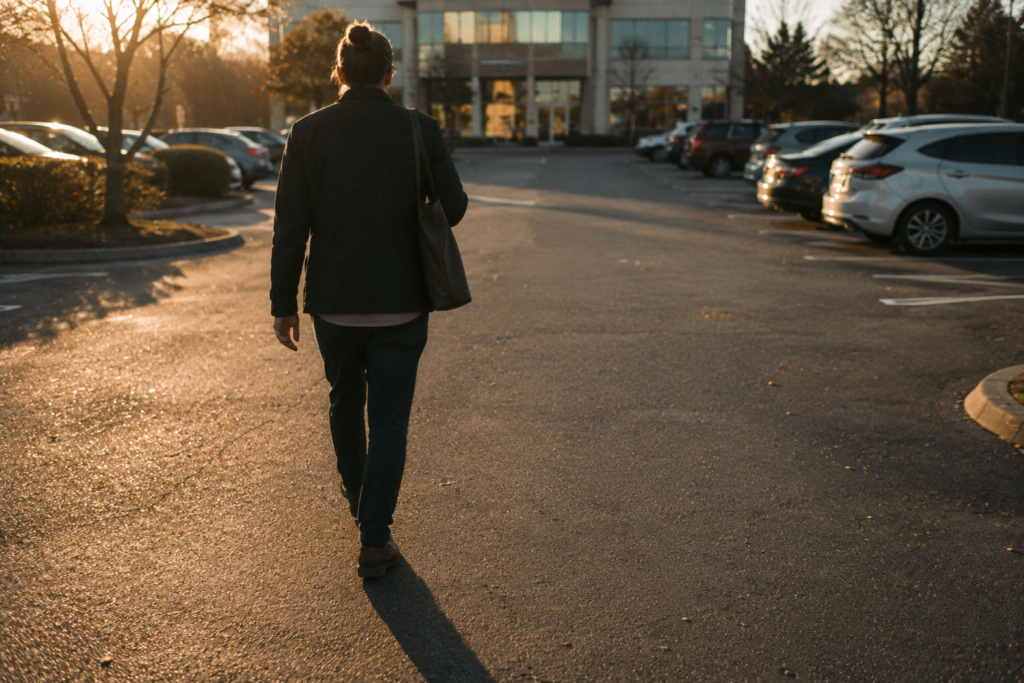
You can make it richer once it’s familiar. Widen the attention out from your feet to the whole moving body — the arms, the breath dropping into step with your legs, the temperature of the air on your hands. Or narrow it down to one single detail and stay there: just the instant each foot leaves the ground, held for the length of a block. There’s no correct version and nothing to perfect. A walking meditation on the way to the mailbox counts. So does one down a hospital corridor, or back and forth across a small kitchen while the pasta comes to a boil. The distance is beside the point. The attention is the entire thing.
A moving body isn’t a distraction from a clear mind
There’s an old assumption buried underneath the stillness myth — that the body has to go quiet before the mind can work well. The evidence leans the other way. In 2014, two Stanford researchers ran a series of experiments on walking and creative thinking, more than a hundred and seventy people across the set. The result was consistent and a little startling: people came up with far more creative, free-flowing ideas while walking than while sitting, and the boost hung around for a while even after they sat back down. It held indoors on a treadmill facing a blank wall, and it held outside on a path. The movement itself was doing the work, not the view.
I’ll give you the honest edge of that study too, because it’s the interesting part. Walking lifted the open, generative kind of thinking — lots of ideas, odd connections, the what-if mode. For problems with one single correct answer, the walkers actually did slightly worse than the people sitting. So this is not walking makes you sharper at everything. It’s that a moving body swings open one particular door — the wandering, associative kind of thought — that a rigidly still body tends to keep shut. Which is worth sitting with, if you’ve spent years believing you had to freeze in place to go inward. The old walking traditions knew this long before the treadmills. Some of the deepest thinking our species has ever done happened on foot, back and forth, going nowhere in particular.
Where your day is already hiding walking meditations
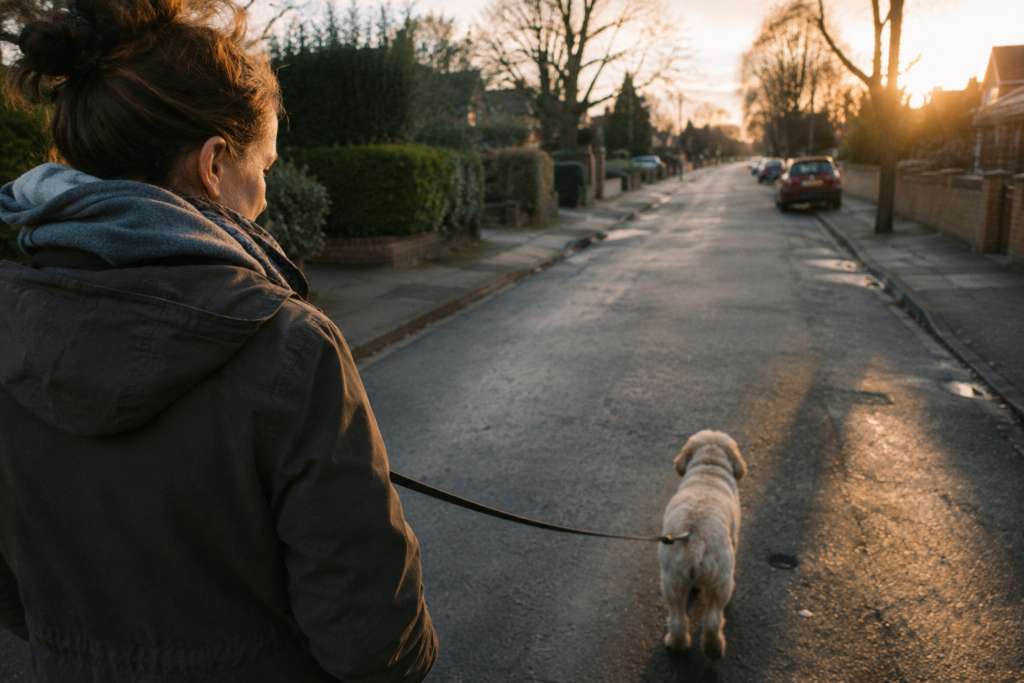
The best part is that you don’t have to bolt anything onto your schedule. A modern day is stitched through with walks you already take on autopilot, phone in hand, mind running three hours ahead of your feet. The walk from the front door to the car. The platform to the train. The parking lot into the office. The loop around the block with the dog while you scroll the news you didn’t want. The march to the school gate and back. Every one of those is a walking meditation standing there waiting — all you have to do is look down at your feet instead of down at a screen. You’re already walking. You’re already spending the minutes. The only thing that changes is where your attention goes while you spend them.
Start with exactly one. Pick a short walk you do every single day without thinking about it, and make that one walk your walking meditation. The stretch from the bus stop to your door. The hallway to the bathroom at work. Whatever it is, when you’re on it — feet on the ground, attention on the steps — count to ten and begin again when you drift. Do that most days and you’re not cramming a new practice into an overloaded life. You’re just walking the way you always walk, awake to it now instead of gone. Ten steps, most days, tucked into the seams of a life you’re already living.
You were never bad at meditating
So set down the idea that you failed at meditation because you couldn’t sit still. You didn’t fail at anything. You were handed the wrong instructions — told the stillness was the medicine, when the stillness was only ever the box it came in. Some people do find their way in sitting quietly, and good for them. You might find yours moving, and there’s nothing second-rate about that door. A walking meditation asks nothing of you that your body isn’t already doing several times a day. It only asks you to actually be there for it.
Try it on the next walk you take. Not tomorrow, not once things finally calm down — the next time your feet carry you from one room to the next. Look down. Feel the ground meet your foot. Count ten steps and start over when your mind slips its leash, because it will. The restless mind you were sure disqualified you from meditation turns out to be the whole reason walking meditation exists in the first place. You were never meant to sit still to find it. You were meant to walk.
Meditation for Cancer: A Practical Companion for Patients, Families, and Caregivers takes this same idea into the specific weeks of treatment.
References
• Teut M, Roesner EJ, Ortiz M, Reese F, Binting S, Roll S, Fischer HF, Michalsen A, Willich SN, Brinkhaus B (2013). “Mindful Walking in Psychologically Distressed Individuals: A Randomized Controlled Trial.” Evidence-Based Complementary and Alternative Medicine 2013, Article ID 489856 — pmc.ncbi.nlm.nih.gov/articles/PMC3747483/ (74 adults with moderate-to-high perceived stress; 8 mindful-walking sessions over 4 weeks vs a waiting-list control; adjusted Cohen’s Perceived Stress Scale change −8.8 [95% CI −10.8, −6.8] in the walking group vs −1.0 in the control, “resulting in a highly significant group difference (P < 0.001)”).
• Prakhinkit S, Suppapitiporn S, Tanaka H, Suksom D (2014). “Effects of Buddhism Walking Meditation on Depression, Functional Fitness, and Endothelium-Dependent Vasodilation in Depressed Elderly.” The Journal of Alternative and Complementary Medicine 20(5):411–416 — doi.org/10.1089/acm.2013.0205 (45 depressed adults aged 60–90 randomized to sedentary control, traditional walking exercise, or Buddhist walking meditation, 3×/week for 12 weeks; both walking groups improved fitness and vascular reactivity, but “depression score decreased (p<0.05) only in the BWM group”).
• Oppezzo M, Schwartz DL (2014). “Give Your Ideas Some Legs: The Positive Effect of Walking on Creative Thinking.” Journal of Experimental Psychology: Learning, Memory, and Cognition 40(4):1142–1152 — doi.org/10.1037/a0036577 (176 participants across 4 experiments; walking substantially increased divergent/creative ideation vs sitting, indoors on a treadmill and outdoors, with a residual boost after walking).