By Arumi Nomad
There is a moment, just before you slip beneath the surface of a cenote, when the world above dissolves. The Yucatán jungle releases you. The limestone lip of the earth opens like a mouth, and you descend—not just into water, but into something far older. The ancient Maya called these places the entrance to Xibalba, the underworld. But they understood something else too, something that speaks directly to those of us navigating the tender terrain of fertility: cenotes were the womb of Mother Earth herself.
I first encountered this metaphor sitting with a Maya elder near Tulum, preparing for a temazcal ceremony as the sun began its descent. “The cenote and the temazcal,” she told me, “they are the same medicine with different faces. One is the cool water that remembers everything. The other is the warm darkness that helps you forget what no longer serves you. Together, they teach the body how to be born again.”
For those walking the fertility path—whether you’re preparing your body for conception, recovering from loss, or simply seeking to reconnect with your deepest creative potential—these ancient practices offer something our modern world has largely forgotten: the profound healing available when we return, symbolically and somatically, to the womb.
The Sacred Waters: What Cenotes Remember
Cenotes are geological marvels, formed over millennia as limestone bedrock collapsed to reveal the crystalline groundwater beneath. There are thousands of them scattered across the Yucatán Peninsula, each one unique—some open to the sky like great stone bowls collecting light, others hidden in cathedral-like caverns dripping with stalactites that took millions of years to form.
But geology tells only part of the story.
For the Maya, cenotes represented the profound intersection of life and death, the seen and unseen worlds. Water, in Maya cosmology, symbolized purification, fertility, and regeneration. It was the primordial element from which all life emerged. The cenote itself was understood as a reflection of the womb of Mother Earth—a place where one could connect with the divine and experience renewal.
This wasn’t merely poetic language. The Maya built entire cities around these sacred waters. Temples and pyramids were often aligned to create symbolic connections with nearby cenotes. At Mayapán, the great pyramid was constructed directly over a cenote, its nine levels representing the realms of the underworld, oriented to the cardinal points in a cosmology centered on the relationship between earthly existence and the regenerative depths below.
When you float in a cenote today—held by water that fell as rain perhaps ten thousand years ago, filtered through stone older than human memory—you’re participating in a tradition of renewal that predates modern medicine by millennia. The Maya brought offerings to these waters asking for fertility, health, and the blessing of new beginnings. They understood what we’re only beginning to rediscover: that certain places on Earth carry a particular capacity for transformation.
The Nervous System Knows
Here’s where ancient wisdom meets contemporary science in a way that continually astonishes me.
The crystal-clear waters of most cenotes maintain temperatures between 24-26°C (75-79°F)—cool enough to activate what researchers call the “dive reflex,” a physiological response present in all air-breathing vertebrates. When cool water contacts your face, particularly around the eyes and forehead, it stimulates the trigeminal nerve, which in turn activates the vagus nerve through what scientists call the trigeminal-vagal reflex arc.
Why does this matter for fertility?
The vagus nerve is the longest cranial nerve in your body, wandering from brainstem to abdomen, touching nearly every major organ along the way. It’s the primary channel of your parasympathetic nervous system—the “rest, digest, and reproduce” state that allows healing, hormone regulation, and yes, conception.
When vagal tone is healthy, your body can move fluidly between states of activation and recovery. Heart rate variability increases. Inflammation decreases. The hypothalamic-pituitary-adrenal axis—that cascade of stress hormones that can disrupt ovulation, implantation, and healthy pregnancy—begins to settle.
Research has shown that cold water immersion can increase vagus nerve activity significantly, shifting the body from sympathetic dominance (fight-or-flight) into parasympathetic mode. One study found that even brief facial immersion in cold water produced measurable bradycardia and shifts in heart rate variability indicative of enhanced vagal activation.
For anyone whose fertility journey has been marked by chronic stress, unexplained inflammation, or the particular nervous system dysregulation that comes from repeated disappointment and medical interventions, this isn’t trivial. It’s the body remembering how to soften. How to receive. How to prepare the ground for new life.
Entering the Womb of Steam
If cenotes represent the cool, liquid memory of the earth, the temazcal offers something complementary: the warm, dark enclosure where transformation happens through heat, breath, and surrender.
The word itself comes from the Nahuatl temaz (sweat house) and calli (home). But the Maya understood this structure as something more—the womb of Mother Earth made manifest in stone, earth, and volcanic rock.
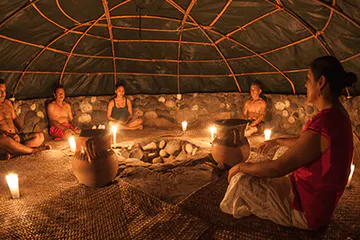
The symbolism is deliberate and precise. The dome-shaped structure replicates the rounded form of pregnancy. The entrance is small and low to the ground, requiring participants to crawl through on hands and knees—a physical return to the vulnerability of emerging into the world. In many traditions, the fire pit outside the temazcal sits exactly nine steps from the entrance, representing the nine months of gestation. The interior is dark, warm, and humid, recreating the amniotic environment we all once knew but cannot consciously remember.
The volcanic stones brought into the ceremony are called “grandmothers”—abuelitas—because they carry the memory and wisdom of the Earth herself. When water infused with medicinal herbs is poured over these heated stones, the steam that rises is understood as the breath of life, carrying prayers and intentions through every pore.
In Aztec tradition, the temazcal was associated with Temazcalteci, the goddess of purification, fertility, and childbirth. Pregnant women would enter the temazcal to prepare for labor, believing the steam eased the birthing process and promoted healthy delivery. Postpartum mothers returned to heal, to close the body, to mark the transition from one identity to another.
The Ceremony of Returning
I want to be clear: authentic temazcal is not a spa treatment. It’s not meant to be comfortable. The heat can be intense—body temperatures rise to 104°F or higher—and the duration (typically two to four hours) asks something of you that most modern experiences don’t: sustained presence in discomfort without escape.
This is part of its medicine.
The ceremony typically unfolds in four rounds, or “doors,” each corresponding to a cardinal direction and element. Between rounds, the entrance briefly opens, allowing fresh air to enter and more heated stones to be placed in the central pit. Throughout, the temazcalero or temazcalera—the ceremony guide—leads prayers, songs, and invocations, often in indigenous languages that carry frequencies our minds don’t need to understand for our bodies to receive.
Participants may be invited to speak their intentions, their grief, their hopes. There is often weeping. There is sometimes laughter. There is almost always a moment when you’re certain you cannot stay, followed by the discovery that you can.
And then you emerge.
Crawling back through that low doorway, you are—symbolically and somatically—being born. The cool night air touches your skin like a first breath. Many ceremonies end with a cold-water plunge, completing the cycle: from the heated darkness of the womb into the shocking clarity of new existence.
What the Body Learns
The therapeutic benefits of temazcal operate on multiple levels. Physically, the intense heat promotes vasodilation, improving circulation to muscles, organs, and reproductive tissues. Sweating supports the elimination of toxins through the skin. The respiratory system opens as herbal steam is breathed in, often including plants like rosemary, eucalyptus, and rue that carry their own medicinal properties.
But something else happens that’s harder to quantify yet essential to understand: the nervous system learns something new.
When you stay present through intensity—when you breathe through the moments you want to flee, when you soften into heat that initially feels unbearable—you’re teaching your autonomic nervous system that it can handle more than it thought. You’re expanding your window of tolerance. You’re proving to yourself, in the most embodied way possible, that discomfort is not the same as danger.
For those preparing for the intensity of conception, pregnancy, labor, or the particular grief of fertility loss, this is profound training. Not in the muscular, pushing-through sense, but in the yielding sense. The staying sense. The discovering-you-are-held sense.
Integrating the Medicine
I don’t share these practices as curiosities or bucket-list experiences. I share them because they represent something our fertility journeys desperately need: pathways back to the body’s own wisdom about creation, transformation, and renewal.
You don’t need to travel to the Yucatán to access this medicine, though I hope some of you will (our Vitalis Quest retreats in Cancún intentionally incorporate both cenote immersion and authentic temazcal ceremony as part of our holistic approach). The principles can be adapted:
Cool water on the face, held for even thirty seconds, begins activating the vagal pathways. A cold shower ending—starting at the feet and working upward—can shift nervous system states measurably. Infrared saunas, while not carrying the ceremonial container of temazcal, offer some of the thermal benefits and can be enhanced with intentional breathwork and meditation.
But something precious is lost when we strip these practices from their context entirely. Part of what heals in temazcal is the community—sitting in circle with others who witness your release. Part of what heals in cenotes is the place—water that has been held sacred for thousands of years carries a different quality than chlorinated pools, however much we might wish otherwise.
Our ancestors understood that certain transformations require certain containers. That the body holds memories our conscious minds have forgotten. That returning to the womb—whether through cool water, warm steam, or the darkness of earth itself—is not regression but renewal.
An Invitation
If you’re reading this in the midst of a fertility journey—if you’re in the tender weeks of waiting, or the grief of a pregnancy that didn’t continue, or the frustration of cycles that don’t cooperate, or the particular exhaustion of having tried everything the medical world offers—I want to leave you with an image.
Picture yourself descending into crystal-clear water. Feel the cool embrace holding your entire body, your weight released, the sounds of the world above muted and distant. You float in a natural cathedral formed over millions of years, light filtering down in shafts that seem almost divine. You are held by the earth herself. You are suspended between worlds. Your nervous system, despite everything it’s been through, begins to remember a state it knew long ago: safety. Receptivity. The fertile ground from which all life emerges.
You don’t have to do anything here. You don’t have to try. You simply have to let the water hold you.
This is the medicine the ancient Maya understood. This is what the cenotes remember. And this is what your body, too, can rediscover—not through more effort, more intervention, more striving, but through the profound act of returning to the womb from which all new life begins.
Arumi Nomad is the author of “Fertile Ground: A Compassionate Guide for Women, Men & Couples Navigating the Journey to Parenthood” and founder of Vitalis Quest, offering holistic fertility retreats in Cancún that integrate cenote immersion, temazcal ceremony, and nervous system regulation practices. Learn more at aruminomad.com.